

More news on this day
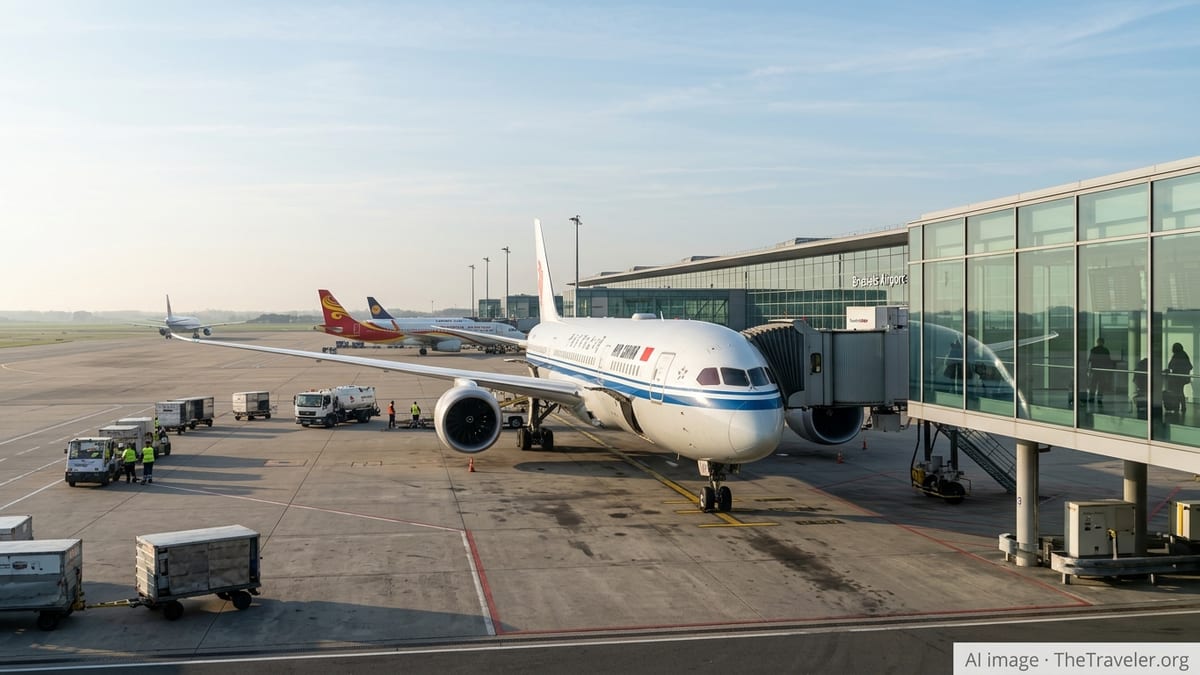
Air China is set to launch new nonstop routes from Brussels to Beijing and Chengdu in late March 2026, a move that broadens travel options between Europe and China and highlights the growing importance of China–Belgium relations.
Get the latest news straight to your inbox!
New routes anchor Brussels in Europe–China air network
According to published schedules for the 2026 summer season, Air China will inaugurate a nonstop Brussels–Beijing service on 24 March 2026, initially operating five times per week before ramping up to daily flights from 1 April. Publicly available information shows that the route will connect Brussels Airport with Beijing Capital International Airport, one of Asia’s busiest hubs.
From 26 March 2026, the carrier will also begin three weekly flights between Brussels and Chengdu Tianfu International Airport, bringing a major western Chinese gateway into direct reach of Belgian and wider European travelers. Industry timetable reports indicate that the Chengdu flights are planned with overnight departures from China and morning arrivals in Belgium, aligning with onward European connections.
These launches position Brussels as a more prominent node in the Europe–China aviation map. The new routes arrive at a time when demand for business, academic, and leisure travel between the two regions is gradually rebuilding, and when airlines and airports are working to restore and diversify long-haul capacity.
Airport and airline updates suggest that the additions by Air China will sit alongside existing services operated by other Chinese carriers from Brussels to Beijing, Shanghai, Shenzhen, and Chongqing, signalling intensifying competition and choice on the Belgium–China corridor.
Expanded connectivity for Belgian and European travelers
The Brussels–Beijing route is expected to act as a primary gateway for European travelers heading not only to the Chinese capital but also to secondary cities across the country. Beijing Capital functions as a major transfer hub within Air China’s network, providing onward links to destinations such as Xi’an, Harbin, Kunming, Guangzhou, and numerous regional centers that are difficult to reach nonstop from Europe.
Midday departures from Brussels, highlighted in aviation schedule analyses, are designed to sync with morning arrivals from short-haul European flights. This timing offers one-stop itineraries to China for travelers originating in nearby markets including northern France, the Netherlands, western Germany, and the Nordic countries, who can route via Brussels rather than larger hubs such as Frankfurt or Paris.
The Chengdu Tianfu service provides an additional layer of connectivity. Public route announcements describe flight times of around 10 to 11 hours, opening a direct path to Sichuan Province for tourists, students, and corporate travelers. Chengdu’s extensive domestic network, including links to Tibet, Yunnan, and other western provinces, broadens access to regions that previously required transfers via coastal megacities.
Travel-industry commentary notes that the combined effect of these routes is to give Belgian-based businesses and institutions more flexibility in planning trips to multiple Chinese regions, while also enabling Chinese travelers to use Brussels as a transit point to reach a wider spread of European cities.
Tourism gains for Belgium, China and beyond
Tourism bodies and aviation observers expect the new services to stimulate two-way leisure travel. For Belgian and neighboring European travelers, the daily Beijing flights make short and medium-length trips to China more viable, with overnight eastbound sectors and daytime westbound returns that fit typical holiday patterns.
Chengdu, described in tourism and destination materials as a gateway to Sichuan’s culinary culture and panda conservation sites, stands to benefit from greater visibility in European source markets. Nonstop access from Brussels may encourage tour operators to build more itineraries that combine the city with nearby attractions such as Jiuzhaigou, Mount Emei, or wider southwest China circuits.
On the inbound side, more direct capacity from China into Belgium could reinforce Brussels’ role as both a city-break destination and a jumping-off point for visits to Bruges, Antwerp, Ghent, and other regional highlights. Publicly available traffic data show that Chinese visitor numbers to Belgium have been steadily improving as travel restrictions ease, and the additional seats could support further growth.
Industry commentary also points to spillover effects for neighboring countries. Because Brussels Airport serves catchment areas that extend into the Netherlands, Luxembourg, and western Germany, Chinese tourists arriving on the new Air China flights may disperse across Benelux and the Rhine region, spreading the economic benefits beyond Belgium’s borders.
Strengthening economic and diplomatic ties
The expansion of direct flights between Brussels and major Chinese cities is widely viewed as complementing a broader deepening of China–Belgium and China–European Union relations. Beijing is both China’s political centre and the seat of its central government institutions, while Brussels hosts core EU bodies and numerous international organizations, making direct air connections between the two capitals symbolically significant.
Economic reports highlight that Belgian companies are active in sectors such as pharmaceuticals, chemicals, advanced manufacturing, and logistics in the Chinese market, while Chinese firms have invested in Belgian infrastructure, technology, and distribution hubs. More frequent and geographically diverse air services can lower travel time and costs for executives, engineers, and researchers engaged in these cross-border projects.
Observers of China–EU relations note that air connectivity often tracks diplomatic engagement, trade volumes, and people-to-people exchanges such as academic partnerships and cultural programs. New long-haul routes, particularly those linking political and innovation centres, are commonly interpreted as tangible manifestations of these broader ties.
By linking Brussels directly with both Beijing and Chengdu, Air China’s move reflects the growing importance of China’s interior regions in outward investment and trade, and provides an additional platform for Belgian and European stakeholders seeking to build relationships beyond China’s coastal hubs.
Competitive landscape at Brussels Airport
The launch of Air China’s Brussels services adds to a steadily expanding Chinese presence at the airport. Reports from aviation outlets detail how Hainan Airlines recently inaugurated a Brussels–Chongqing route and already serves Beijing, Shanghai, and Shenzhen, while other Asian carriers connect the Belgian capital with cities including Shanghai and Hong Kong.
Brussels Airport has promoted China-bound services as part of its strategy to diversify long-haul connectivity and reinforce its role as a niche intercontinental hub. Additional frequencies and destinations from Air China are expected to increase overall capacity between Belgium and China and may also exert competitive pressure on fares, especially during off-peak travel periods.
Travel-distribution partners within the Europe–China joint venture framework, including Lufthansa Group airlines, are likely to market the new flights as part of integrated itineraries. Public information from corporate programs suggests that agencies and corporate clients will gain more itinerary combinations and booking flexibility as a result of the added routes.
As capacity builds, analysts will be watching load factors, fare trends, and schedule adjustments through the first full summer season to gauge how demand responds. For now, the introduction of nonstop Brussels–Beijing and Brussels–Chengdu services signals renewed confidence in the long-term prospects of China–Europe travel and underscores the strategic role of Brussels in that evolving network.