

More news on this day
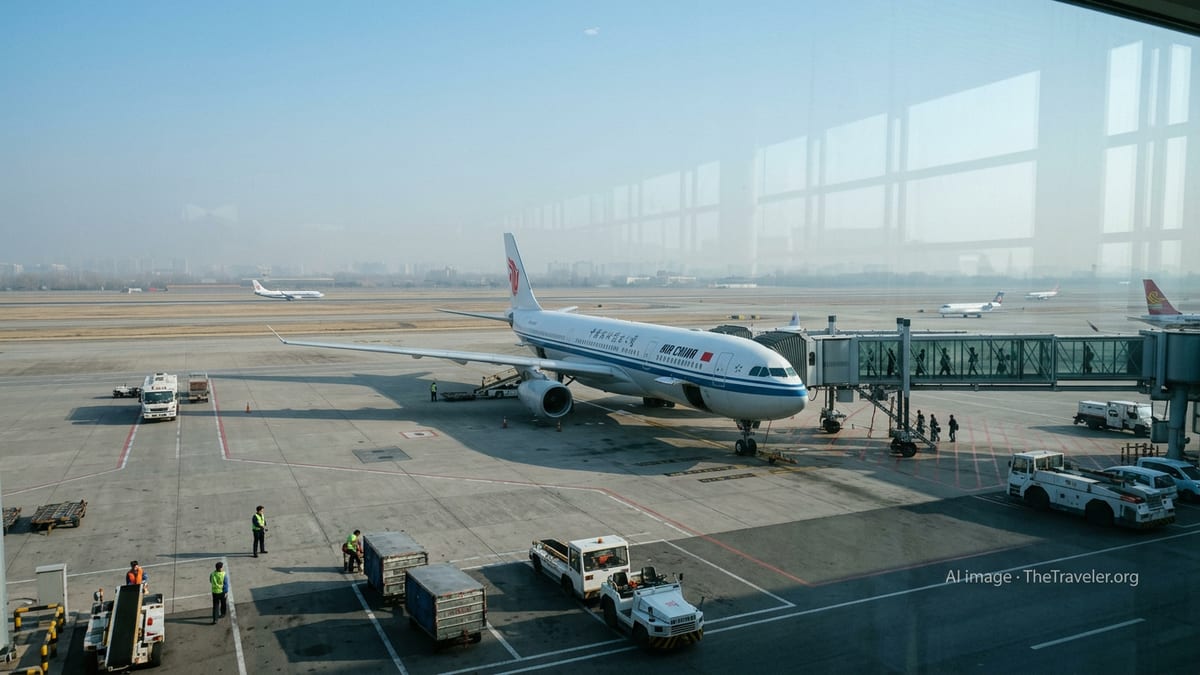
Air China’s decision to restart flights between Beijing and Pyongyang on March 30, 2026, after a four-year suspension is being read as a significant marker of North Korea’s gradual post‑pandemic reopening and a fresh chapter in China–North Korea connectivity.
Get the latest news straight to your inbox!
A Quiet but Symbolic Restart in the Skies
According to information published by the airline and reported in international coverage, Air China will operate its Beijing–Pyongyang service initially once a week on Mondays, with a reduced schedule already flagged for June. The measured rollout underlines how carefully both sides are calibrating the return of regular air links after years of severe Covid‑19 controls and political uncertainty.
The route, which had long been a practical lifeline between the two capitals, was effectively frozen when North Korea sealed its borders in early 2020, halting tourism, expelling most diplomats and slashing cross‑border trade. In the years since, the only regular air traffic involving Pyongyang has primarily been Air Koryo services to a limited number of destinations, notably Vladivostok, as well as occasional charter or special flights.
The resumption of a scheduled Chinese carrier on the route therefore carries symbolism that goes beyond its modest frequency. It indicates that both Beijing and Pyongyang now see enough stability in health protocols, border management and bilateral relations to restore a link that is central to official travel and, in time, could again support tightly controlled tourism flows.
The move also follows the recent restoration of passenger train services between China and North Korea, suggesting a coordinated effort to normalize core transport channels. For travel watchers, the timing looks like a staged transition from strictly controlled exchanges to a more regular pattern of cross‑border movement.
What It Signals About China–North Korea Relations
Publicly available information on the route decision fits into a broader pattern of closer China–North Korea engagement since the pandemic. China remains North Korea’s dominant trading partner and key political interlocutor, and regular flights between the capitals are a practical tool for sustaining high‑level contact as Pyongyang cautiously reopens selected gateways.
Analysts note that the restoration of the Beijing–Pyongyang link comes as North Korea has also deepened connectivity with Russia, including renewed flights and expanding economic and military cooperation. In this context, Air China’s return to Pyongyang helps ensure that Beijing retains a central role in managing North Korea’s limited external ties and does not cede too much diplomatic space to Moscow.
The move is also consistent with China’s broader push to rebuild its international route network after years of intermittent restrictions. Re‑establishing a politically sensitive but historically important short‑haul route signals confidence that the relationship with Pyongyang is on stable footing and that both sides can coordinate health, security and immigration measures.
At the same time, the constrained schedule and the lack of any broader tourism announcement underline ongoing caution. Observers point out that Beijing appears keen to support gradual normalization without triggering a sudden, large‑scale influx of travelers or creating expectations that North Korea is fully open to the outside world.
North Korea’s Cautious Reopening and Tourism Prospects
Since late 2023 and 2024, open‑source reporting has traced a slow, uneven process of North Korea easing its pandemic‑era isolation. Initial steps saw Russian holidaymakers admitted on tightly controlled itineraries, followed by limited group visits to specific economic zones and resorts. At times, these openings were rolled back or paused, underscoring Pyongyang’s priority on control over any tourism‑driven revenue.
By 2025, specialist tour operators reported carefully scripted pilot trips for selected foreign groups, particularly to the Rason Special Economic Zone and newly developed coastal areas. However, the country has not yet returned to the more routine pre‑2020 model of package tourism centered on Pyongyang, mass games events and set sightseeing circuits.
In this context, the return of Air China’s Beijing–Pyongyang service is being viewed as necessary infrastructure rather than an immediate invitation to mass tourism. Travel companies with experience in the country emphasize that visas, itineraries and group sizes remain subject to change at short notice, and that North Korea’s authorities continue to prioritize political messaging, security and public health over visitor numbers.
Still, the resumption of a major international carrier on the route adds a critical piece to the logistical puzzle. Once tourist visas are more widely granted, having a regular connection from Beijing, a major Asian hub, will be essential for tour operators assembling itineraries from Europe, North America and the wider Asia‑Pacific region.
What This Means for Future Cross‑Border Travel
For now, most potential travelers will not see an immediate change in access to North Korea. Current advisories and operator guidance continue to stress that the reopening process is partial and that many nationalities face legal or policy barriers to visiting. In some countries, including the United States, government restrictions on travel to North Korea remain in effect, limiting demand even if flights and visas become more available.
In the medium term, however, Air China’s renewed presence in Pyongyang could shape a new map of regional travel. If the route’s frequency increases and North Korea incrementally widens tourist access, Beijing could re‑emerge as the primary staging point for group tours, aviation‑themed trips and niche itineraries focused on rail, mountains or coastal resorts.
Travel specialists foresee a scenario in which Pyongyang is gradually reintegrated into multi‑stop Northeast Asia journeys, combined with cities such as Beijing, Dalian or Shenyang. That would echo pre‑pandemic patterns, when travelers often used a short Air China or Air Koryo hop from the Chinese capital to start highly structured visits inside North Korea.
The evolution of this route will also be watched by regional competitors. Russia’s new direct links to Pyongyang, together with potential overland corridors via China and North Korea’s own internal transport upgrades, suggest that multiple players are vying to shape how and where foreign visitors, business delegations and officials enter the country.
Strategic Implications for the Region’s Travel Landscape
Beyond the bilateral story, Air China’s return to Pyongyang is a reminder of how air routes can serve as indicators of geopolitical alignment in Northeast Asia. The coexistence of expanding Russia–North Korea air links and a revived China–North Korea connection points to a more closely knit bloc on the region’s northern flank, with implications for sanctions enforcement, trade flows and security dynamics.
For the wider travel industry, the development illustrates that North Korea’s reopening will likely be phased, politically shaped and highly uneven across markets. Operators and airlines are preparing for a landscape in which specialized, small‑group travel ramps up well before any mass tourism is possible, and where access can tighten again if health or security conditions change.
Air China’s cautious schedule, combined with the staged restoration of trains and select tourist corridors, suggests that the coming years will test the resilience and adaptability of this nascent recovery. For travelers, it means that visiting North Korea will remain a niche, tightly managed experience, even as a few more aircraft begin tracing a familiar arc between Beijing and the North Korean capital.