

More news on this day
Air Congo is set to take a decisive step beyond its domestic roots, launching its first wave of direct regional flights from Kinshasa to key African cities from late March 2026, in a move aimed at reshaping connectivity for the Democratic Republic of the Congo and Central Africa.
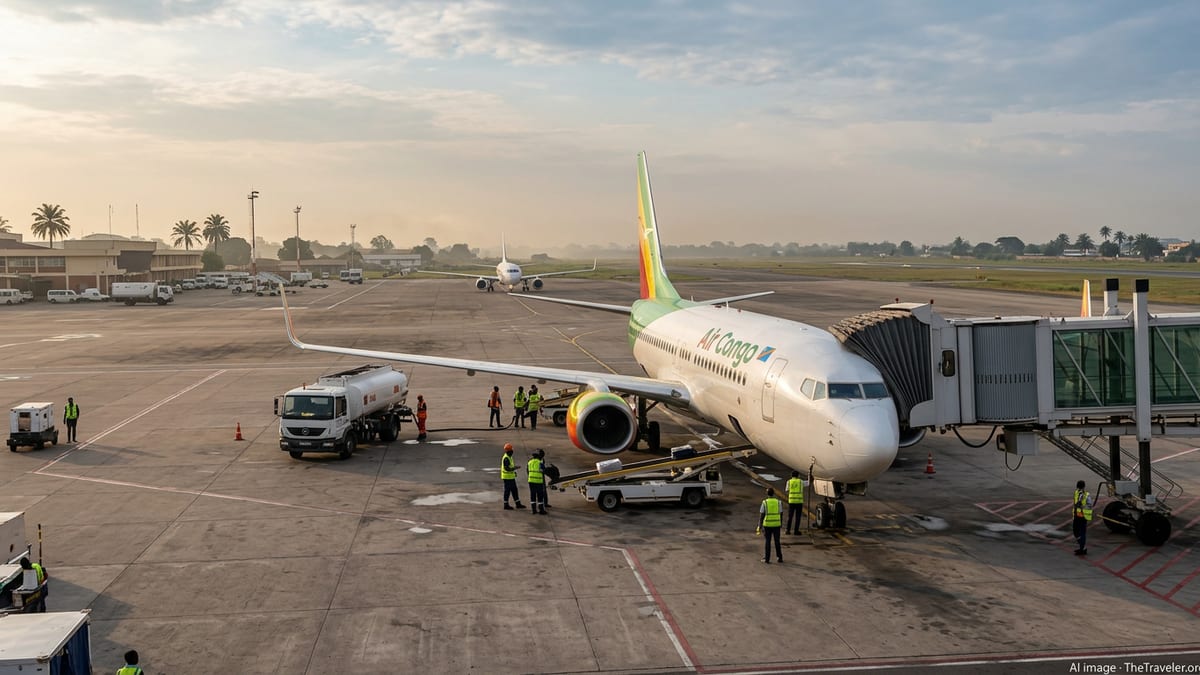
New Regional Routes Roll Out From March 2026
The Kinshasa-based flag carrier has confirmed that its inaugural regional services will begin on March 22, 2026, with nonstop flights from N’djili International Airport to Johannesburg in South Africa and Entebbe in Uganda. A second tranche of destinations follows on March 28, when Air Congo launches direct links to Douala in Cameroon and Cotonou in Benin. The first phase of expansion will be completed on April 4, 2026, with the start of services to Dar es Salaam in Tanzania.
The new routes mark the airline’s first scheduled international flights since it commenced operations as a domestic carrier in December 2024. Until now, Air Congo has focused on connecting major Congolese cities such as Lubumbashi, Goma, Kisangani, Kolwezi, Kalemie and Mbuji-Mayi, building up market share on internal routes while preparing its fleet and crews for cross-border operations.
According to officials, the regional services will initially be operated with Boeing 737-800 aircraft, part of a fleet of three jets currently in service and leased via its strategic partner Ethiopian Airlines. Additional aircraft, including turboprops for thinner domestic routes, are expected over the coming months, giving the carrier greater flexibility to balance growing domestic and regional demand.
Strategic Partnership Underpins Expansion
Air Congo is structured as a joint venture between the government of the Democratic Republic of the Congo, which holds 51 percent, and Ethiopian Airlines, which owns 49 percent and provides management expertise, aircraft and technical support. The partnership was formally announced in December 2024 as part of Ethiopian’s broader multi-hub strategy across Africa.
Under the arrangement, Ethiopian has supplied Boeing 737-800 jets on lease, as well as training programs for Congolese pilots, cabin crew, technicians and commercial staff. Executives from both sides have consistently framed Air Congo as a long-term project to create a viable, modern flag carrier able to compete in regional markets while meeting international safety and service standards.
The launch of regional routes represents a key milestone in that plan. By adding Johannesburg, Entebbe, Douala, Cotonou and Dar es Salaam, Air Congo is connecting Kinshasa with important political, economic and tourism centers in southern, eastern and western Africa. Aviation analysts say this could enable the new airline to tap corporate traffic, diaspora demand and growing intra-African tourism flows.
The move also comes as former national carrier Congo Airways remains grounded amid heavy debts and operational difficulties, leaving a gap in both domestic and regional connectivity. Air Congo has steadily moved to occupy that space, and the shift into regional markets will further consolidate its position as the DRC’s primary flag carrier.
Direct Links Promise Faster Travel and New Competition
For travelers, the most immediate impact of the new network will be faster journeys and fewer connections. Today, passengers flying from Kinshasa to West and Central African cities such as Douala and Cotonou often route through hub airports like Addis Ababa, Lomé or Abidjan, adding several hours to travel times and increasing costs.
By offering nonstop flights from Kinshasa, Air Congo is positioning itself as the most direct option on several corridors. On the Kinshasa to Douala route in particular, the airline is expected to enjoy at least a short-term monopoly, capturing pent-up demand from business travelers, traders and officials who have long called for direct connectivity between the DRC and Cameroon.
On other axes, the new carrier will enter competitive markets. The Kinshasa to Entebbe route is already served by Uganda Airlines, while Air Tanzania operates between Kinshasa and Dar es Salaam. Industry observers note that Air Congo’s entry could stimulate competition on fares and schedules, but also caution that sustained reliability and operational discipline will be crucial if the young airline is to win and retain passengers in these contested markets.
Johannesburg, one of Africa’s busiest hubs, is seen as a strategic prize. Direct flights from Kinshasa will not only cater to business and mining traffic between the DRC and South Africa, but also offer Congolese travelers easier access to onward long-haul connections through O. R. Tambo International Airport.
Building on Rapid Domestic Momentum
The regional push comes after a brisk first year in the domestic market. Since its launch in December 2024, Air Congo has quickly captured a significant share of internal traffic, operating frequent services from Kinshasa to mining centers and provincial capitals. Local media and officials have reported average load factors often between 80 and 100 percent on key routes, reflecting strong demand for reliable air links across the vast Central African nation.
The airline’s expansion has coincided with broader changes in the Congolese aviation landscape. With Congo Airways largely absent from the skies, Air Congo’s growth has helped stabilize domestic connectivity, particularly to cities where air travel is often the only practical alternative to lengthy and difficult surface journeys.
Fleet growth has been central to this development. In February 2026 the carrier took delivery of an additional Boeing 737-800, bringing the number of jets in operation to three. An ATR 72-600 turboprop is expected to join the fleet shortly, allowing the airline to open new domestic points such as Beni, Bunia, Isiro, Gbadolite, Mbandaka and Kalemie, and to improve frequency on existing short-haul routes.
Aviation commentators say this combination of dense domestic coverage and targeted regional links could form the basis of a sustainable hub operation in Kinshasa, especially if future additions to the fleet include longer-range aircraft capable of reaching destinations in the Middle East and Europe, which the airline has signaled as long-term ambitions.
Regional Connectivity and Economic Impact
Beyond aviation metrics, policymakers in Kinshasa present Air Congo’s regional debut as part of a broader economic agenda. Improved air links are seen as essential for attracting investment into sectors ranging from mining to agribusiness and services, as well as for integrating the DRC more closely into regional trade blocs and tourism circuits.
Direct flights to Johannesburg, Dar es Salaam and Entebbe are expected to facilitate corporate travel, government missions and cross-border projects, while routes to Douala and Cotonou could support traders and small businesses moving goods between Central, West and Southern Africa. Travel industry executives say that easier air access may also encourage tour operators to package multi-country itineraries that include the DRC’s national parks and river landscapes alongside more established regional destinations.
For passengers, the launch of regional flights by a homegrown carrier offers the prospect of schedules better aligned with local needs, as well as customer service tailored to Congolese travelers. At the same time, industry experts stress that Air Congo will need to maintain strict safety standards, invest in staff training and manage costs carefully if it wants to turn early momentum into long-term viability.
As the first aircraft depart Kinshasa for their new African destinations from late March 2026, the airline’s performance on punctuality, reliability and customer experience will be closely watched by both regulators and passengers. For now, the expansion underscores a new phase for the DRC’s aviation sector, with Air Congo at the center of efforts to secure the country a stronger place on the continent’s air transport map.