

More news on this day
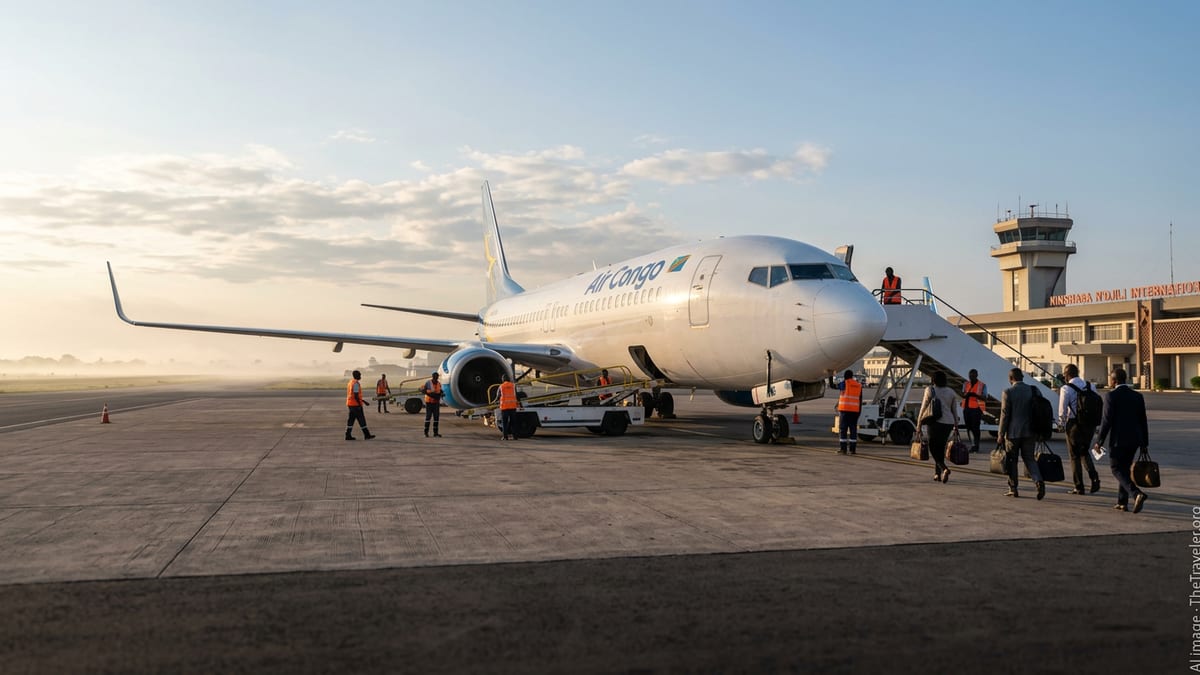
Air Congo will launch its first wave of sub-regional services from March 22, 2026, rolling out new routes from Kinshasa to Johannesburg, Entebbe and other African hubs in a move set to redefine regional connectivity for the Democratic Republic of Congo.
New Routes Mark a Strategic Shift Beyond Domestic Operations
The Kinshasa-based national carrier confirmed that services to Johannesburg in South Africa and Entebbe in Uganda will begin on March 22, 2026, followed by new links to Douala in Cameroon and Cotonou in Benin from March 28, and Dar es Salaam in Tanzania from April 4. The rollout represents Air Congo’s first foray beyond its domestic network, which until now has focused on major Congolese cities such as Lubumbashi, Goma and Kisangani.
The expansion follows the recent delivery of an additional Boeing 737-800 in early February, bringing the airline’s operational fleet of the type to three aircraft. Company officials have framed the upgrade as a prerequisite to sustaining regular regional operations while maintaining high-frequency domestic services from Kinshasa’s N’djili International Airport.
According to statements from Congolese authorities, the new sub-regional phase is designed to support trade, investment and business travel between the Democratic Republic of Congo and key economic centers in Central, Eastern and Southern Africa. The airline’s leadership has stressed that point-to-point connectivity from Kinshasa will cut journey times for travelers who previously relied on distant hubs for intra-African connections.
While detailed timetables and frequencies for each new route have yet to be fully published, industry data show that Johannesburg, Entebbe, Douala, Cotonou and Dar es Salaam are all slated to be served directly from Kinshasa, with schedules aligned to business and government travel demand.
Kinshasa–Johannesburg and Entebbe at the Heart of the Launch
Johannesburg and Entebbe have been chosen as the inaugural international destinations, underscoring their importance in Air Congo’s regional strategy. Johannesburg, one of Africa’s busiest aviation and financial hubs, offers Congolese passengers and businesses improved access to Southern Africa’s largest economy, as well as onward links across the continent.
For Entebbe, the new route positions Air Congo on a corridor that has seen rising traffic volumes between Central and East Africa. Uganda’s main international gateway serves both the capital Kampala and a growing number of regional travelers, and Air Congo’s entry will inject new capacity alongside Uganda Airlines on the Kinshasa–Entebbe axis.
Analysts note that, beyond passenger flows, both routes carry symbolic weight. Direct services to Johannesburg reconnect Kinshasa more firmly with South Africa’s corporate and diplomatic community, while Entebbe opens a streamlined bridge to East African institutions and regional organizations. Travel industry observers in Kinshasa say the launch could help re-establish the city’s role as a crossroads for African air traffic.
The March 22 start date coincides with the beginning of the Northern Hemisphere summer scheduling season, when airlines traditionally introduce network changes. For Air Congo, that timing provides an opportunity to capture early demand from business travelers, diaspora communities and regional tourists planning mid-year trips.
Douala, Cotonou and Dar es Salaam to Follow Within Weeks
Just six days after the first flights, Air Congo plans to widen its sub-regional reach with the start of services to Douala and Cotonou on March 28, 2026. Both cities are important commercial ports and financial centers, historically linked to the Democratic Republic of Congo through trade in raw materials, manufactured goods and services.
These westward routes are expected to appeal in particular to traders, logistics operators and professionals who currently route via distant hubs such as Addis Ababa, Lomé or Abidjan to move between the DRC and coastal West Africa. By cutting out intermediate stops, the airline aims to offer shorter travel times and more predictable connections.
On April 4, 2026, Air Congo’s regional build-out continues eastward with the launch of flights to Dar es Salaam. The Tanzanian city has emerged as a key Indian Ocean gateway for Central and East Africa, with growing cargo and passenger demand linked to infrastructure projects, mining and energy investments. The Kinshasa–Dar es Salaam link will place Air Congo in direct competition with previously established operators on the route.
Executives close to the project say the three-phase rollout allows the airline to test market response and fine-tune schedules, while progressively ramping up aircraft utilization. Early bookings for the first flights, according to local travel agencies, indicate strong interest from both corporate and VFR (visiting friends and relatives) segments.
Fleet Growth and Partnerships Underpin Regional Ambitions
Air Congo’s ability to move into the sub-region so soon after launch is closely tied to its partnership structure. Created as a joint venture between the Congolese state, which holds a 51 percent stake, and Ethiopian Airlines, which owns 49 percent, the carrier has benefited from fleet, training and technical support shared with one of Africa’s largest and most experienced airline groups.
Since its first commercial flight in December 2024, the company has progressively built its domestic presence using Boeing 737-800 aircraft leased from Ethiopian Airlines. Industry reports indicate that a fourth aircraft is due to join the fleet in the months ahead, followed by turboprop aircraft intended to reinforce thinner domestic routes.
Government officials in Kinshasa have repeatedly highlighted aviation as a pillar of national development policy, arguing that modern, reliable air links are essential for a vast country where surface transport remains limited. The decision to accelerate regional expansion in 2026 is seen as an attempt to leverage the airline’s early domestic momentum, while taking advantage of demand shifts as African carriers reconfigure post-pandemic networks.
Air Congo’s management has also pointed to strong load factors on its internal routes as a sign that the market can sustain further growth. High seat occupancy rates on flights between Kinshasa, Lubumbashi and other provincial centers have provided both revenue and operational experience in preparation for more complex international operations.
Competitive Pressures and Opportunities Across Central and East Africa
The airline’s new routes will open fresh competition on some corridors and create entirely new nonstop options on others. On Kinshasa–Entebbe, Air Congo will join Uganda Airlines, which already operates multiple weekly frequencies between the two cities. Travel agents expect the entry of a second carrier to translate into sharper pricing and improved schedule choice for passengers.
On the Dar es Salaam route, Air Congo’s arrival will add to the options linking the DRC with Tanzania, a relationship that has deepened through trade and investment over the past decade. Here too, additional capacity could pressure fares, but industry observers say the underlying demand remains strong enough to support multiple operators, particularly as tourism to both countries expands.
By contrast, Kinshasa’s forthcoming links to Douala and Cotonou will for the moment give Air Congo a first-mover advantage on direct services. Travelers currently endure time-consuming connections via third-country hubs to reach these West and Central African cities. Direct flights are expected to appeal not only to business travelers but also to regional institutions, NGOs and diplomatic missions seeking more efficient travel between their bases.
Regional aviation specialists caution that the success of Air Congo’s expansion will depend on operational reliability, competitive pricing and effective marketing beyond the DRC. However, they also note that the timing aligns with a broader trend of African carriers strengthening intra-African networks, mirroring continental ambitions for deeper economic integration through initiatives such as the African Continental Free Trade Area.