

More news on this day
Air Congo is set to deepen regional connectivity across Central, East and Southern Africa in March and April 2026, unveiling a new network from its Kinshasa hub to Johannesburg, Entebbe, Douala, Cotonou and Dar es Salaam as the young flag carrier accelerates its growth strategy.
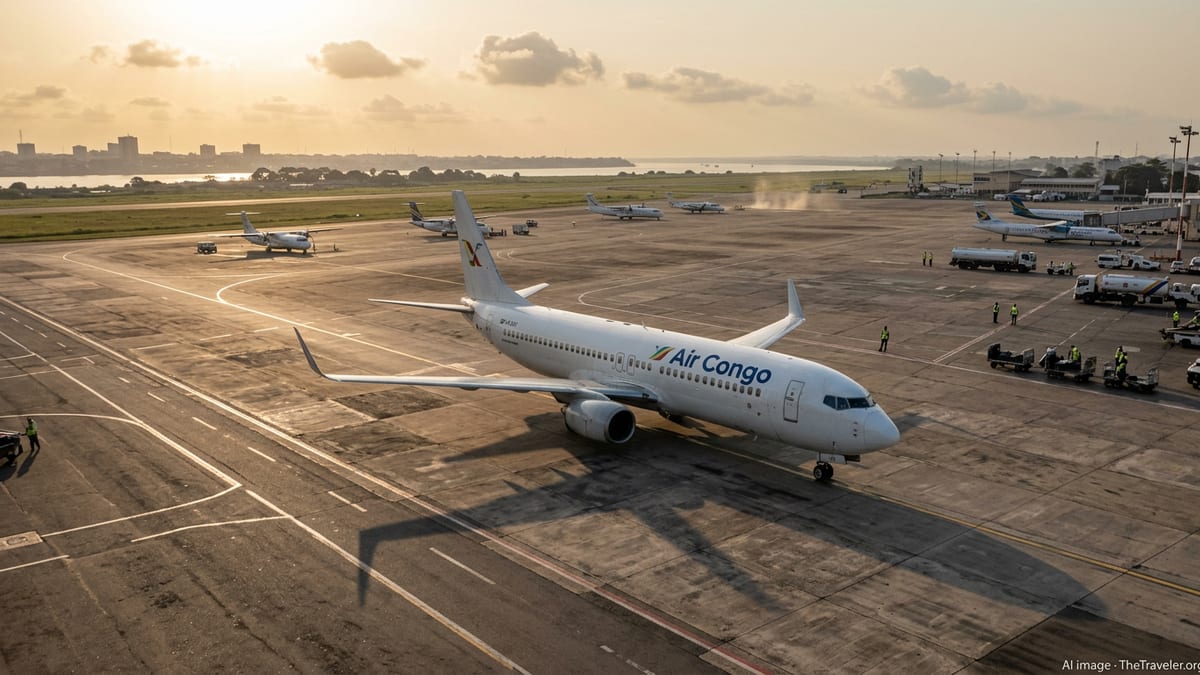
A Young Flag Carrier Moves Onto the Regional Stage
Launched in late 2024 as the Democratic Republic of the Congo’s new flag carrier, Air Congo has quickly shifted from a domestic start-up to an airline with regional ambitions. With operations centered at Kinshasa’s N’Djili International Airport, the carrier was initially tasked with improving links across the DRC’s vast territory while laying the groundwork for international services.
That international phase is now taking shape. On 20 February 2026, Air Congo announced plans to open routes from Kinshasa to Cotonou, Douala, Johannesburg and Kampala, followed by additional services that will extend its reach into East Africa. Updated schedules indicate that services to Johannesburg and Entebbe via eastern Congo, to Cotonou via Douala, and to Dar es Salaam via Lubumbashi are being phased in from late March into April 2026.
The move is underpinned by a partnership structure that gives the Congolese state a controlling stake alongside Ethiopian Airlines, which is providing aircraft, expertise and maintenance support. For Kinshasa, the expansion marks a visible step in a broader policy goal of transforming N’Djili into a regional hub and positioning the DRC more firmly within Africa’s air transport map.
Industry observers see the new routes as a test of Air Congo’s ability to compete in a fragmented but fast-growing market where established players such as Ethiopian Airlines, Kenya Airways, RwandAir and regional low-cost carriers are all vying for share.
Route Launches Connect Five Key African Gateways
According to provisional timetables and planning documents, Air Congo’s new network roll-out is structured around a series of tag sectors that link Kinshasa with secondary cities inside the DRC and onward to major African gateways. Services to Johannesburg and Entebbe are scheduled to begin around 22 March 2026, operating via eastern Congo, while flights to Cotonou through Douala are planned to come online from 28 March.
Dar es Salaam features later in the sequence, with the airline planning to add the Tanzanian commercial capital in early April via Lubumbashi, the DRC’s mining and industrial center. By using these domestic intermediate stops, Air Congo aims to feed traffic from provincial cities onto international legs, a model that also supports the government’s objective of connecting the country’s 26 provinces by air.
The choice of destinations reflects a mix of commercial and political calculations. Johannesburg remains one of the continent’s busiest international gateways and a critical market for trade, finance and medical travel. Entebbe, serving Uganda’s capital Kampala, is an increasingly important regional hub. Douala and Cotonou are vital ports for Central and West Africa, and Dar es Salaam sits at the heart of East Africa’s Indian Ocean corridor.
By plugging Kinshasa into this network of coastal ports and financial centers, Air Congo is betting that demand for intra-African travel will continue to rise among business travelers, traders, diaspora communities and a slowly recovering tourism sector.
Partnership With Ethiopian Airlines Shapes Fleet and Strategy
Air Congo’s growth is closely tied to its strategic partnership with Ethiopian Airlines, which holds a minority stake and is leasing aircraft to the Congolese carrier. The current fleet consists primarily of Boeing 737-800s operated on short and medium-haul routes, with additional ATR 72 turboprops earmarked for thinner domestic sectors.
This arrangement allows Air Congo to scale up regional operations relatively quickly without the capital outlay of purchasing new aircraft outright. Ethiopian’s role extends beyond metal on the ramp, with technical support, crew training and maintenance capabilities being developed in Kinshasa as part of a wider multi-hub strategy that Ethiopian is pursuing across the continent.
For the DRC government, the partnership is also a way to avoid past pitfalls experienced by earlier national carriers, which struggled with aging fleets, safety concerns and chronic underinvestment. By anchoring the new airline in an established African aviation group while maintaining majority local ownership, officials hope to build a more sustainable platform for long-term growth.
Plans outlined in recent policy papers also point to a future long-haul component, including the possible acquisition of a widebody aircraft to serve intercontinental destinations such as Brussels, Paris and Dubai. In the near term, however, the focus remains squarely on knitting together key African city pairs and consolidating the new regional network.
Boost to Trade, Investment and Regional Mobility
The launch of routes from Kinshasa to Johannesburg, Entebbe, Douala, Cotonou and Dar es Salaam is expected to have ripple effects beyond the aviation sector. Improved air links reduce travel times, ease the movement of people and goods, and can support investment flows between the DRC and its neighbors.
Central African economies have long been hampered by limited direct flights, forcing travelers to route through hubs outside the region or rely on road and river transport that is slower and less reliable. Direct and one-stop air services open up new possibilities for cross-border business trips, conference travel, medical referrals and educational exchange.
For traders and logistics operators, the network offers fresh options for moving high-value and time-sensitive cargo between mining centers in the DRC and port cities on the Atlantic and Indian Ocean coasts. The Douala and Cotonou links in particular could facilitate access to maritime shipping lanes, while Johannesburg remains a critical node for financial and professional services.
Tourism agencies in the region are also watching developments closely. While leisure travel to and from the DRC is still limited by infrastructure and perception challenges, better connectivity to established tourism gateways such as Johannesburg, Entebbe and Dar es Salaam could gradually help reposition the country as a feasible add-on destination for regional itineraries focused on nature, culture and adventure.
Challenges Ahead in a Competitive African Skies Market
Despite the optimism surrounding Air Congo’s expansion, the airline faces a demanding operating environment. African carriers have historically contended with high operating costs, currency volatility, regulatory hurdles and infrastructure constraints, and many have struggled to achieve consistent profitability.
On several of the new routes, Air Congo will encounter direct or indirect competition from regional incumbents and global carriers feeding passengers via larger hubs. Johannesburg and Dar es Salaam are already served by multiple airlines from across the continent, while Entebbe, Douala and Cotonou sit within the catchment areas of established alliances and codeshare networks.
Maintaining reliability and service standards will be critical for the young carrier as it works to build trust among passengers and corporate travel buyers. Recent incidents in the Congolese aviation sector have highlighted the importance of robust ground handling, safety oversight and customer care, particularly as traffic ramps up on international services.
For now, the launch of these new routes places Air Congo firmly on the radar of African aviation watchers. The coming months will show whether the airline can translate a bold network map and strong political backing into a resilient, commercially viable operation that helps reposition Kinshasa as a genuine hub between Central, East and Southern Africa.