

More news on this day
Air Congo is set to step beyond its domestic roots from late March 2026, rolling out new routes to South Africa, Tanzania and key regional hubs in a move poised to reshape African connectivity and hospitality flows through the Democratic Republic of Congo.
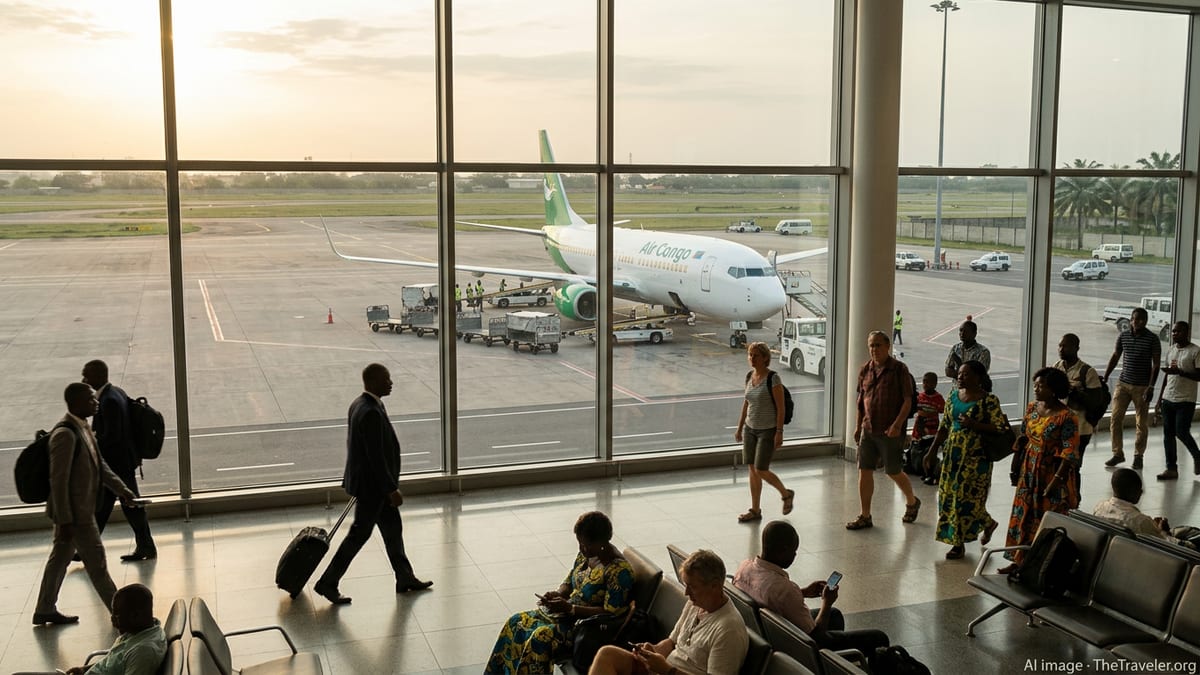
New Southern and Eastern Africa Routes Take Flight
From March 22, 2026, Air Congo will begin a phased launch of its first international network from its Kinshasa hub, introducing direct links to Johannesburg in South Africa and Entebbe in Uganda. A second wave will follow on March 28 with services to Douala in Cameroon and Cotonou in Benin, before Dar es Salaam in Tanzania joins the map on April 4. The sequence marks the airline’s transition from a purely domestic operator to a regional carrier serving Central, Eastern and Southern Africa.
The new flights will give travelers in the Democratic Republic of Congo much faster access to major African capitals that have historically required long, multi-stop itineraries. Direct Kinshasa services to Douala and Cotonou are expected to be particularly attractive to business travelers who today often route via Addis Ababa, Lomé or Abidjan, adding cost and hours of travel time. By inserting Kinshasa into these flows, Air Congo is positioning the DRC as a more convenient gateway for intra-African journeys.
Johannesburg and Dar es Salaam stand out as strategic additions. Johannesburg is one of the continent’s busiest aviation hubs, with a dense web of connections across Southern Africa and long-haul links to Europe, the Middle East and Asia. Dar es Salaam, meanwhile, is a growing entry point for Tanzania’s safari circuits and coastal resorts, giving Congolese travelers and regional visitors new options to combine business trips with leisure itineraries.
Schedule filings indicate that the flagship Kinshasa–Lubumbashi–Johannesburg service is planned at three weekly frequencies at the start of the northern summer 2026 season, providing a regular lifeline between the DRC’s economic centers and South Africa. As demand matures, aviation analysts expect both capacity and frequency to rise, especially on routes that quickly prove their commercial potential.
Expanding Fleet and Infrastructure to Support Growth
To underpin the new routes, Air Congo has been quietly scaling up its young fleet. Initially launched in December 2024 with two Boeing 737-800 aircraft serving domestic destinations such as Lubumbashi, Goma and Kisangani, the carrier has since taken delivery of a third jet and outlined plans for additional aircraft over the next two years. Officials have also signaled the arrival of turboprop ATR 72-600s to deepen coverage of secondary cities inside the DRC.
This fleet growth is part of a broader aviation investment program led by Kinshasa. The government has announced upgrades to key airports, including work at N’djili International Airport to expand terminal capacity and modernize airside infrastructure, as well as the rehabilitation of regional fields such as Mbuji-Mayi and Lubumbashi. These improvements are designed to handle larger aircraft and higher passenger volumes as new domestic and international services come online.
The airline itself is structured as a joint venture in which the DRC government holds a majority stake and Ethiopian Airlines provides technical and managerial expertise. That partnership gives Air Congo access to training pipelines, maintenance facilities and operational know-how that are essential for a carrier seeking rapid but sustainable growth. Ethiopian has previously supported the creation or relaunch of several African airlines, and industry observers see the DRC project as one of its most ambitious collaborations to date.
As Air Congo’s fleet grows, so does its ambition. Officials have already flagged plans for widebody aircraft, including Boeing 787 Dreamliners, to open intercontinental services from Kinshasa to Brussels, Paris and Dubai later in 2026 and beyond. While those long-haul moves will depend on market conditions and regulatory milestones, the new African routes in March and April are viewed as the critical first test of the airline’s ability to compete in a crowded regional arena.
Transforming Regional Hospitality and Tourism Flows
The timing of Air Congo’s regional expansion aligns with a broader rebound in African tourism and business travel. Tanzania’s safari circuits, from the Serengeti to the Ngorongoro Crater, and coastal getaways around Dar es Salaam and Zanzibar are seeing resurgent demand, while South Africa’s urban and wine tourism remains a major draw. By offering more direct access via Kinshasa, the DRC’s flag carrier aims to capture a slice of this growing market and redistribute travel flows through Central Africa.
For hoteliers and tour operators, the new connections open tangible opportunities. Congolese travelers will find it easier to plan multi-country itineraries that stitch together meetings in Johannesburg with a few days on the Tanzanian coast or in Ugandan national parks. Conversely, visitors from East and Southern Africa will have more straightforward options to explore the DRC’s own emerging tourism assets, from Kinshasa’s riverside culture to nature experiences in provinces like North Kivu and Haut-Katanga.
Industry stakeholders in Kinshasa say they are already fielding more inquiries tied to the forthcoming routes, particularly from regional conferences and trade fairs that want better access for delegates from multiple African capitals. The hospitality sector is responding with hotel refurbishments and new openings near airports and business districts, anticipating higher year-round occupancy rather than purely seasonal peaks.
Crucially, the new flights also promise to ease travel for the Congolese diaspora and regional workers who move regularly between mining centers, ports and commercial hubs. More predictable schedules and shorter travel times can reduce costs for employers and create a more stable base of demand for hotels, guesthouses and airport services across the network.
Business Travel, Trade and the Promise of a Kinshasa Hub
Beyond tourism, Air Congo’s move into Tanzania, South Africa and neighboring markets speaks directly to the growth of intra-African trade under frameworks such as the African Continental Free Trade Area. Johannesburg, Douala and Cotonou are all key nodes for banking, logistics and commodities, while Dar es Salaam functions as a vital maritime outlet for the Great Lakes region. Direct flights from Kinshasa are expected to streamline corporate travel and facilitate faster movement of executives, technicians and traders.
Kinshasa’s ambition is to evolve from a relatively isolated capital into a true regional hub that can connect traffic flows from West and Central Africa to Eastern and Southern Africa. With more African carriers recalibrating their networks in favor of short and medium-haul routes within the continent, Air Congo’s entry into these markets adds another piece to a fast-changing connectivity puzzle.
Analysts caution that success will depend on reliability, competitive pricing and effective partnerships, both with Ethiopian Airlines and with other regional carriers. Interline and codeshare agreements could allow Air Congo passengers to connect more seamlessly onward from Johannesburg or Dar es Salaam to secondary cities across Southern and East Africa, while also feeding international services as long-haul plans materialize.
For now, the focus is squarely on delivering the initial wave of routes as filed. If flights to Johannesburg, Dar es Salaam and their companion destinations meet expectations, they could signal the emergence of a new central corridor in African aviation, with Kinshasa as a rediscovered hub and Air Congo as a catalyst for a more integrated hospitality and travel ecosystem across the continent.