

More news on this day
Air Europa is deepening its push into Latin America with a new codeshare agreement on Sky Airline’s Lima to Santiago route, creating smoother one‑ticket connections between the Peruvian and Chilean capitals and the Spanish carrier’s hub in Madrid.
Get the latest news straight to your inbox!
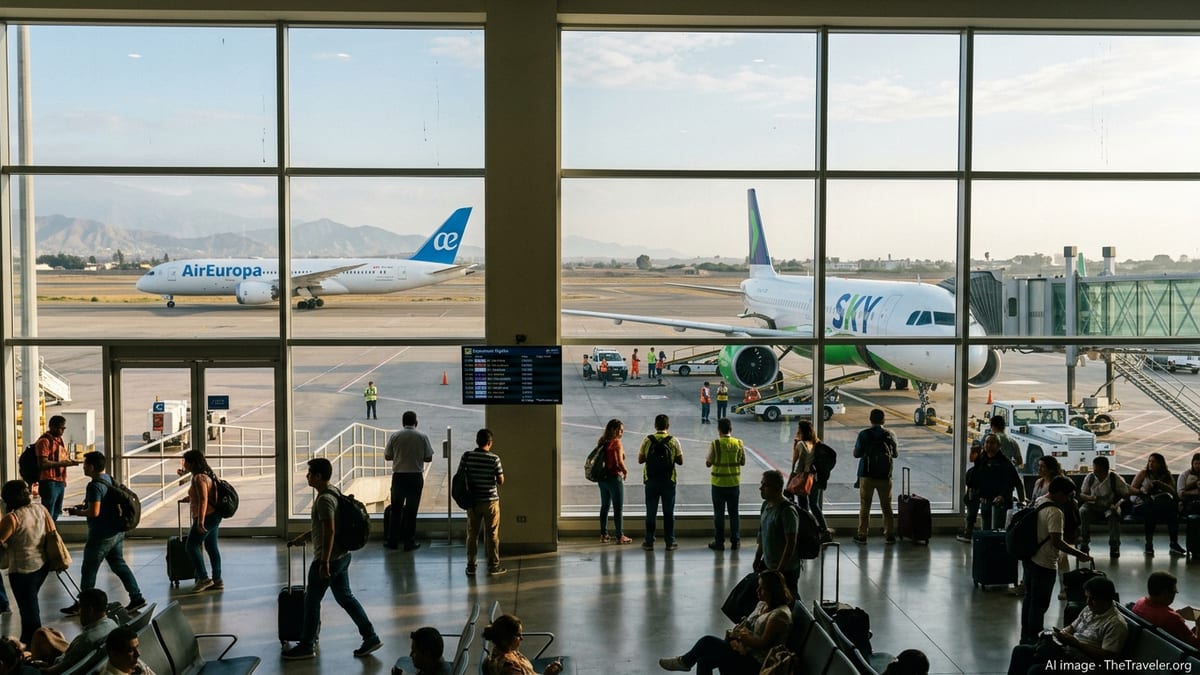
New Codeshare Turns Lima–Santiago Into a Strategic Link
The new codeshare arrangement, which began appearing in schedules for the Northern Hemisphere summer 2026 season, places Air Europa’s "UX" code on select Sky Airline-operated flights between Lima and Santiago. Publicly available timetable data indicates that the agreement is part of a broader rollout of shared services between the two airlines covering several routes to and from the Peruvian capital.
According to published coverage from aviation industry outlets, the Lima–Santiago sector is among the first to carry the new joint branding. The route is already one of Sky Airline’s key international links from Peru, and the addition of Air Europa’s marketing presence positions the corridor as a feeder for long haul demand, particularly for travelers heading to and from Europe via Madrid.
Schedules show that the codeshare is structured to complement Air Europa’s nonstop Madrid–Lima operation, allowing passengers to book combined itineraries that include domestic and regional sectors on Sky Airline under a single Air Europa code. This effectively transforms the Lima–Santiago link into a trunk connection within the airline’s transatlantic network.
The development follows a period of close commercial cooperation between the two carriers. They initially launched an interline agreement that allowed through-ticketing and baggage transfers on separate flight numbers. The shift to codeshare represents a deeper level of integration, with both airlines now jointly marketing specific services on the Lima–Santiago route.
Connecting Europe With Chile and Peru on a Single Ticket
The new codeshare is designed to simplify journeys that previously required separate reservations or reliance on other regional partners. Publicly available information from Air Europa’s network announcements shows that the carrier sees Lima as a strategic gateway to western South America, and the Sky Airline partnership extends that reach southward to Chile.
Under the arrangement, travelers originating in cities across Europe can now purchase a single ticket from their departure point to Santiago via Madrid and Lima, with the final sector flown by Sky Airline but sold under an Air Europa flight number. Aviation trade publications report that this structure enables coordinated schedules and standardized conditions across the combined itinerary, including through-check of baggage.
The agreement also improves access in the reverse direction. Passengers starting in Santiago can connect to Sky Airline’s Lima flights and then continue on Air Europa to Madrid and onwards to destinations in Spain and the rest of Europe. Industry analysis notes that this reinforces Madrid’s role as a hub for South America–Europe traffic, particularly for leisure and visiting friends and relatives segments.
Reports indicate that Sky Airline, which operates as a low cost carrier, benefits from additional feed from Europe without having to deploy its own long haul aircraft. At the same time, Air Europa broadens its footprint in Chile, a market that has historically been served through indirect routings or partnerships with other regional airlines.
Lima and Santiago Strengthen Roles as Regional Hubs
Both Lima’s Jorge Chávez International Airport and Santiago’s Arturo Merino Benítez International Airport have been expanding their roles as regional hubs for South America, and the new codeshare fits within those broader trends. Airport statistics and airline route data highlight Lima as a growing connection point linking the southern cone, Andean countries and the Caribbean with long haul services to Europe and North America.
Sky Airline has developed a network from Lima that includes multiple domestic Peruvian destinations as well as international flights to Chile, Brazil, Argentina and other regional markets. By overlaying Air Europa’s code onto key sectors such as Lima–Santiago, the carriers create additional transfer options that tie smaller Peruvian cities into the European long haul network via a combination of Sky and Air Europa flights.
In Santiago, the partnership helps diversify connectivity for travelers beyond the country’s traditional reliance on other regional and global network carriers. Aviation analysts point out that the availability of one-stop options to Madrid through Lima may attract price-sensitive passengers who are willing to connect in exchange for competitive fares and expanded schedule choice.
The timing of the codeshare also coincides with long term infrastructure and capacity upgrades in both capitals. Terminal expansions and airside improvements in Lima and Santiago have been aimed at supporting increased transfer traffic, and the Air Europa–Sky Airline partnership is expected to contribute additional connecting flows across both airports.
Building on Previous Interline Cooperation Across Latin America
The new codeshare agreement builds on an existing interline relationship between Air Europa and Sky Airline that has been in place for more than a year. Earlier announcements from both companies described an arrangement allowing Air Europa passengers to access more than 30 Sky Airline destinations in Chile, Peru and other parts of Latin America through single-ticket itineraries.
That earlier phase of cooperation focused primarily on interline services, where each airline maintained its own separate flight numbers but agreed to handle connecting passengers and luggage across their networks. Aviation-focused reporting at the time underlined that this structure simplified travel between Europe and secondary cities in Chile and Peru, even before the codeshare was introduced.
With the transition to a full codeshare on routes such as Lima–Santiago, Air Europa takes a more visible role in regional traffic flows. The UX code now appears on Sky Airline operated flights that are marketed as part of Air Europa’s official schedule, giving the Spanish carrier greater control over how capacity is presented and sold in distribution channels worldwide.
At the same time, Sky Airline gains access to Air Europa’s sales and marketing reach in Europe, including corporate accounts and tour operators that may previously have favored other connecting options. Publicly available commentary from industry observers suggests that aligning distribution systems in this way can be especially important for low cost carriers seeking to capture higher yielding connecting traffic.
Competitive Landscape and Traveler Implications
The enhanced cooperation between Air Europa and Sky Airline arrives in a competitive context for South America–Europe travel, where several global airline groups and alliances are contesting market share. Analysis from aviation consultancies notes that multiple European carriers already serve major gateways such as São Paulo, Lima and Santiago, often partnering with local airlines to extend their reach.
Within this landscape, Air Europa’s new codeshare on Lima–Santiago gives it a stronger proposition in western South America, particularly for travelers whose journeys combine city pairs in Peru and Chile. The presence of a SkyTeam member on this corridor, working with a regional low cost partner, may encourage other groups to refine their own partnership strategies in the region.
For passengers, the immediate implications are practical rather than symbolic. The availability of one-ticket itineraries, aligned schedules and through-check baggage on Lima–Santiago connections can reduce travel complexity, especially for those carrying multiple bags or making tight connections in Madrid. Travel industry coverage also points to potential benefits in terms of clearer rebooking options when disruptions occur, because the entire journey sits within a single reservation structure.
While detailed performance data for the new codeshare has yet to emerge, the move reflects a broader pattern of airlines using partnerships to expand without committing additional long haul aircraft or opening new bases. As more Latin American carriers pursue similar arrangements, the Lima to Santiago corridor is likely to remain a focal point for experiments in cross-border cooperation between network and low cost operators.