

More news on this day
France’s government-backed flag carrier Air France is reshaping its Summer 2026 program, adding a high-profile Paris to Las Vegas route while refocusing long-haul capacity toward Asia as continued Middle East disruptions alter traditional traffic flows.
Get the latest news straight to your inbox!
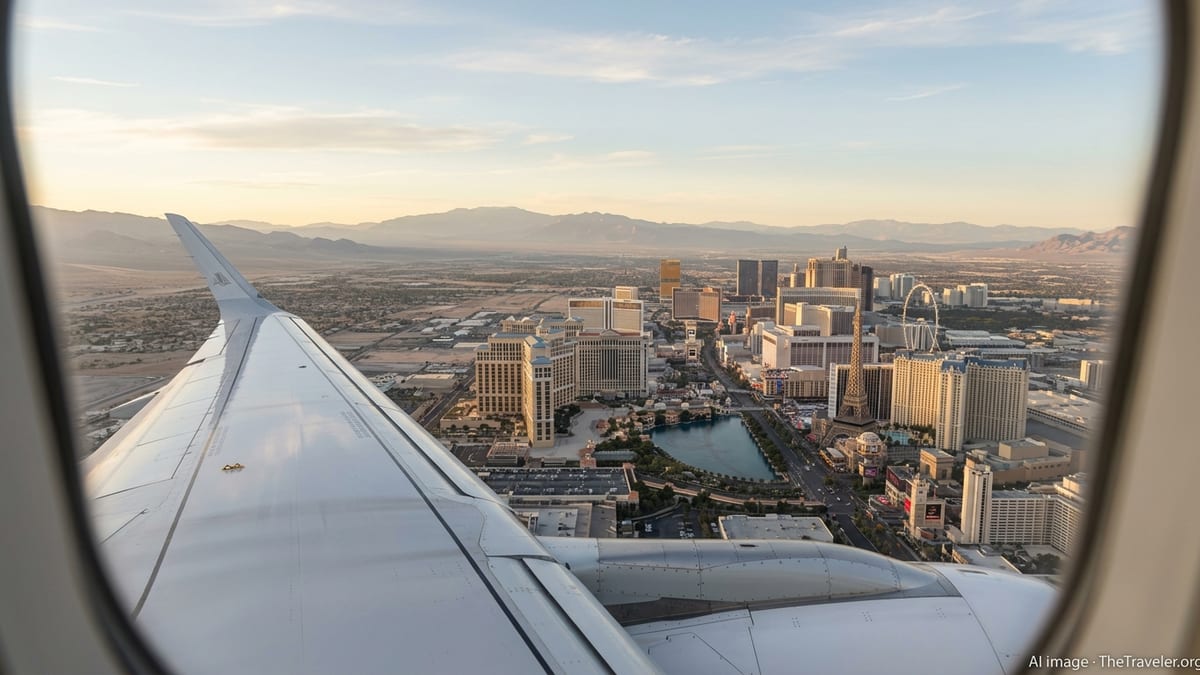
New Paris–Las Vegas Route Anchors Transatlantic Push
Air France has confirmed that Las Vegas will be the first new destination in its Summer 2026 schedule, with nonstop service from Paris-Charles de Gaulle scheduled to begin on April 15, 2026. Public information from the airline and industry outlets indicates that the route will operate three times weekly, on Mondays, Wednesdays and Saturdays, placing the Nevada city firmly within Air France’s core long-haul portfolio for the April to October season.
The flights are set to be operated by Airbus A350-900 aircraft in a three-class configuration, offering business, premium economy and economy seating. Aviation data services report that the aircraft will carry more than 300 passengers per flight, positioning Air France to compete in a market where capacity had been constrained in recent years as low-cost carriers trimmed operations into Las Vegas.
Company statements describe the Las Vegas launch as part of a broader long-haul expansion strategy that has been under way since 2024, with overall long-haul capacity increasing year on year. By designating Las Vegas as its 19th destination in the United States and its 26th in North America, Air France is reinforcing Paris-Charles de Gaulle’s role as a key European gateway for inbound leisure demand to the American West.
Tourism and aviation analysts note that Las Vegas had been one of the largest unserved US cities without nonstop service to Paris prior to this announcement. The new connection is expected to stimulate both leisure and convention traffic, linking France and wider Europe to a market that relies heavily on international airlift and has been actively courting additional legacy carriers.
Government Strategy and Network Rebalancing
The reshaping of Air France’s Summer 2026 schedule is unfolding against a backdrop in which France retains a strategic interest in its national carrier through the Air France-KLM group. Public filings show that French authorities have encouraged a focus on profitable long-haul growth, particularly on routes that reinforce Paris as a global hub while diversifying away from more volatile markets.
Corporate reports covering 2023 and 2024 highlight a sustained push into North America and Asia, with capacity to those regions rising faster than the network average. At the same time, official documents point to a measured reduction in capacity to parts of the India and Middle East region, citing geopolitical tensions and airspace restrictions that have complicated planning and raised operating costs on some routings.
Within this framework, industry observers view the Las Vegas launch as emblematic of a broader strategic shift. Rather than relying solely on traditional trunk routes to US East Coast hubs, Air France is increasing its presence in high-yield leisure markets in the western United States, using modern widebodies with strong cargo capability and fuel efficiency to support profitability.
For France, the adjustments also serve a wider policy goal of maintaining a strong national long-haul airline at a time of heightened competition from Gulf carriers and emerging low-cost long-haul operators. By pivoting toward markets where direct competition from Middle Eastern hubs may be less intense, the airline is seeking to safeguard traffic flows that might otherwise be diverted through non-European transit points.
Asia Capacity Ramps Up as Middle East Routes Face Headwinds
Annual registration documents and recent results presentations from the Air France-KLM group show that capacity growth has been strongest in Asia, particularly in China and Japan, where demand rebounded sharply once border restrictions were lifted. In 2024, the group reported double-digit percentage increases in available seat kilometers to major Asian markets, and guidance for 2025 and 2026 points to further incremental growth on those corridors.
At the same time, the carrier has described its capacity evolution in the India and Middle East region as more cautious, noting a reduction in available seats compared with pre-crisis levels. Industry analysts link this trend to the complex geopolitical situation in parts of the Middle East, which has periodically disrupted airspace, lengthened flight times and created uncertainty for both passengers and airlines operating via traditional Gulf and Levantine hubs.
Recent disruptions to Middle Eastern airspace, reported across multiple airlines, have reinforced the case for European and Asian carriers to prioritize routings that avoid potential bottlenecks. For Air France, this has translated into an emphasis on nonstop and north-of-conflict routings to East and Southeast Asia, and an acceleration of capacity deployment to markets such as China, South Korea and Japan that can be served efficiently from Paris.
Industry commentary suggests that this rebalancing is also shaping alliance and partnership strategies. With some Gulf carriers temporarily reducing or rerouting services because of regional tensions, passengers who might once have flown to Asia via Dubai, Doha or Abu Dhabi are increasingly booking itineraries that connect through European hubs, including Paris-Charles de Gaulle, thus supporting Air France’s decision to reinforce its Asia flying program.
Widebody Fleet and Premium Cabins Underpin the Plan
The redeployment of capacity toward Asia and the introduction of new long-haul routes such as Paris to Las Vegas are supported by Air France’s ongoing widebody renewal program. Company disclosures indicate that the A350-900 is central to this strategy, offering significant fuel savings relative to older aircraft and enabling the airline to open long, thin routes that might not have been viable in the past.
By Summer 2026, Air France expects a growing share of its long-haul fleet to feature upgraded business cabins and an expanded La Première first class offering on select aircraft. Internal planning documents and previous network announcements show that the airline intends to concentrate these premium products on routes with strong high-yield demand, notably in North America and Asia, where corporate travelers and affluent leisure passengers support higher average fares.
Deploying the A350 on the Las Vegas route aligns with this approach. The aircraft’s range and economics allow the airline to balance leisure-driven demand with sufficient premium seating to attract high-spend visitors, event organizers and casino sector partners who favor nonstop connectivity from Europe. The same aircraft type is also being used to reinforce growth in Asia, where slot constraints at key airports encourage airlines to maximize capacity and product quality on each available frequency.
From a competitive standpoint, the renewed fleet and premium focus give Air France tools to differentiate its Paris hub proposition at a time when travelers are increasingly sensitive to cabin quality on long-haul journeys. As more A350s enter service and older widebodies are retired, the carrier expects network flexibility to increase, making it easier to shift capacity between transatlantic and Asia-Pacific markets in response to demand and geopolitical developments.
Implications for Travelers and Tourism Flows
For travelers, the reshaped Summer 2026 schedule means more options both across the Atlantic and toward Asia, but also a shifting map of one-stop connections as Air France recalibrates the balance between Middle East and Asia capacity. Passengers from France and wider Europe will gain a new nonstop gateway to Las Vegas, while travelers from North America connecting via Paris will see a denser schedule on several Asian routes.
Tourism bodies in Nevada have highlighted in public meetings that international arrivals are increasingly important to sustaining visitor growth, particularly as capacity from some North American markets has declined. Analysts expect that the arrival of a well-established European flag carrier in April 2026 will help offset some of the recent reductions in low-cost traffic and broaden the destination’s reach in continental Europe.
On the Europe to Asia side, travelers are likely to experience a gradual consolidation of capacity onto key nonstop routes, with Paris serving as an alternative to Middle Eastern hubs for journeys to East Asia. While schedules remain subject to change in response to evolving conditions in the Middle East, published information suggests that Air France is positioning itself to capture traffic that is diversifying away from disrupted corridors.
Overall, France’s reshaped long-haul strategy for Summer 2026 underscores how geopolitics, fleet renewal and tourism demand are combining to redraw global air networks. With Las Vegas entering the map for Air France and Asia taking a larger share of available capacity, passengers will see new routings and products emerge as airlines continue to adapt to a fluid operating environment.