

More news on this day
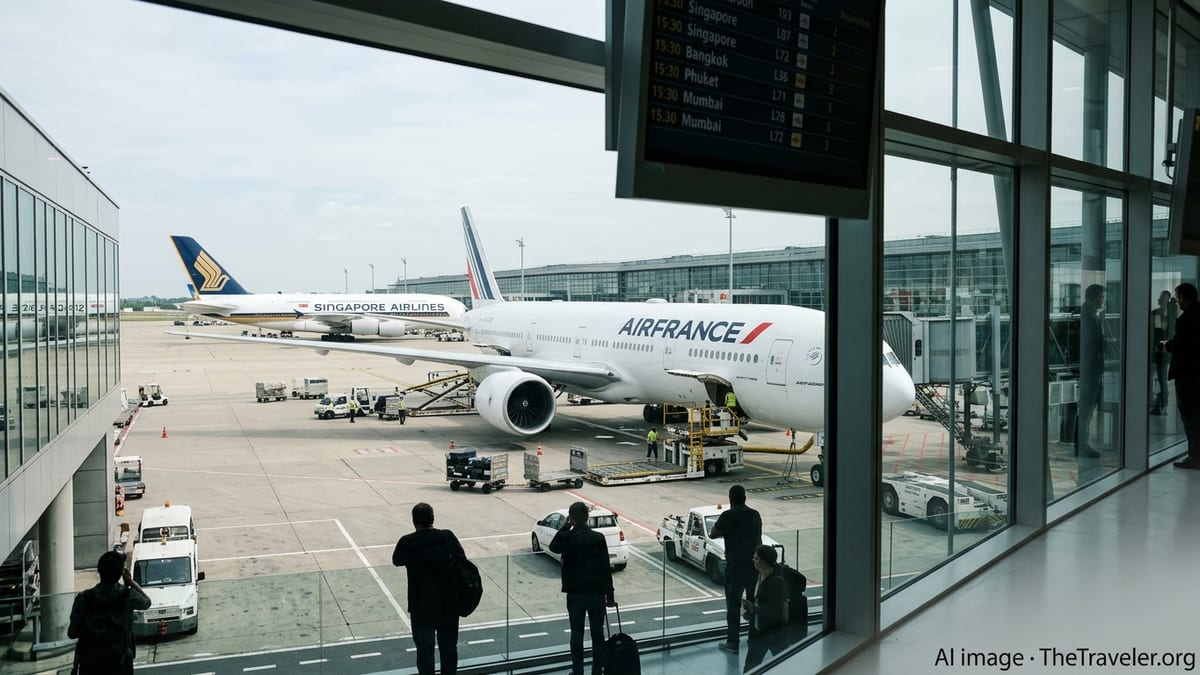
Air France is pressing ahead with an ambitious expansion of its Asian network, adding Singapore to a roster that includes Bangkok, Phuket and Mumbai, even as renewed conflict in the Middle East forces airlines worldwide to redraw long-haul flight paths.
Get the latest news straight to your inbox!
Singapore Joins a Rapidly Growing Asia Network
Publicly available schedule data and recent network announcements show that Singapore has become one of Air France’s key Asian gateways, with multiple weekly services linking Changi Airport to Paris Charles de Gaulle. The city-state now sits alongside Bangkok and other regional hubs as the carrier concentrates more of its long-haul growth in Asia while demand from Europe remains robust.
Corporate information released for the winter 2024 to 2025 season highlighted that Air France was already stepping up frequencies to Singapore and Bangkok, positioning both cities as high-capacity routes in its long-haul portfolio. The strategy builds on restored travel appetite following the pandemic and leverages strong premium and connecting traffic between Europe and Southeast Asia.
Separate aviation scheduling platforms indicate that nonstop flights between Paris Charles de Gaulle and Singapore Changi are operated by widebody aircraft with typical flight times of around 12 and a half to 13 hours. That places Singapore among Air France’s longer intercontinental sectors, now complicated by the need to route around increasingly restricted Middle Eastern airspace.
Phuket and Bangkok Underscore Thailand’s Appeal
Thailand has emerged as a focal point of Air France’s Asia push. Earlier planning for the winter 2024 to 2025 season already signaled a doubling of capacity to Bangkok compared with the previous year, reflecting the capital’s importance as both a leisure and business destination. Subsequent announcements for the winter 2025 to 2026 season confirmed that Phuket would be introduced as a new nonstop route from Paris.
According to corporate releases detailing the upcoming schedule, flights between Paris and Phuket are slated to begin in late November 2025 with several weekly services on Boeing 777-300ER aircraft. Industry coverage notes that this will raise Air France’s total number of Asian destinations to double digits, with Phuket joining Bangkok as the airline’s second destination in Thailand.
For travelers, the addition of Phuket offers a direct link between one of Europe’s busiest hubs and one of Southeast Asia’s most popular beach regions, bypassing the need to connect via Gulf or regional carriers. At a time when Middle Eastern air hubs are facing disruptions, the availability of point-to-point links from Paris to Thai destinations is expected to appeal to both European holidaymakers and Asia-based travelers seeking alternatives to circuitous routings.
Mumbai and Wider South Asian Connectivity
Network documents and route summaries for Air France’s winter timetables also list Mumbai among its expanding destinations in the wider Asia and Middle East region. The Indian financial capital has long been a competitive market served by European, Gulf and Asian airlines, but heightened geopolitical risk around the Gulf has shifted some attention back to direct Europe–India links.
Published schedules suggest that Paris–Mumbai flights are timed to connect with Air France’s broader European network, providing one-stop access for travelers across the continent into western India. This forms part of a broader patchwork of services into South and Southeast Asia, with Singapore, Bangkok, Phuket and Mumbai collectively anchoring an eastbound corridor that deliberately skirts the most volatile parts of the Middle Eastern airspace.
India’s own role as a production base and technology hub means that reliable capacity between Europe and cities such as Mumbai carries importance beyond tourism. In the current environment, airlines that can maintain stable, nonstop or minimally rerouted links between major economic centers stand to capture both business and cargo demand diverted from more affected corridors.
Middle East Tensions Force Rerouting and Longer Flight Times
The expansion of Air France’s Asian network is unfolding against a backdrop of severe disruption in the Middle East. Since late February 2026, joint military strikes on Iran and the subsequent escalation around the Strait of Hormuz have prompted widespread airspace closures and heightened operating risks across the region. Reports from international news agencies describe hundreds of thousands of passengers stranded or delayed after multiple Middle Eastern states temporarily shut their skies.
Coverage from global outlets notes that Israel, Iran, Iraq, Kuwait, Bahrain, Qatar and other states have imposed partial or full airspace restrictions at various points, affecting key hubs such as Dubai, Abu Dhabi and Doha. When combined with earlier closures and sporadic missile and drone incidents over the Red Sea and parts of Yemen, these measures have effectively squeezed traditional Europe–Asia flight corridors that once tracked more directly over the Gulf.
Aviation and risk-analysis publications report that many international airlines, especially those based outside the region, now treat Iranian and adjacent airspace as particularly sensitive. Industry estimates cited in specialist reporting suggest that rerouting long-haul flights around these zones can add between 90 and 120 minutes to flight times, depending on the route and prevailing winds. Those additional hours translate into higher fuel burn, crew costs and scheduling complexity.
While Air France has not publicly detailed each routing change for its Asia services, flight-tracking data for Europe–Asia sectors broadly show aircraft taking more northerly or southerly paths to avoid contested skies. For routes to Singapore, Bangkok, Phuket and Mumbai, this can mean longer tracks over Central Asia, the Caucasus or the Indian Ocean, reshaping what used to be more predictable flight patterns.
Costs, Fares and What Travelers Can Expect
Analysts and aviation economists have warned that the combination of longer routings, elevated fuel prices and insurance premiums linked to operating near conflict zones is likely to exert upward pressure on airfares in the months ahead. A recent industry briefing on airline cost dynamics concluded that avoiding Iranian and certain Middle Eastern airspaces not only lengthens flights but also disrupts aircraft rotations, reducing overall utilization.
For passengers flying between Europe and Asia on carriers such as Air France, the immediate impact is most visible in extended block times and shifting departure or arrival schedules. Flight-search data and timetable updates already reflect incremental changes, with some services departing earlier or arriving later to accommodate the extra routing distance while still fitting within airport curfews and connection banks.
Travel advisories from governments and international organizations continue to urge caution for journeys that transit or approach conflict-affected areas, but Southeast Asian destinations such as Singapore, Bangkok and Phuket, along with South Asian cities including Mumbai, remain accessible via adjusted routings. For many travelers, the choice increasingly centers on whether to connect via hubs closer to the Middle East or opt for carriers and schedules that keep to northern or southern detours.
As the situation in the Middle East evolves, airlines are expected to keep updating routings and capacity, but current schedules indicate that Air France is maintaining and even expanding its footprint across key Asian markets. For the tourism sector in Singapore, Thailand and India, the persistence of these links offers a degree of resilience at a time when traditional Europe–Gulf–Asia corridors face some of their most significant challenges in years.