

More news on this day
Air France passengers from North America, Europe and North Africa are facing another day of disruption as a fresh wave of cancellations and delays strands travelers in France and across the airline’s international network, snarling journeys between New York, Sweden, the United Kingdom, Tunisia and beyond.
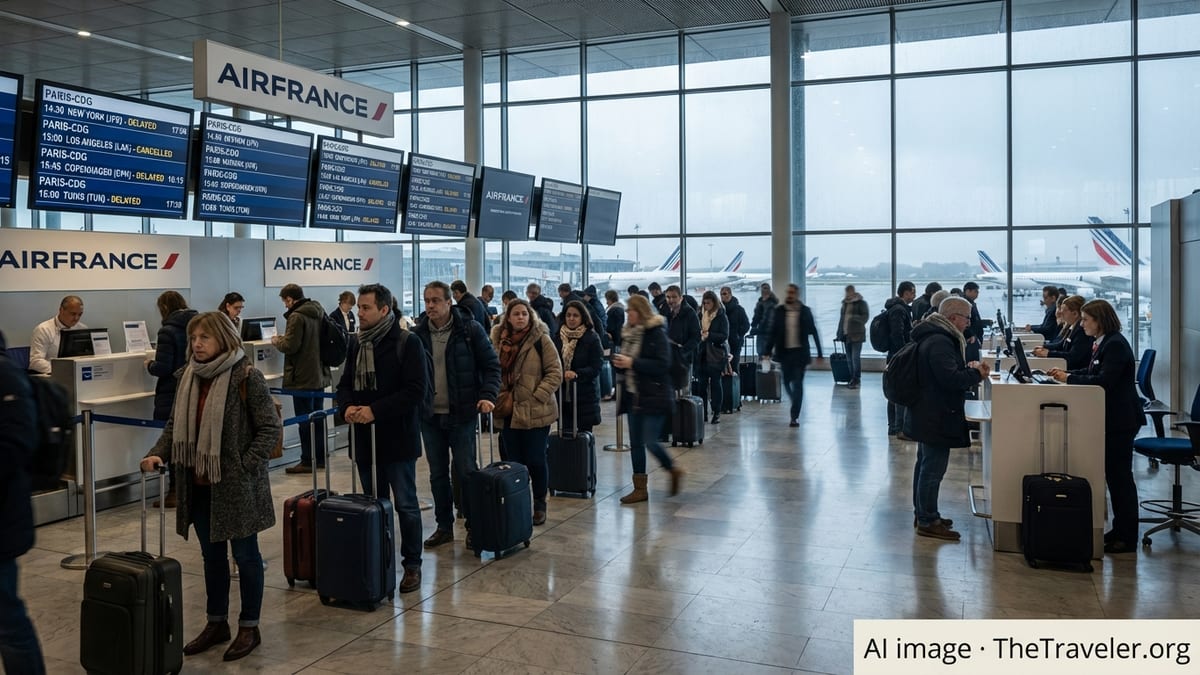
Fresh Disruptions Hit Air France Winter Operations
Air France is confronting renewed operational turbulence as 14 flights were cancelled and at least 7 significantly delayed across its network, according to current airport and flight-tracking data. The latest disruptions are concentrated around its Paris hubs while rippling outward to destinations including New York, Los Angeles, Copenhagen and Tunis, leaving passengers facing overnight stays, missed connections and rebookings deep into the week.
The cancellations, which represent a small but highly visible share of the carrier’s daily schedule, come on top of a broader pattern of winter disruption affecting multiple European airlines. Industry trackers report that France, the United Kingdom, Spain, the Netherlands, Denmark and other countries have all seen elevated levels of delays and cancellations in recent days, compounding the impact for travelers who rely on connecting services through Paris Charles de Gaulle and Orly.
While the precise causes vary by route, aviation sources point to a mix of winter weather, air traffic control constraints and crew-rostering challenges as key drivers. For passengers, the result is the same: crowded terminals, long queues at customer service desks and uncertainty over when they will finally depart.
Routes Linking New York, Los Angeles and Paris Hardest Hit
Long haul routes linking France and the United States remain among the most affected, with services between Paris and New York particularly disrupted. Recent data shows repeated cancellations and delays on transatlantic flights that connect Paris Charles de Gaulle with New York’s John F. Kennedy International Airport, a key business and leisure corridor. Passengers report being held in departure halls for hours as they wait for revised departure times or reassignment to later services.
Los Angeles has also experienced knock-on effects, as delays on eastbound transatlantic flights tighten already busy schedules on the West Coast. Travelers transiting through Paris from the United States to onward destinations in North Africa or Northern Europe are especially vulnerable. A missed overnight departure from New York or Los Angeles can mean a full day lost, as onward flights from Paris to Tunis, Copenhagen or regional French cities often operate only once or twice daily in the winter timetable.
The disruptions are particularly challenging for passengers on tight itineraries, including business travelers, those connecting onward to family events, and tourists at the tail end of their trips. With aircraft operating close to capacity during peak waves at Charles de Gaulle, finding open seats on the same day has become increasingly difficult when multiple flights are cancelled or heavily delayed.
Scandinavian and UK Connections Feel the Strain
Beyond the transatlantic trunk routes, Air France passengers in Scandinavia and the United Kingdom are experiencing mounting frustration as delays in Paris cascade through the airline’s short and medium haul network. Copenhagen, an important northern European spoke, has seen repeated schedule disruptions as aircraft arriving late from France cause subsequent departures to push back, narrowing connection windows in both directions.
Travelers from Sweden and Denmark who rely on Paris as a transfer point for long haul flights to North America and North Africa are particularly exposed. A modest delay on a morning departure to Paris can mean missing a once-daily onward service to a US city or to hubs such as Tunis, forcing rebookings that stretch into the next day. In several recent instances, passengers reported being offered hotel vouchers and meal assistance while waiting for alternative connections.
The United Kingdom, one of Air France’s largest European markets, is also heavily affected when operations in Paris degrade. Flights linking London and regional UK cities to Charles de Gaulle feed a dense web of connecting traffic. When aircraft rotations are disturbed by cancellations or staffing issues, even short UK–France sectors can see extended delays, contributing to crowding at both ends and stranding some passengers mid-journey.
Tunis and North Africa Face Downstream Consequences
Tunisia’s capital, Tunis, remains a crucial link in Air France’s North African network, and any disruption in France can quickly spill over. Flight data in recent days shows irregular operations on routes between Paris and Tunis, with select services cancelled and others operating with substantial delays. For Tunis-bound travelers originating in North America or Northern Europe, disruption at Charles de Gaulle or Orly can mean lengthy unplanned layovers.
Business travelers and members of the large Tunisian diaspora in Europe have shared accounts of crowded boarding gates and sudden gate changes, reflecting the struggle to keep aircraft and crews in the right place amid rolling delays. With some flights already operating at reduced winter frequency, a single cancellation can wipe out all same-day options and force overnight stays in Paris or alternative routings via other hubs.
North African destinations also tend to be more vulnerable when airlines reshuffle aircraft to protect higher-yield transatlantic or intra-European business routes. Aviation analysts note that when irregular operations hit, carriers often prioritize flagship services to cities such as New York over secondary routes, leaving passengers to Tunis, Algiers or Casablanca more likely to endure cancellations or lengthy delays.
Stranded Passengers Confront Long Queues and Patchy Information
For many travelers, the most immediate frustration is not the cancellation itself but the difficulty in getting timely, clear information and rebooking assistance. At Paris Charles de Gaulle, passengers describe long lines at customer service counters as multiple flights are cancelled or delayed around the same departure wave. Similar scenes are playing out, on a smaller scale, at airports including New York JFK, Los Angeles International, Copenhagen and Tunis, where travelers rely on local staff for updates from Paris-based operations control.
Digital tools have helped some passengers get ahead of the crowds. Many Air France customers now rely on the carrier’s mobile app and text alerts to receive disruption notifications, select alternative flights and, in some cases, arrange meal vouchers or hotel accommodation. However, travelers without reliable mobile access or who booked via third-party agents often report being the last to receive updates, exacerbating anxiety and confusion at the gate.
Language barriers and complex itineraries can further complicate matters. Multi-stop journeys involving partner airlines or codeshares require coordination between different reservation systems, which can slow down rebooking. Families traveling with children and elderly passengers are among those most affected by long service queues and last-minute schedule changes.
Why Cancellations Are Spiking Across Europe
The Air France disruptions are unfolding against a wider backdrop of irregular operations across European aviation. In the past weeks, Europe’s major hubs, including Paris, London, Amsterdam and Madrid, have all experienced elevated levels of delays and cancellations. A combination of winter weather, constrained air traffic control capacity and lingering staffing shortages at airlines and airports has made schedules brittle, particularly during peak travel periods.
Data compiled from multiple European airports points to hundreds of daily delays and scores of cancellations across France, the United Kingdom, Spain, Denmark, Norway and other markets on some of the worst days. Low visibility, high winds and de-icing requirements have slowed operations, while tight crew rosters leave airlines with limited flexibility when flights run late or staff call in sick.
Analysts say that while demand for air travel has largely recovered, the underlying operational resilience has not fully caught up. This mismatch means that what might once have been a minor weather event can now trigger widespread knock-on effects, as there are fewer spare aircraft and crews to absorb disruption. For Air France and its passengers, that translates into more frequent rolling delays and occasional clusters of cancellations across key routes.
What Rights Passengers Have When Flights Are Cancelled
For travelers stranded in France or at outstations such as New York, Los Angeles, Copenhagen or Tunis, understanding their rights is crucial. Under European Union air passenger rules, when a flight departing from an EU or UK airport is cancelled or subject to a long delay, airlines must offer the choice of a refund or re-routing at the earliest opportunity. In many cases they must also provide care, including meals, refreshments and, where necessary, hotel accommodation.
Compensation in cash may be due if the cancellation is announced at short notice and is not caused by extraordinary circumstances such as severe weather or air traffic control strikes. The amount varies depending on the distance of the flight, with long haul passengers facing cancellations on routes such as Paris to New York or Los Angeles potentially entitled to higher sums if the disruption is within the airline’s control.
Consumer advocates recommend that passengers keep boarding passes, booking confirmations and any written communication from the airline, as these documents are often required when filing a claim. They also suggest that travelers document out-of-pocket expenses, such as meals and overnight stays, which may be reimbursable under certain conditions.
How Air France and Travelers Are Responding
Air France has been working to stabilize its schedule and re-accommodate disrupted passengers, using a mix of rebookings on its own services and, where possible, seats on partner airlines. The carrier is also directing travelers to online self-service tools, which allow eligible customers to change travel dates, request vouchers or apply for refunds when delays and cancellations meet compensation thresholds.
For travelers currently on the move, experts advise checking flight status frequently, arriving early at the airport in case security lines are longer than usual, and keeping essential items such as medications, chargers and a change of clothes in carry-on bags in case of unexpected overnight stays. Flexible planning and travel insurance that covers delays and missed connections can soften the impact of sudden schedule changes.
With winter still in full swing across Europe and North America, further operational challenges are likely. For now, passengers flying with Air France on routes touching Paris, Tunis, Copenhagen, New York, Los Angeles and other key cities are being urged to monitor their itineraries closely and be prepared for last-minute adjustments as airlines navigate a volatile operating environment.