

More news on this day
France and Japan are drawing fresh attention to their long-running aviation and cultural ties as Air France unveils a new exhibition concept that spotlights the history and future of transpacific air travel, positioning both countries as leading voices in how culture, technology and tourism intersect at 35,000 feet.
Get the latest news straight to your inbox!
Aviation Heritage Reframed as Cultural Diplomacy
The new Air France initiative builds on the airline’s established role as an ambassador of French travel culture, extending that positioning into a focused narrative around transpacific routes that link France, Japan and the wider Asia Pacific region. Publicly available corporate material portrays Air France as closely tied to France’s cultural influence abroad, with decades of investment in art, design and gastronomy woven into its brand identity.
In framing the story of transpacific flight as a cultural encounter rather than just a technical achievement, the exhibition concept reflects a broader shift in how airlines present themselves to travelers. Instead of showcasing only aircraft or route maps, the experience is designed to place emphasis on people, places and design objects that shaped passenger journeys between Europe and Asia, including Japan’s emergence as a premium long-haul destination for French and European travelers.
The project also aligns with growing interest among travelers in the heritage of global aviation, including the era when long-range flights were symbols of postwar optimism and international cooperation. By curating this history through a Franco-Japanese lens, the exhibition positions Air France as a carrier that not only connects continents but also interprets the meaning of those connections.
Industry observers note that cultural storytelling of this kind can strengthen a flag carrier’s role in national soft power, especially at a time when tourism, creative industries and transport policy are increasingly discussed together in government strategies.
France and Japan Deepen Cultural and Tourism Links
The emphasis on transpacific travel arrives as France and Japan continue to foreground culture in their bilateral relationship, with tourism, gastronomy and design frequently highlighted as shared strengths. Reports on France’s tourism promotion strategies describe Air France as a key partner in amplifying the country’s cultural image abroad, including in major Asian markets.
Japan, for its part, has spent the past decade consolidating its reputation as a high-value long-haul destination for European visitors, investing in regional airports, cultural events and inbound promotion that appeal strongly to French travelers. Major Japanese culture showcases in Paris and other French cities have helped familiarize local audiences with Japanese contemporary art, fashion and pop culture, adding momentum to the aviation links that carry visitors in both directions.
Within this context, an exhibition that highlights the shared story of air travel helps bring coherence to a complex set of relationships spanning national tourism boards, cultural institutions and airlines. It signals that France and Japan see aviation not only as infrastructure but also as an expressive medium through which national identities and mutual curiosity are projected.
Analysts of cultural diplomacy suggest that such projects can be particularly significant during periods of global uncertainty for travel, providing a narrative of continuity and shared values even as routes and demand patterns evolve.
Inside the Exhibition: From Golden Age Cabins to Low-Carbon Futures
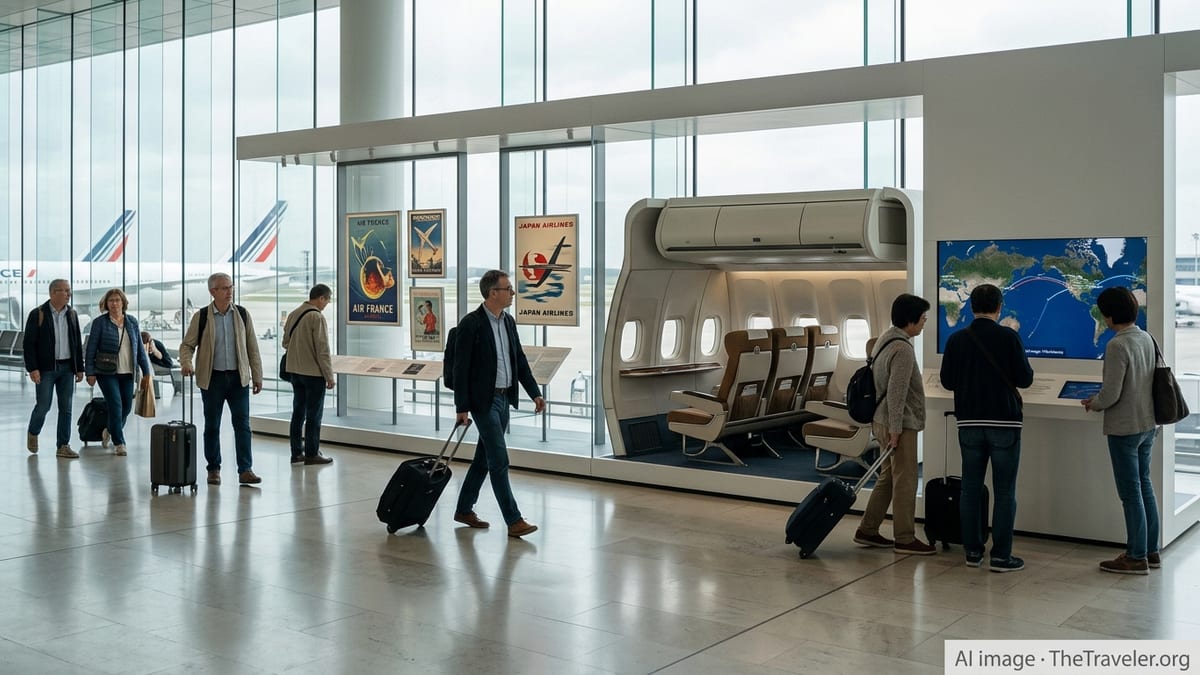
The Air France exhibition concept, as outlined in recent corporate communication on experiential brand spaces, draws on the company’s experience designing immersive environments in partnership with prominent French cultural venues. The new transpacific-focused installation is described as open to a broad public, blending archival material with interactive elements that look ahead to the next generation of long-haul travel.
Historical sections are expected to explore the evolution of cabin design, uniforms and inflight service that defined the golden age of long-haul flying between Europe, North America and Asia. Vintage posters, tableware and cabin mock-ups illustrate how both French and Japanese aesthetics have influenced the look and feel of onboard hospitality, from culinary partnerships to typography and cabin lighting.
Forward-looking zones address how transpacific air travel is being reshaped by new aircraft technology, fuel efficiency goals and changing passenger expectations. Industry documents highlight Air France’s investments in newer long-haul fleets and sustainability programs, themes that are mirrored in the exhibition through visualizations of reduced-emission aircraft, reimagined cabin layouts and digital services aimed at making lengthy ocean crossings more comfortable.
By setting these historical and futuristic elements side by side, the exhibition encourages visitors to see transpacific routes as a living narrative. Japan and France, positioned at opposite ends of many of these journeys, stand in as reference points for how design, climate responsibility and cultural experience might converge in the coming decades.
Showcasing Airports and Cities as Cultural Gateways
Beyond the airline itself, the project highlights the role of airports and surrounding cities as cultural gateways that frame any transpacific journey. Paris Charles de Gaulle and major Japanese hubs such as Tokyo’s international airports have invested in art installations, retail design and culinary offerings intended to give travelers a first or final taste of national culture during their transfer or arrival.
Travel sector reports often describe these hubs as “aerotropolis” environments in which aviation, hospitality and cultural amenities are tightly interwoven. The Air France exhibition taps into that idea by portraying terminals not only as transit zones but as curated spaces where French and Japanese influences can be experienced in compressed form, from patisserie counters and sake bars to museum-quality displays in concourses.
For destination marketing organizations in both countries, this kind of storytelling reinforces the message that the journey itself is part of the cultural experience. With visitors increasingly attentive to every stage of their trip, from check-in to arrival hall, the ability of France and Japan to coordinate narratives across airlines, airports and city attractions is becoming a competitive advantage.
Observers in the aviation and tourism sectors suggest that elevating airports and routes into cultural symbols can also help sustain traveler interest during demand fluctuations, keeping the idea of a future transpacific trip vivid even when immediate booking conditions are uncertain.
Implications for Future Transpacific Travel Trends
The unveiling of an exhibition focused specifically on the transpacific axis underscores how crucial these routes remain for both France and Japan, even as global travel patterns continue to shift. Network planning updates from major carriers point to ongoing efforts to balance North American, Asian and Pacific traffic flows, with Japan frequently serving as a strategic hub for European travelers heading deeper into Asia or across the Pacific.
By framing these long-haul links as cultural bridges, Air France and its partners may be seeking to differentiate full-service, legacy carriers from lower-cost or purely point-to-point competitors. The exhibition signals an expectation that demand for enriched, story-driven travel experiences will grow, particularly among leisure and premium passengers who view the flight as an integral part of their journey rather than a mere transfer.
For policymakers and tourism bodies in both countries, the initiative also provides a visible platform to emphasize cooperation on sustainable aviation, visitor dispersal beyond major cities and support for creative industries that benefit from easier transpacific access. The narrative of shared heritage and future-oriented innovation is likely to feature prominently in upcoming cultural seasons and bilateral tourism campaigns.
As travelers resume and reimagine long-distance trips across the Pacific, the Air France exhibition offers a curated lens on the past and possible futures of these journeys, casting Japan and France as co-authors of an evolving story of cultural diplomacy at altitude.