

More news on this day
Air France will suspend its Paris–Havana flights from late March to mid-June, citing a worsening jet fuel shortage in Cuba that threatens to derail the island’s fragile tourism recovery.
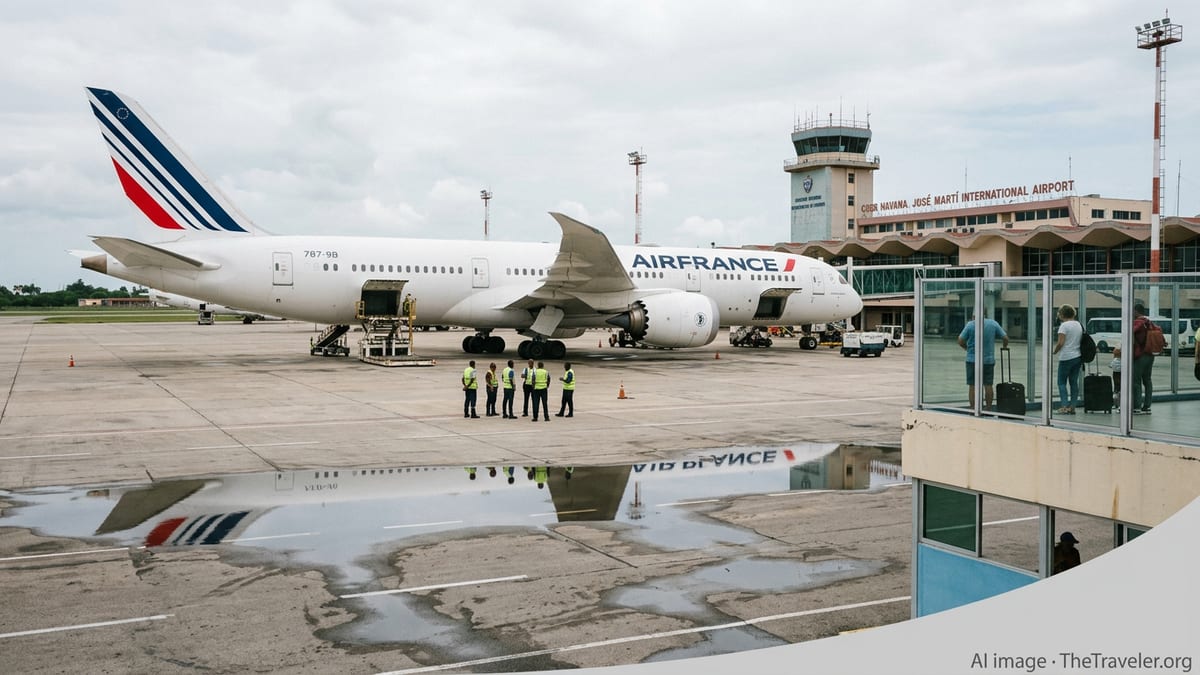
Air France Pulls Back as Cuba’s Fuel Squeeze Deepens
The French flag carrier confirmed that services between Paris-Charles de Gaulle and Havana will be halted from March 28 or 29, with a provisional restart set for June 15, depending on whether fuel supplies stabilize. The route, typically operated three times a week with high-capacity Boeing 787 aircraft, is one of Europe’s key direct links to Cuba.
Until now, Air France had tried to keep the connection alive by adding a technical stop in the Bahamas on westbound legs so aircraft could refuel outside Cuba. But with Cuban authorities extending their notice of jet fuel shortages across major airports at least into April, the airline has decided that a full pause is unavoidable.
In a statement to news agencies, Air France said the decision was driven by the lack of fuel on the island and its knock-on effects on economic and tourism activity. The company emphasized that the suspension is temporary and framed it as a safety and reliability measure rather than a permanent withdrawal from the Cuban market.
Customers booked on the affected flights are being contacted individually by email, text message, and through the airline’s app. They are being offered the option to rebook for later dates, accept a travel voucher, or request a full refund without penalties, according to Air France and industry reports.
Cuba’s Jet Fuel Shortage Hits Critical Stage
The suspension follows a stark warning from Cuban aviation authorities in early February that jet fuel would not be available at nine airports across the island, including Havana’s José Martí International Airport, for at least a month. That advisory has since been extended, confirming that the crisis is more than a short-term disruption.
Cuba’s fuel problems are rooted in a broader energy crunch that has led to rolling blackouts, long queues at service stations, and repeated calls from the government for citizens to conserve electricity. The situation has been exacerbated by the abrupt halt of shipments from Venezuela, historically Havana’s main oil supplier, following new pressure and sanctions linked to political turmoil in Caracas.
Even before Air France’s move, carriers serving Cuba had been forced to improvise, adding refueling stops in third countries or cutting frequencies. Industry data suggest that hundreds of weekly flights to the island have been affected in recent weeks, with some airlines opting to suspend services entirely as the cost and complexity of rerouting climbed.
For Cuba, the aviation fuel shortage is more than a technical issue. It is another manifestation of a deepening economic crisis marked by chronic foreign currency shortages, dwindling imports, and mounting difficulties in maintaining essential infrastructure. The strain on air connectivity now sits alongside power cuts and fuel rationing as visible signs of the country’s mounting instability.
Tourism Lifeline Under Strain
The timing of Air France’s suspension is particularly painful for Cuba’s tourism sector, which has struggled to regain its footing after the pandemic. Visitor numbers remain significantly below pre-2019 levels, and the island has been banking on European and Canadian travelers to fill the gap left by sharply reduced U.S. tourism.
The Paris–Havana route has long been a vital corridor for both leisure travelers and the Cuban diaspora in Europe. For many Cubans, especially those unable to transit through the United States due to visa and geopolitical constraints, flights from European hubs such as Paris offer one of the few viable gateways to the wider world.
Over the past several weeks, Canadian and European airlines have also pared back or suspended services to Cuban destinations as the fuel crisis has intensified. Taken together, the cuts amount to a significant reduction in inbound capacity at the very moment the government had hoped to accelerate a long-awaited tourism rebound.
Tour operators report growing uncertainty among travelers, who face last-minute schedule changes, unexpected refueling stops, or outright cancellations. Industry analysts warn that perceptions of Cuba as an unpredictable destination could linger long after fuel supplies are restored, undermining marketing campaigns aimed at reassuring visitors and investors.
Travelers Scramble for Alternatives
With Air France stepping back for several weeks, travelers booked on the Paris–Havana route are weighing their options. Some are rebooking for later in the summer in the hope that conditions improve, while others are diverting to destinations in Mexico or the Dominican Republic that offer more stable air links and fewer operational uncertainties.
For European visitors determined to reach Cuba, alternative routings now often involve connections through other Latin American hubs or multi-leg itineraries stitched together on different carriers. This tends to increase travel time and cost, a deterrent for budget-conscious holidaymakers already contending with higher airfares and inflation in key source markets.
Travel agencies in France and across Europe say they are fielding a spike in calls from confused customers seeking clarity on whether upcoming trips will go ahead. Many are advising clients to consider flexible tickets, comprehensive travel insurance, and contingency plans if they choose to keep Cuba in their plans for the coming months.
Meanwhile, Cubans living in Europe face the prospect of postponed family visits or complicated rerouting through third countries. For this group, the suspension is less about vacations and more about maintaining personal ties, adding a human dimension to what can otherwise appear as a purely commercial airline decision.
Wider Economic and Political Reverberations
Air France’s move underscores how closely Cuba’s aviation links are intertwined with broader geopolitical dynamics. The country’s dependence on Venezuelan oil, combined with long-standing United States sanctions, has left it acutely vulnerable to external shocks in energy supply. The current fuel crunch and resulting air service disruptions are a direct reflection of those pressures.
Economists note that tourism is one of the few sectors where Cuba can earn hard currency relatively quickly, making reliable air access critical for hotels, private guesthouses, restaurants, and small businesses that serve visitors. Every canceled flight ripples through local economies, from taxi drivers and tour guides to artisans and street vendors.
The suspension also sends an uncomfortable signal to potential investors and travel partners who watch air connectivity as a barometer of a destination’s stability and openness to business. Repeated interruptions risk reinforcing a perception of Cuba as high risk, something the government has been trying to counter through new investment laws and incentives aimed at the tourism industry.
For now, officials and airline executives alike are framing the suspension as temporary. But if fuel shortages persist or intensify, more carriers could follow Air France’s lead or delay planned expansions into the Cuban market. That prospect looms large over an island that has long relied on tourism as a rare bright spot in an otherwise beleaguered economy.