

More news on this day
Air France has joined a growing chorus of major European airlines, including Lufthansa, KLM, Ryanair, easyJet, British Airways and SAS, urging the European Union to adjust its ambitious sustainable aviation fuel timeline, warning that high costs and constrained supply could drive up fares, strain connectivity and undermine the competitiveness of the region’s carriers.
Get the latest news straight to your inbox!
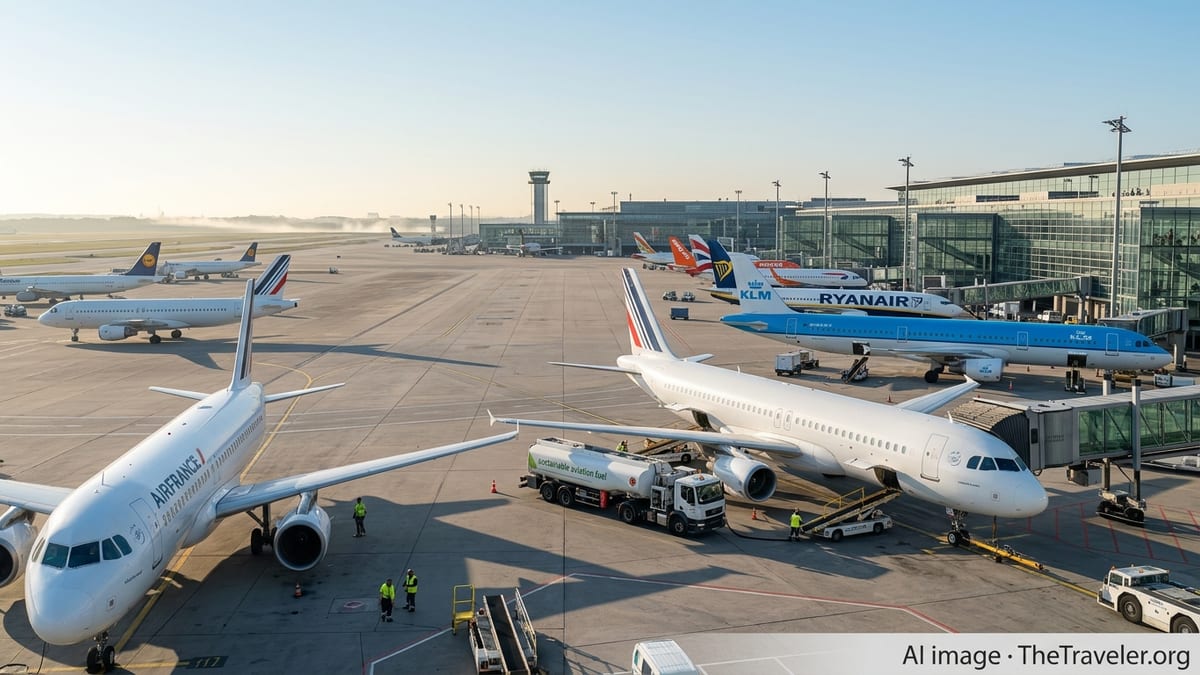
Airlines Close Ranks Against Accelerating EU Fuel Mandates
Air France, through its Air France–KLM group, has moved into alignment with other leading European carriers calling for a more gradual rollout of the European Union’s sustainable aviation fuel requirements. Industry associations representing airlines such as Lufthansa Group, Ryanair, easyJet, British Airways owner IAG, SAS, TAP and others have argued in recent weeks that the pace of mandated green fuel blending is outstripping what the market can currently deliver.
The concerns center on the ReFuelEU Aviation regulation, which from 2025 obliges fuel suppliers at EU airports to ensure a minimum 2 percent share of sustainable aviation fuel in jet fuel, with the target rising to 6 percent in 2030 and continuing upward toward 70 percent by 2050. Airlines maintain that while the objectives are in line with long-term climate goals, the near- and medium‑term milestones risk becoming punitive if supply bottlenecks and price gaps are not addressed.
Recent commentary from airline groups has emphasized that Europe’s aviation sector faces more demanding climate rules on intra‑European routes than many non‑EU competitors, raising fears that carriers based in the bloc could lose market share on long‑haul and connecting traffic. Publicly available industry statements frame the current debate not as opposition to decarbonization, but as a dispute over timing, cost allocation and the supporting policy framework.
For travelers, the coordinated lobbying signals that environmental surcharges and higher base fares may increasingly be justified as a direct consequence of green fuel mandates, even as the companies involved promote sustainability as a core part of their brands.
High SAF Prices, Limited Production Define the Market
At the heart of airline unease is the cost and availability of sustainable aviation fuel, which remains a small fraction of global jet fuel supply. Industry analyses cited in recent coverage suggest that SAF use by European airlines is still in the low single digits as a share of fuel consumption, with leading groups such as IAG and Air France–KLM only beginning to scale up procurement through long‑term contracts.
SAF typically costs several times more than conventional kerosene, reflecting the expense of current feedstocks, processing technologies and the still‑nascent production base. Airlines argue that meeting mandated blend levels will therefore add billions of euros in cumulative cost over the coming decade, with little short‑term flexibility to reduce fuel burn or switch to alternative zero‑emission propulsion on most routes.
Published data on national markets underline the scale of the challenge. In Spain, for example, estimated sustainable aviation fuel consumption was reported at around 120,000 tonnes in 2025, a volume that was broadly available in the market. However, to meet a 6 percent EU blending requirement by 2030, Spain alone would require several times that amount, including a dedicated quota of synthetic SAF derived from green hydrogen and captured carbon.
Airlines insist that without rapid expansion of refineries, generous investment incentives and safeguards to prevent feedstock competition with other sectors, SAF prices will remain elevated and availability patchy. This, they say, leaves them paying higher compliance costs than foreign rivals serving European destinations from hubs outside the bloc.
Air France–KLM’s Balancing Act Between Support and Skepticism
Air France–KLM has publicly endorsed the principle of the ReFuelEU Aviation framework and has set out plans to secure up to several million tonnes of SAF through long‑term agreements stretching into the 2030s. Company strategy documents highlight sustainable fuel as a central plank of its environmental transition, alongside fleet renewal and operational efficiency measures.
At the same time, recent position papers and policy briefings from the group urge the European Union to adopt additional measures to reduce the cost of SAF and to put in place tracking systems that make it easier to verify and credit usage. The company’s Brussels‑focused submissions call, in particular, for tools that would allow SAF produced or supplied in one location to be counted toward compliance at another, so long as sustainability criteria are met.
Air France’s decision to rally behind a broader airline bloc pressing for adjustments to the SAF timetable reflects this dual approach. The carrier is investing in contracts and pilot projects to secure supply while also signaling that the current regulatory trajectory could become economically unsustainable if market realities do not shift. This mirrors the stance of Lufthansa, IAG and other large groups that have warned publicly of fare increases and possible route reductions as environmental costs rise.
For hubs such as Paris Charles de Gaulle and Amsterdam Schiphol, where Air France–KLM concentrates a significant share of its traffic, the balance between maintaining connectivity and meeting increasingly stringent fuel rules will shape future network decisions and the mix of long‑haul and short‑haul services.
Low‑Cost and Legacy Carriers Present a United Front
One notable feature of the current pushback is the rare alignment of low‑cost airlines and traditional network carriers. Ryanair, easyJet and other budget operators have joined Lufthansa Group, Air France–KLM, British Airways owner IAG, SAS and TAP within leading airline associations that are pressing Brussels to re‑examine the pace and design of green aviation fuel obligations.
Industry commentary indicates that these carriers collectively transport around 800 million passengers annually across Europe, giving them significant leverage in debates over regulation and taxation. Their common message is that a mismatch between policy ambition and industrial capacity could force airlines to raise fares, slow growth plans and, in a worst‑case scenario, prompt consolidation if weaker operators struggle to absorb higher fuel bills.
While some low‑cost airlines have made only minimal use of SAF so far, they have announced ambitious 2030 targets on paper. Legacy groups, by contrast, often point to more substantial early procurement but smaller cost buffers. Both models ultimately face the same arithmetic: if SAF remains several times more expensive than fossil fuel and is mandated in large volumes, the economics of short‑haul point‑to‑point flying and long‑haul network operations alike come under strain.
This emerging united front places additional pressure on EU policymakers, who must weigh the risk of carbon leakage and lost connectivity against the need to bring aviation into line with the bloc’s broader climate law and renewable energy targets.
Climate Advocates Warn Against Weakening EU Ambition
Environmental organizations and climate researchers argue that the latest airline campaign to delay or soften green fuel mandates fits a wider pattern of resistance to robust aviation climate policy in Europe. Reports from groups such as Greenpeace and InfluenceMap have previously highlighted extensive airline lobbying against measures ranging from emissions trading reforms to flight caps at major hubs.
These analyses contend that airlines frequently endorse long‑term climate neutrality targets in principle while seeking to dilute the concrete instruments needed to deliver them, including kerosene taxation, tighter emissions pricing and binding SAF sub‑targets. Advocacy groups caution that relaxing the ReFuelEU timeline could lock in higher emissions for decades and slow investment in next‑generation fuels and technologies.
Researchers also warn that placing too much emphasis on sustainable aviation fuel risks obscuring the need to manage demand for flying, especially on short‑haul routes where rail alternatives exist. Studies cited in public debates suggest that even with optimistic SAF deployment, aviation would still rely heavily on fossil kerosene by 2040 without additional measures.
As Air France and its peers intensify their calls for cost relief and timetable changes, the political test for the European Union will be whether it can preserve the credibility of its climate goals while responding to mounting pressure from one of the bloc’s most visible and strategically important industries.