

More news on this day
Air France-KLM is preparing to phase out its 59 Boeing 777-300ER aircraft sooner than originally planned, a pivotal fleet move that underscores how France and the Netherlands are accelerating their shift toward cleaner, more efficient long-haul aviation.
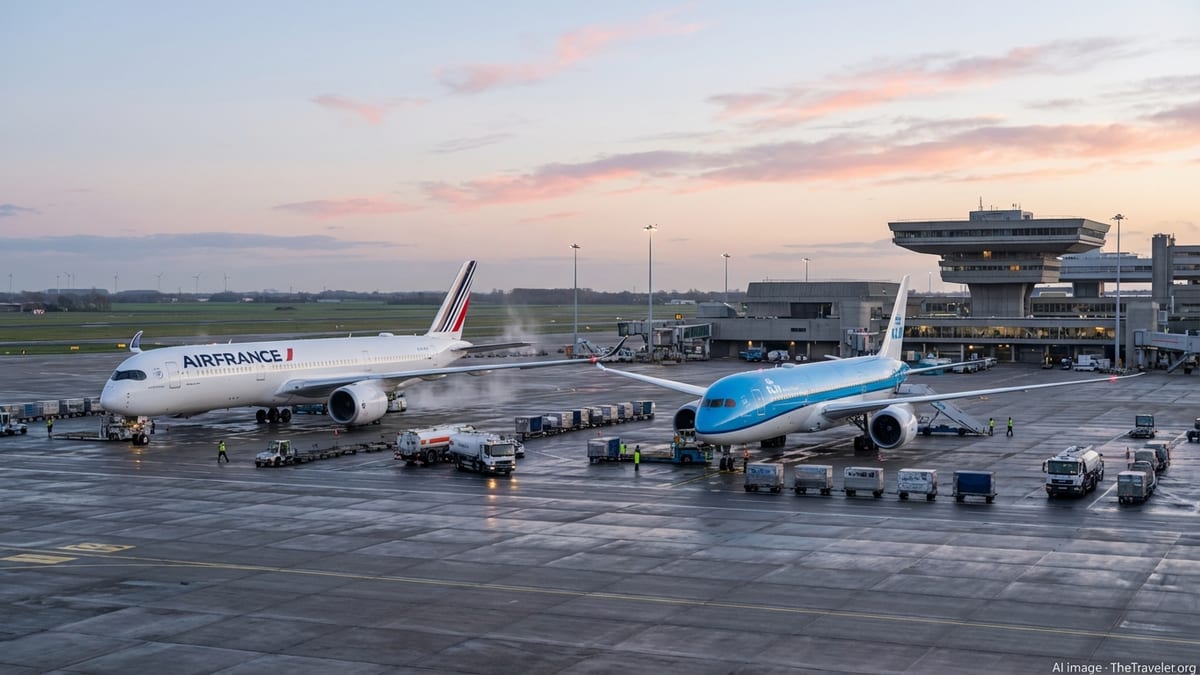
Accelerated Fleet Strategy Signals New Long-Haul Era
Group chief executive Ben Smith signalled during the airline’s 2025 results briefing that Air France-KLM aims to move “sooner rather than later” on replacing its Boeing 777-300ERs, a clear indication that the flagship twinjets will exit the fleet earlier than once anticipated. The decision reflects the pressure on European carriers to cut emissions and operating costs while preserving the global reach of their long-haul networks from Paris Charles de Gaulle and Amsterdam Schiphol.
The group currently operates 59 Boeing 777-300ERs, with 43 flying under the Air France banner and 16 at KLM. Many of these aircraft were delivered in the mid-2000s, placing them squarely into mid to late life by industry standards. As next-generation widebodies arrive, the 777-300ERs, once the backbone of flagship routes linking Europe with North America, Asia and Africa, are increasingly out of step with the airline’s environmental and cost ambitions.
Air France-KLM has already embarked on what it calls a group-wide fleet transformation, but the fresh urgency around the 777-300ERs indicates a more aggressive timeline. Airframes that once might have expected to serve into the early to mid-2030s could now face retirement or redeployment significantly earlier, depending on how quickly replacement capacity can be secured from Airbus or Boeing.
This pivot comes as the group posts record financial results, providing rare headroom to make long-term fleet choices. With operating profit for 2025 reaching around 2 billion euros and revenues above 33 billion euros, executives are positioning accelerated fleet renewal as both a strategic and financial opportunity rather than a costly defensive measure in a downturn.
Airbus A350 and Boeing 777-9 in the Frame
In outlining the group’s options, Smith singled out two primary candidates to succeed the Boeing 777-300ER: the Airbus A350-1000 and Boeing’s still uncertified 777-9. Air France-KLM is already deeply invested in the Airbus A350 family, with a major order placed in 2023 covering A350-900 and A350-1000 aircraft to replace older Airbus A330s and Boeing 777-200ERs. That existing commitment, coupled with operational familiarity at Air France, gives Airbus a clear advantage.
The A350-1000 offers a similar seating capacity to many of Air France’s higher-density 777-300ER layouts, but with a meaningful cut in fuel burn and emissions per seat. Its composite airframe and modern engines also promise lower maintenance requirements. For an airline group publicly tying its strategy to sustainability and next-generation fleets, extending the A350 footprint would simplify operations and accelerate the transition toward its 2030 emissions goals.
Boeing’s 777-9, meanwhile, would provide even greater capacity and a familiar family lineage for crews and maintenance teams accustomed to the 777 platform. Yet the ongoing delays in certification and entry into service complicate planning for any carrier that wants certainty over delivery schedules in the second half of the decade. For Air France-KLM, which is targeting around 80 percent of its fleet to be next generation by 2030, timing may matter as much as performance.
Industry analysts note that engine commonality, training costs and residual values will all weigh heavily on the final choice. Air France-KLM has grown its Boeing 787-9 and 787-10 fleets in parallel with the A350, giving it flexibility but also creating a complex long-haul portfolio. Any 777-300ER replacement decision will therefore be bound up with a longer-term question of whether to tilt the group more firmly toward Airbus or to maintain a finely balanced dual-supplier approach.
Financial Strength Underpins Ambitious Renewal
The accelerated 777-300ER exit comes against a backdrop of strong financial momentum. In 2025 Air France-KLM delivered a record operating result of roughly 2 billion euros on revenues a little above 33 billion euros, with operating margin improving to just over 6 percent. The group highlighted robust demand for premium cabins and careful cost control, even as it absorbed higher airport charges, particularly at Amsterdam Schiphol.
Premiumization has become central to the group’s business model, with La Première, business class and premium economy now accounting for more than a third of passenger revenues. This revenue mix reinforces the case for investing in new-generation widebodies that can support high-yield cabin products, reliable schedules and quieter, more comfortable cabins on long-haul routes.
Fleet renewal is already driving a significant portion of Air France-KLM’s capital spending. New and modified lease obligations tied to aircraft deliveries pushed net debt higher in 2025, but the leverage ratio remains within the group’s target range. Management has reiterated guidance for around 3 billion euros of net capital expenditure in 2026, largely directed toward aircraft and related infrastructure, confirming that the group has room on its balance sheet for a large 777-300ER replacement order.
Executives emphasise that each next-generation aircraft typically reduces fuel consumption by 20 to 25 percent per passenger kilometre compared with the models they replace. With jet fuel still one of the airline’s largest expenses and sustainable aviation fuel adding cost pressure, the economics of early retirement for older widebodies are becoming increasingly compelling, even before factoring in carbon pricing and environmental regulation.
Environmental Pressures Drive France–Netherlands Aviation Shift
Beyond pure economics, environmental policy in France and the Netherlands is accelerating the transition away from older long-haul aircraft. Both governments have been vocal about curbing aviation emissions, with measures ranging from new ticket taxes and domestic flight restrictions in France to capacity caps and noise constraints under discussion at Amsterdam Schiphol. For Air France-KLM, flying quieter, more efficient aircraft is no longer just a competitive edge, it is a licence to operate in its home markets.
Air France-KLM reports that by the end of 2025, 35 percent of its fleet consisted of new-generation aircraft, up eight percentage points from the year before. The group is targeting around 80 percent next-generation aircraft by 2030, a goal that will be difficult to reach without accelerating the withdrawal of the 777-300ER, one of the most numerous and emissions-intensive types still flying in its long-haul operation.
Sustainable aviation fuel has also become a central pillar of the group’s transition plan. In 2025, Air France-KLM incorporated nearly 3 percent SAF across its network, comfortably ahead of European legal mandates. The airline has signalled its ambition to exceed the European Union’s 6 percent SAF requirement for 2030, aiming instead for up to 10 percent. Modern widebodies such as the A350 and 787 are certified for higher blend ratios, making them better suited to support this strategy than earlier-generation aircraft.
The environmental impact is particularly acute at major hubs like Paris Charles de Gaulle and Amsterdam Schiphol, where communities and regulators are increasingly sensitive to aircraft noise and local air quality. New-generation widebodies can reduce the noise footprint by more than half compared with older jets, a substantial benefit as authorities weigh future operating restrictions. Retiring the 777-300ERs earlier than planned is therefore as much about protecting future growth at these hubs as it is about lowering the group’s carbon footprint.
Operational Impacts on Key Long-Haul Markets
The 777-300ER has long been the workhorse of Air France’s most popular leisure and high-density routes, particularly to the Caribbean, Indian Ocean, Latin America and key destinations in Asia. Some of these aircraft are configured with more than 470 seats, giving the airline unmatched unit cost advantages where demand is strong and relatively seasonal. Replacing them will require careful capacity and network planning to avoid squeezing profitable markets or diluting the customer experience.
On trunk routes where demand is consistently high, larger A350 variants or, potentially, the Boeing 777-9 could preserve seat counts while offering a more modern onboard product. On thinner or more volatile markets, a move to slightly smaller but more efficient aircraft may prove optimal, allowing Air France and KLM to maintain frequencies while adjusting capacity more finely to demand.
KLM, whose 16 Boeing 777-300ERs support a broad intercontinental network from Amsterdam, faces additional constraints due to Dutch political debates over Schiphol’s environmental footprint. Deploying quieter, lower-emissions aircraft into the slots it already controls is one way to defend connectivity for the Netherlands while responding to government and community pressure. A faster retirement of the 777-300ERs could therefore become a focal point in discussions about the future scale and shape of Schiphol’s long-haul operations.
Passengers are likely to see an acceleration in cabin upgrades as newer aircraft replace older ones on flagship routes. Air France has invested heavily in new business-class seats with sliding doors and refreshed premium economy cabins on its A350s and refitted 777-300ERs. As more A350s and 787s enter service, a greater share of long-haul flights from France and the Netherlands will offer the group’s latest premium products, a key selling point in fiercely contested corporate and high-end leisure segments.
France and the Netherlands Rebalance Their Aviation Roles
The 777-300ER decision is also part of a wider strategic rebalancing between Air France’s Paris hub and KLM’s Amsterdam operations. While both carriers are under the same corporate umbrella, they face different political, regulatory and market dynamics, and fleet choices can subtly shift the centre of gravity within the group. More efficient new-generation widebodies arriving at one hub sooner than another can influence where new routes are launched or frequencies added.
France has moved aggressively to promote rail over short-haul air travel, including restrictions on some domestic flights where high-speed rail offers competitive journey times. That policy nudges Air France toward concentrating more on intercontinental and medium-haul connections via Charles de Gaulle. Deploying a renewed long-haul fleet out of Paris supports this repositioning and reinforces France’s role as a premium gateway for global travellers.
In the Netherlands, by contrast, the debate has focused on overall airport capacity and noise at Schiphol. Any constraints on the number of annual movements make it imperative that each slot is used as efficiently as possible in economic and environmental terms. Replacing older widebodies like the 777-300ER with newer jets that carry similar numbers of passengers but produce fewer emissions per flight helps KLM defend its slot portfolio and the Netherlands’ status as a global connecting hub.
As Air France-KLM fine-tunes its fleet plan, observers will watch for clues about whether more new-generation aircraft are allocated to Paris or Amsterdam, and how quickly 777-300ER retirements proceed at each carrier. The answers will shape not only the group’s internal balance but also the wider landscape of long-haul connectivity in Western Europe.
Capacity Constraints and the Global Orderbook Challenge
One of the practical hurdles to rapidly replacing 59 widebody aircraft is the crowded global orderbook at both Airbus and Boeing. With airlines worldwide racing to renew fleets or expand for growth, delivery slots for large twinjets are scarce deep into the decade. Smith acknowledged this reality in his comments, noting that Air France-KLM must move quickly if it wants to secure production positions that align with its 2030 sustainability and fleet targets.
The group’s existing orders for A350s and 787s provide a partial solution, but a comprehensive 777-300ER replacement will almost certainly require a new, large-scale commitment. That, in turn, demands a detailed assessment of when aircraft can realistically be delivered and how they will be phased in without disrupting existing operations. The timing of Boeing’s 777-9 certification will be crucial if the type is to remain a live contender.
Leasing markets could offer interim flexibility, particularly for carriers prepared to accept used new-generation aircraft coming off other airlines’ books. Yet the unique cabin configurations and brand requirements of Air France and KLM make off-the-shelf solutions less attractive for core long-haul routes. Tailored new-build aircraft that integrate the group’s latest cabin concepts, in-flight entertainment and connectivity standards are likely to remain the priority.
Analysts expect Air France-KLM to announce a decision on the direction of its 777-300ER replacement strategy within the next couple of years, in line with guidance for capital expenditure and sustainability milestones. Once orders are placed, the group will still face the logistical challenge of managing parallel fleets during the transition, training crews on new types and redeploying or offloading older aircraft in a buoyant but selective secondary market.
What Passengers and the Wider Industry Should Expect
For travellers, the most visible outcome of an accelerated 777-300ER retirement will be a growing prevalence of newer aircraft on long-haul flights to and from France and the Netherlands. More routes will see the Airbus A350 and Boeing 787 as standard, bringing quieter cabins, improved air quality, upgraded seating and modern in-flight technology. The shift should enhance the overall perception of Air France-KLM as a premium, sustainability-focused group.
Airports in both countries can expect gradual reductions in noise and emissions per movement as the new-generation fleet share climbs, which may ease community tensions and create a more favourable environment for future development. Regulators, meanwhile, will look closely at whether accelerated fleet renewal translates into measurable progress toward national climate targets, given that aviation remains a politically sensitive contributor to greenhouse gas emissions.
For the broader industry, Air France-KLM’s move adds momentum to a wider trend among network carriers to pull forward the retirement of older widebodies. As more airlines commit to early exits for types like the 777-300ER, demand for next-generation aircraft will stay intense, potentially reinforcing backlogs and putting further pressure on manufacturers to ramp up production while preserving quality and safety.
Ultimately, the decision to replace 59 Boeing 777-300ER jets earlier than anticipated cements Air France-KLM’s role as a bellwether in European long-haul aviation. How the group navigates the interplay of environmental policy, industrial constraints and commercial opportunity will help define the next chapter for air travel between Europe and the rest of the world, with France and the Netherlands at its centre.