

More news on this day
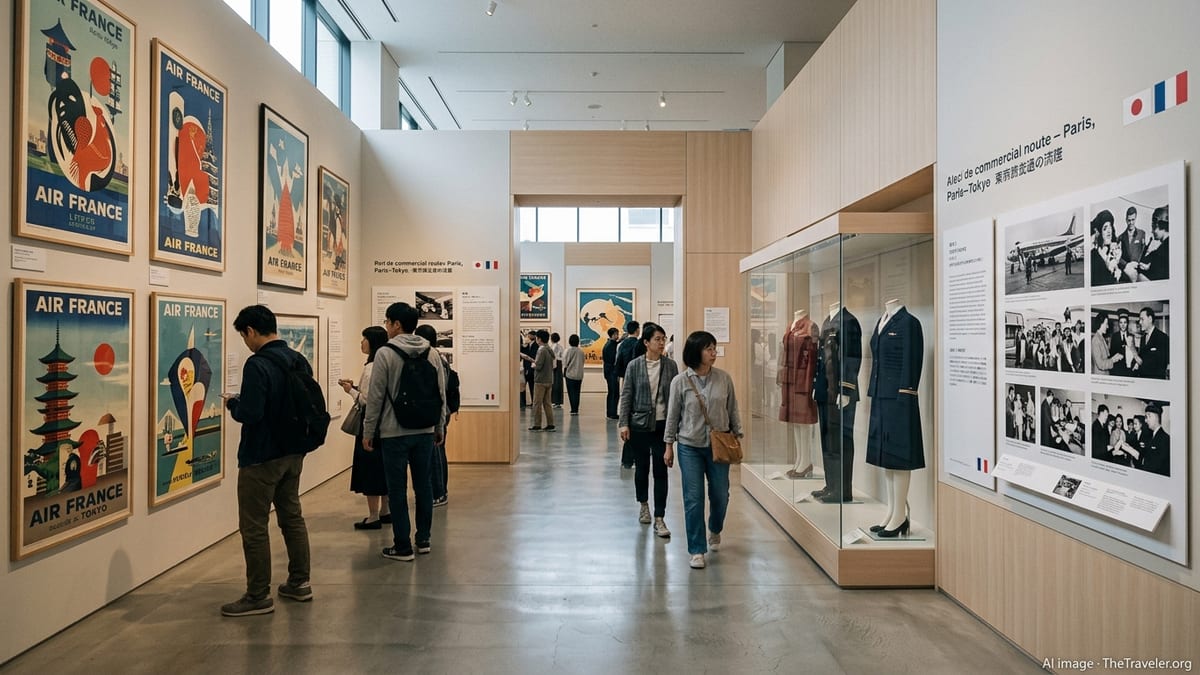
Air France has opened a major exhibition in Tokyo that traces nearly a century of its aviation heritage while highlighting long-standing links between France and Japan, positioning the show as both a cultural encounter and a showcase of global air travel history.
Get the latest news straight to your inbox!
Showcasing a Global Airline’s Legacy in Japan’s Capital
The new exhibition in Tokyo presents a curated journey through Air France’s evolution from early intercontinental routes to today’s long-haul networks that connect Paris with Japanese cities. Publicly available information on the airline’s heritage initiatives indicates that recent traveling shows have focused on design, innovation, and the aesthetics of French hospitality, themes that are also emphasized in the Tokyo project.
In line with earlier heritage exhibitions associated with Air France, the Tokyo show brings together archival photographs, historic route maps, vintage advertising posters, and cabin objects that chart how international air travel has changed over time. The material uses the airline’s brand history as a lens on broader developments in commercial aviation, including technological progress and the globalization of tourism.
The exhibition also reflects the broader trend of airlines using cultural programming to reinforce their identities in overseas markets. In Tokyo, organizers are presenting the airline not only as a transport provider, but as a long-term actor in Franco-Japanese exchange, underlining how scheduled flights helped support business, tourism, and cultural ties from the mid twentieth century onward.
Reports on similar events suggest that such showcases are typically designed for a wide audience, from aviation enthusiasts to casual visitors. In Tokyo, the layout and interpretive texts appear to balance technical content, such as aircraft evolution, with lifestyle-focused themes including in-flight dining, fashion, and design.
Aviation History Told Through Design, Objects, and Archives
The centerpiece of the Tokyo exhibition is a series of thematic zones that track different eras in aviation. Each section combines original objects with reproductions from company archives to illustrate how long-haul flying has shifted from pioneering adventure to an everyday form of global mobility. Attention is given to the role of aircraft like long-range jets that made frequent travel between Europe and Asia increasingly accessible.
Cabin design and onboard service receive particular focus, echoing earlier exhibitions in Europe and Africa that drew attention to uniforms, tableware, and graphic design. In Tokyo, original cabin elements such as seats, service items, and amenity kits are presented alongside design sketches and photographs, highlighting how ideas of comfort and “French art de vivre” have been adapted for international travelers, including those from Japan.
Vintage posters and advertising artwork, some featuring stylized depictions of Mount Fuji, cherry blossoms, and Japanese cityscapes, underscore how the airline has represented Japan to French and European audiences over the decades. At the same time, the exhibition notes how imagery of Paris, the Riviera, and French landmarks has shaped Japanese perceptions of France as a leisure and cultural destination.
A dedicated section on technological change draws connections between aircraft innovation, route expansion, and environmental concerns. Exhibits explain how successive generations of aircraft have reduced travel times between Paris and Tokyo, while more recent material points to industry-wide efforts to improve fuel efficiency and explore lower-emission operations.
Franco-Japanese Cultural Dialogue at the Heart of the Exhibit
Alongside aviation history, the Tokyo show foregrounds the cultural relationship between France and Japan. Archival material highlights milestones such as the introduction of regular flights between the two countries, special services timed around major sporting events, and collaborations in fashion, gastronomy, and design that took place onboard and on the ground.
The exhibition uses these historical episodes to explore how air routes supported the movement of artists, students, business travelers, and tourists in both directions. According to published coverage of Air France cultural partnerships, similar projects in other countries have emphasized how air travel helped shape modern cultural diplomacy by making exchange more frequent and more visible.
In Tokyo, bilingual panels and interpretive texts invite visitors to consider the mutual influences between the two cultures. French designers who drew on Japanese aesthetics, and Japanese creatives who reinterpreted Parisian style, both feature in the narrative. The result is a framing of aviation not only as infrastructure, but as a bridge that helped ideas, tastes, and trends circulate between Europe and East Asia.
Public information on the exhibition concept also points to an emphasis on shared modernity. By tracing parallel developments in French and Japanese design, technology, and urban life, the show suggests that postwar growth in both countries was shaped in part by the opening of regular, reliable air links.
Interactive Experiences for Travelers, Residents, and Enthusiasts
The Tokyo exhibition incorporates interactive and multimedia elements designed to appeal to a wide cross-section of visitors. These include digital timelines of routes between France and Japan, touchscreens featuring cabin interiors from different decades, and audio-visual stations that play historical newsreel footage, advertising films, and contemporary promotional material.
For aviation enthusiasts, technical displays outline the specifications of aircraft that have traditionally operated on Japan routes, with particular attention to long-haul widebody models now associated with flights between Paris and Tokyo. Diagrams and scale models demonstrate how advances in aerodynamics, materials, and engine efficiency reshaped long-distance travel.
Families and general visitors will find more experiential installations, such as re-created cabin spaces where visitors can sit in period-style seats and view reproductions of in-flight menus and magazines. According to descriptions of similar Air France heritage projects, these immersive elements are typically designed to evoke the atmosphere of flying in previous decades, while remaining accessible and photo-friendly.
By combining archival depth with interactive design, the Tokyo show aligns with a broader shift in museum-style aviation exhibitions worldwide. Rather than presenting aircraft and artifacts as static objects, organizers are using digital tools and scenography to tell stories about how everyday life, work, and travel habits changed as international flying became commonplace.
Strengthening Air France’s Profile in a Key Asia-Pacific Market
Industry observers note that the launch of a prominent heritage exhibition in Tokyo also carries strategic significance for Air France in one of its most important Asia-Pacific markets. Public information on the airline’s network and product strategy shows that routes linking Paris to Tokyo are central to its long-haul offering, with investment in upgraded cabins and airport services aimed at both business and leisure travelers.
By staging a cultural event anchored in aviation history, the airline reinforces its visibility in Japan at a time when competition on Europe–Japan routes remains strong. The exhibition positions the brand as a long-standing partner for Japanese travelers, emphasizing reliability, heritage, and service design that draws on both French and Japanese influences.
The project also aligns with broader efforts in the aviation industry to highlight sustainability, innovation, and workforce development through public-facing events. Interpretive material in Tokyo points to current initiatives in fleet renewal and training, connecting the historical narrative with contemporary priorities in safety, environmental performance, and customer experience.
As an addition to Tokyo’s already dense landscape of cultural and transport-related attractions, the Air France aviation exhibition offers residents and visitors a focused look at how one European airline helped weave new connections between France and Japan. For travelers passing through the city and aviation enthusiasts alike, it provides context for the planes seen at Tokyo’s airports and for the enduring role of air travel in shaping global cultural exchange.