

More news on this day
Hundreds of anxious passengers expecting rescue from the turmoil gripping the Middle East instead found themselves still stranded this week, after a government-chartered Air France repatriation flight from the United Arab Emirates was forced to turn back amid reports of missile fire in the region.
A Rescue Flight Aborted in Mid-Operation
The chartered Air France aircraft had been dispatched on behalf of the French government to help evacuate citizens who have been stuck in the United Arab Emirates since large portions of Middle Eastern airspace began closing on February 28, following the escalation of the Iran conflict. French Transport Minister Philippe Tabarot said the jet was ordered to reverse course on Thursday evening after missile fire was reported in the vicinity of its intended route.
Officials stressed that the aircraft itself was not targeted and was never in immediate danger, but that the missile activity created an unacceptable level of operational risk. The crew followed instructions to abandon the approach and return, underscoring how quickly the regional security picture can shift and how narrow the margin is for civilian flights threading through contested airspace.
French authorities had hoped the mission would be one of several airlifts to bring home thousands of nationals caught up in the abrupt shutdown of major Gulf hubs. Instead, the turnback became a vivid illustration of the fragility of current repatriation plans. For those anxiously waiting at departure gates in Dubai and Abu Dhabi, the news that their long-awaited flight had been forced to retreat was a gut punch.
Air France has already suspended its regular commercial services to key Middle Eastern cities, including Dubai, Riyadh, Tel Aviv and Beirut, following guidance from French and European aviation regulators. The chartered evacuation flight had been seen as a lifeline operating outside that frozen schedule, until the missile episode underlined just how constrained the airline remains.
Stranded Travelers Confront Lengthy Uncertainty
The aborted Air France mission came as tens of thousands of travelers remain stranded across the Gulf, marooned by overlapping airspace closures, rolling missile alerts and sharply reduced flight schedules. Dubai International Airport and Abu Dhabi International, normally among the world’s busiest and most efficient transit hubs, have been operating at a fraction of their usual capacity amid repeated Iranian missile and drone barrages and the dense web of air defense operations responding to them.
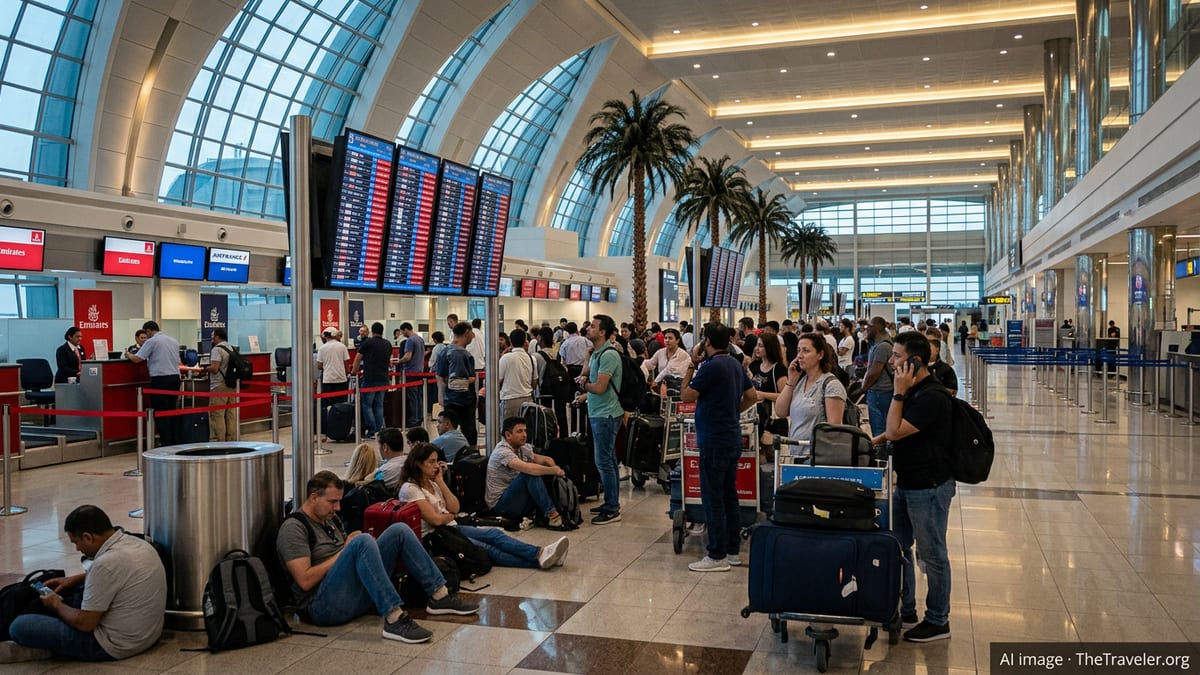
Across airport terminals, scenes have become familiar and fraught. Families sleep on the floor beneath departure boards still crowded with cancellations. Long queues snake from airline service desks as passengers attempt to rebook journeys that have already been postponed several times. Many travelers who had counted on government-organized flights, like the Air France charter, are now confronting the possibility of remaining in limbo for days or weeks longer.
Some have turned to private jet brokers, pushing demand and prices to extraordinary levels as wealthier passengers seek any viable route out of the region via secondary airports in Oman, Saudi Arabia or further afield. Others cling to their existing tickets, refreshing airline apps and waiting for a coveted notification that their flight has been reinstated. For many French citizens who had hoped to board the turned-back Air France aircraft, that message has yet to come.
Travel industry analysts say the scale of disruption rivals that seen at the height of the pandemic, but with a sharper sense of danger given the proximity of active missile strikes. The combination of kinetic conflict, patchwork airspace restrictions and the intense concentration of global traffic through the Gulf has produced a uniquely volatile environment for both airlines and their customers.
Safety First as Airlines Redraw the Map
Air France and other major carriers have been explicit that safety considerations override every other factor in their decision-making. The French flag carrier is coordinating closely with national regulators and the European Union Aviation Safety Agency, which have issued strong advisories to avoid the Tehran and Baghdad flight information regions and to exercise extreme caution in the airspace around Damascus, Beirut and Tel Aviv. That guidance has effectively redrawn traditional corridors between Europe, the Gulf and Asia almost overnight.
To minimize exposure to potential missile and drone trajectories, many airlines have suspended direct services to parts of the Middle East, while others have introduced complex rerouting that adds hours and fuel costs to long-haul journeys. On some days, pressure on safe corridors has been so intense that authorities have preferred to halt civilian traffic entirely rather than risk congestion in skies already crowded with military aircraft and air defense assets.
Even as Gulf carriers such as Emirates and Etihad tentatively restart limited schedules to key global destinations, their operations remain highly constrained by real-time threat assessments. Flights are being timed around windows of relative calm and pre-cleared routes, and many services are restricted to passengers starting or ending their trips in the United Arab Emirates, with transit connections tightly controlled.
For travelers, that means sudden reversals remain an ever-present possibility. A flight that appears confirmed in the morning can be rerouted, delayed or cancelled by afternoon if radar tracks show new missile activity or if debris from interceptions threatens airspace safety. The Air France charter that turned back after encountering missile fire in the broader area is now a case study in how quickly those judgments can change.
Official Reactions and What Travelers Should Expect Next
French ministers have sought to reassure citizens that evacuation efforts will continue, even as they caution that operations can only proceed when security conditions allow. Diplomatic teams are working with Emirati and European partners to secure additional flight slots and to diversify potential departure points, but officials acknowledge that every sortie must be weighed against the latest intelligence on missile and drone threats.
Across Europe, governments are mounting their own repatriation campaigns for nationals scattered from the United Arab Emirates to Qatar and beyond, sometimes chartering aircraft or reserving blocks of seats on the limited commercial flights that still operate. Yet coordination is complicated by the constantly evolving security situation and the finite number of safe air corridors that civil aviation authorities are willing to authorize at any given moment.
For ordinary travelers still stuck in hotel rooms or airport lounges from Dubai to Abu Dhabi, the practical guidance has changed little in recent days. Passengers are being urged to stay closely in touch with their airlines through official apps and customer service channels, to monitor travel advisories from their home governments, and to be prepared for last-minute changes to itineraries as airlines respond to developments in the air and on the ground.
What the Air France episode drives home is that in the current Middle East conflict environment, even flights explicitly designated as rescue missions are not immune to disruption. For hundreds of hopeful passengers who saw that charter as their ticket home, the abrupt turnback has become a sobering reminder that in this region’s skies, safety margins are now determined as much by geopolitics as by weather or technical issues.
Broader Shockwaves for Global Air Travel
The Air France charter’s reversal is just one flashpoint in a much larger upheaval across the global route network. Analysts estimate that since the end of February, tens of thousands of flights have been cancelled or diverted as airlines seek to route around contested skies between Europe, the Gulf and Asia. Average fares on some remaining long-haul services have tripled as capacity shrinks and demand remains intense from both stranded tourists and residents trying to leave conflict-adjacent areas.
Carriers that rely heavily on Gulf hubs as east–west connectors are bearing the brunt, but knock-on effects are rippling through airports in Europe, South and Southeast Asia and even North America, where aircraft and crews are out of position and schedules have been rebuilt repeatedly in a matter of days. Business travelers face extended detours and overnight stops, while leisure passengers often have little choice but to postpone or cancel trips altogether.
Industry observers caution that recovery is likely to be fragmented and uneven. Even if missile activity subsides and more Middle Eastern airspace reopens, airlines will be reluctant to rush back into routes perceived as high risk by both passengers and insurers. For now, the image of a government-chartered Air France flight forced to turn back from its mission has become emblematic of a wider truth: in the Gulf’s embattled skies, every journey is subject to forces far beyond airline timetables.
For travelers and travel planners worldwide, the message is clear. The Middle East remains one of the most dynamic and unpredictable regions on the commercial aviation map, and any trip that passes through its hubs in the coming weeks will require flexibility, close monitoring and a readiness for plans to change at the last moment.