

More news on this day
Air India and the Lufthansa Group have agreed a sweeping new framework to jointly develop India–Europe routes, marking one of the most ambitious tie-ups yet between an Indian and European airline group and signaling a fresh phase of competition for fast-growing traffic between the two regions.
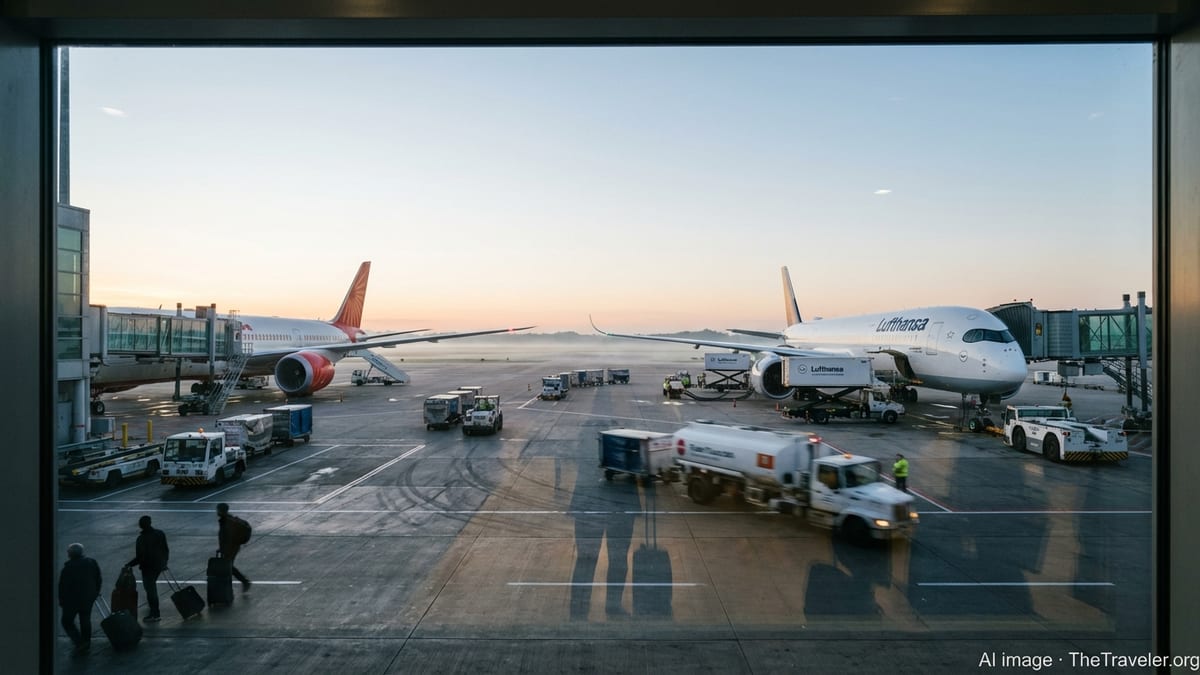
A Landmark Pact in a Rapidly Growing Corridor
Announced on 17 February 2026, the memorandum of understanding between Air India and the Lufthansa Group creates the basis for a joint business on routes linking India with key European markets, including Germany, Austria, Belgium, Italy and Switzerland. The move elevates a long-standing codeshare partnership into a deeper commercial alliance that, once fully implemented, will see the carriers coordinate more closely on schedules, capacity and sales activity.
The pact brings together Air India and its low-cost arm Air India Express with Lufthansa Group carriers Lufthansa, Swiss, Austrian Airlines, Brussels Airlines and ITA Airways. Executives from both sides describe the arrangement as a framework that will now move through regulatory and antitrust scrutiny in multiple jurisdictions, a process likely to shape how far and how quickly the partners can integrate their operations.
While the memorandum does not immediately change day-to-day flying patterns, it signals an intent to treat India–Europe traffic as a shared franchise. In practice, that could mean a gradual transition from overlapping competition on certain trunk routes to a more coordinated network that leans on each airline’s strengths, hubs and fleet composition.
The announcement comes as India consolidates its position among the world’s fastest-growing aviation markets and as Europe’s major carriers look to secure reliable access to South Asia in the face of intense competition from Gulf network airlines and tightening climate policies at home.
From Codeshare Expansion to Joint Business Ambitions
The joint business framework builds on a significant expansion of codeshare activity that the two sides announced in early 2025. That earlier deal saw Air India extend its codeshares not only with Lufthansa and Swiss, but also with Austrian Airlines, taking the total number of shared routes to around 100 across 12 Indian and 26 European cities.
Under that arrangement, Lufthansa Group customers gained streamlined access to 15 destinations across India, from major metros like Bengaluru, Chennai, Hyderabad and Kolkata to leisure and secondary hubs such as Goa, Kochi and Thiruvananthapuram. In turn, Air India customers were able to book onward connections on Lufthansa, Swiss and Austrian to more than two dozen European cities, along with select long-haul links to the Americas.
The new memorandum goes a step further. Rather than merely placing flight numbers on each other’s services, Air India and Lufthansa are exploring joint planning on specific city pairs, closer coordination of flight times, and harmonised sales and marketing strategies. Subject to approvals, this would resemble other transcontinental joint ventures where two or more airlines effectively operate a route network as a single business, sharing revenues and aligning capacity decisions.
For passengers, this could translate into denser schedules on high-demand routes such as Delhi–Frankfurt, Delhi–Munich or Mumbai–Zurich, reduced connection times at European hubs, and a more unified product offering across cabins. For the airlines, deeper cooperation offers a way to reduce duplication, stabilise yields and respond more effectively to competitive pressure from carriers funnelling India–Europe traffic through Middle Eastern or Turkish hubs.
Strengthening Hubs in Delhi, Mumbai and Central Europe
A central aim of the pact is to strengthen gateway hubs at both ends of the corridor. Air India has been working to position Delhi and Mumbai as East–West transfer platforms, reshaping schedules to allow same-day connections between Europe, North America, Australia and parts of Southeast Asia. In late 2024, the airline announced retimed services between Delhi, Frankfurt and Paris, as well as adjusted departures on Delhi–Sydney and Delhi–Melbourne, specifically to create two-way connectivity between Europe and Australia via India.
On the European side, Lufthansa Group’s primary hubs in Frankfurt, Munich, Zurich and Vienna will serve as the main entry points for Indian-origin passengers to connect deeper into continental Europe and the Americas. The earlier codeshare expansion already gave Air India customers access to important commercial centres such as Amsterdam, Brussels, Copenhagen, Geneva, Manchester, Lyon and Stockholm, using Lufthansa Group metal beyond its European gateways.
By layering a joint business framework on top of this network, the partners can, over time, fine-tune which hub handles which flows. High-yield corporate and governmental traffic between Delhi and Frankfurt, for example, may support additional frequencies or premium-heavy aircraft, while leisure and visiting-friends-and-relatives traffic from regional Indian cities might be funnelled via Munich, Vienna or Zurich to optimise aircraft utilisation and slot portfolios.
The coordination could also extend to how both sides use secondary Indian gateways. Lufthansa Group-designated flights may increasingly feed into Air India’s domestic network at points like Bengaluru or Chennai, while Air India leverages European hubs not just for point-to-point demand but as springboards to North America, the Nordics and Eastern Europe.
Rising Trade, People-to-People Flows and Competitive Pressures
The timing of the pact reflects powerful underlying demand drivers. India and the European Union together account for roughly a quarter of global GDP, and the EU is India’s largest trading partner for goods. Bilateral trade in goods surpassed 120 billion euros in 2024, supporting dense corporate travel flows alongside growing investment, technology and services ties.
At the same time, a large Indian diaspora in Europe and rising disposable incomes among India’s middle class are swelling visiting-friends-and-relatives and leisure traffic in both directions. Popular tourism hotspots in Italy, Switzerland and Austria are seeing strong growth in Indian arrivals, while European travellers are increasingly exploring destinations in Rajasthan, Kerala, Goa and the Himalayas, often routing through the main hubs participating in this pact.
Yet the partnership is also a response to heightened competition. Gulf carriers and Turkish Airlines have long dominated one-stop India–Europe itineraries by funnelling passengers through their expansive hubs with high frequencies and aggressive pricing. By tightening their alliance, Air India and Lufthansa Group are seeking to reclaim some of that traffic with a proposition that emphasises non-stop or one-stop connectivity on aligned partners within Star Alliance.
European climate policy adds another layer of complexity. Requirements for sustainable aviation fuel and expanding emissions trading obligations risk raising operating costs for EU carriers more sharply than for rivals based outside the bloc. Deeper cooperation with a fast-growing partner in India offers Lufthansa Group an avenue to keep its India–Europe network attractive while managing the financial impact of these regulations.
What It Means for Passengers: Smoother Journeys and More Choice
For travellers, the most immediate effects of the pact will likely be incremental rather than dramatic. As regulators review the joint business plans, the airlines are expected to continue adding refinements to their existing codeshares, such as expanding fare combinability, synchronising minimum connection times and upgrading through-check capabilities for baggage and boarding passes.
Once approvals are in place, passengers could see more coordinated departure banks at key hubs. Morning and evening waves in Delhi or Mumbai may be calibrated to feed specific transcontinental departures from Frankfurt, Munich, Zurich or Vienna, shortening layovers and improving reliability of connections during busy seasons. In some cases, overlapping flights at inconvenient times may be retimed or consolidated to concentrate demand and free up scarce slots.
Frequent flyers will also stand to gain from a tighter partnership. Both Air India and Lufthansa Group carriers are members of Star Alliance, and their existing reciprocity on mileage accrual and redemption will serve as a foundation for enhanced benefits. Elite status customers are likely to see more consistent recognition across the network, including priority services, higher baggage allowances and lounge access, as both sides work to harmonise the premium travel experience.
Product upgrades on key India–Europe routes could further sweeten the offer. Air India has been deploying refurbished widebodies and ex-Vistara aircraft with improved cabins and inflight entertainment on flights to Frankfurt, while Lufthansa Group continues to roll out its latest long-haul cabins and onboard connectivity. For business travellers, greater certainty about the type of aircraft and cabin standard on a particular route will be an important differentiator.
Strategic Stakes for Air India’s Transformation
The pact with Lufthansa Group dovetails with Air India’s broader transformation agenda under its Vihaan.AI programme, launched after its return to the Tata fold in 2022. The airline has ordered hundreds of new aircraft, merged former affiliates Vistara and AirAsia India into its mainline and low-cost operations, and invested in training infrastructure and a new maintenance base to support future growth.
Partnerships are a critical part of that strategy. Over the past two years, Air India has expanded its web of codeshares and interline agreements to cover more than 800 destinations worldwide, including recent deals in Europe’s Baltic region. These arrangements give the carrier instant global reach while it awaits the delivery of new jets and completes cabin refits across its existing fleet.
The Lufthansa joint business framework positions Air India at the centre of one of Europe’s most sophisticated airline groups, offering access to commercial know-how, network planning expertise and premium customer segments. For the Indian flag carrier, whose ambitions include building Delhi and Mumbai into viable alternatives to Gulf hubs for long-haul transfer traffic, that mentorship and feed are as valuable as the additional seat capacity itself.
Domestically, the move also enhances Air India’s competitive stance against low-cost giant IndiGo, which has been building its own constellation of partnerships with European and North American airlines. By securing a deep anchor relationship with Lufthansa Group, Air India is signalling to the market that it intends to play firmly in the full-service, global-network segment rather than ceding that space to foreign carriers.
Lufthansa Group’s Bet on India’s Next Aviation Chapter
For Lufthansa Group, the agreement is a statement of confidence in India’s long-term aviation potential. The group already operates five national airlines across Europe and carried more than 130 million passengers in 2024, but growth opportunities within its home markets are constrained by slot scarcity, airport capacity limits and regulatory pressures.
India, by contrast, offers both volume and runway for expansion. Rising incomes, a young population and ongoing airport investments are expected to support sustained double-digit growth in air travel demand over the coming decade. By tying its fortunes more closely to Air India, Lufthansa Group is securing privileged access to that growth via a partner whose interests are structurally aligned with its own, given their shared membership in Star Alliance and complementary network strengths.
The partnership also gives Lufthansa Group a counterweight to other emerging alliances targeting the India–Europe–North America triangle. Low-cost carrier IndiGo has signed a broad memorandum with Delta Air Lines, Air France-KLM and Virgin Atlantic, while Gulf carriers continue to deepen their presence in Indian cities. In this context, working with Air India is less an optional extra for Lufthansa Group than a strategic necessity to preserve relevance in a corridor that is rapidly being carved up among powerful competitors.
As the joint business concept moves from memorandum to implementation, much will depend on regulatory approvals, the pace of Air India’s fleet renewal and the partners’ ability to maintain service quality during a period of rapid change. But if successfully executed, the pact has the potential to redefine how millions of people travel between India and Europe, and to cement a new axis of cooperation at the heart of global aviation.