

More news on this day
Air India has consolidated all its Ahmedabad flights at Sardar Vallabhbhai Patel International Airport’s upgraded Terminal 2, marking a major shift intended to simplify journeys for domestic and international travelers using the growing Gujarat hub.
Get the latest news straight to your inbox!
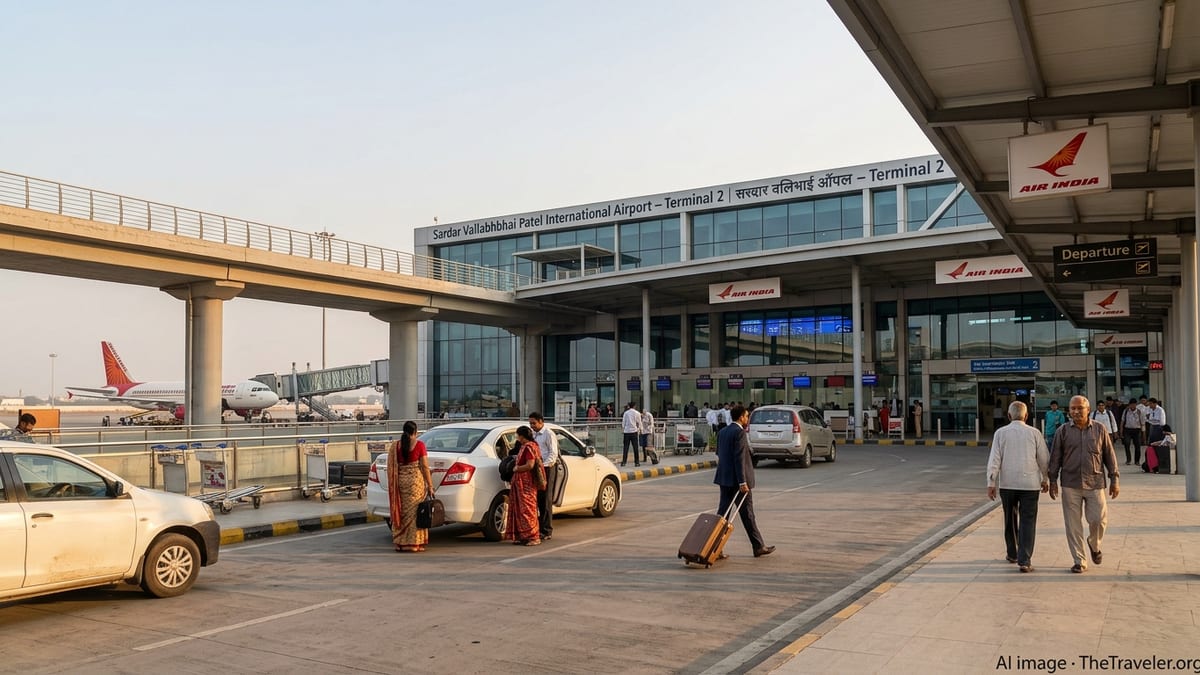
A New Chapter For Ahmedabad’s Gateway
The move of all Air India services in Ahmedabad to Terminal 2 positions the Sardar Vallabhbhai Patel International Airport as a more streamlined gateway for passengers across Gujarat. Publicly available information on the airport shows that Terminal 2 was originally developed as the international facility, with a focus on higher-capacity check-in areas, improved security layouts and more modern passenger amenities. Concentrating a full-service carrier’s schedule in this newer building is seen as a logical extension of that investment.
The airline’s Ahmedabad network carries a mix of domestic connections to major Indian cities and international links that tie the state’s commercial capital to overseas markets. By relocating to a single, upgraded terminal, Air India is aiming to reduce confusion over departure points, shorten walking distances between connecting flights and give travelers a more consistent experience across its routes.
Aviation observers note that the shift is also in line with broader changes across India’s major airports, where newer terminals are increasingly being reserved for full-service or long-haul operations, while older facilities are reconfigured for low-cost or purely domestic traffic. Ahmedabad’s Terminal 2, opened in 2010 as part of a wider modernization effort, now becomes the focal point of Air India’s operations in the city.
What The Terminal 2 Move Means For Passengers
For travelers, the clearest immediate impact is that all Air India flights to and from Ahmedabad now use Terminal 2, eliminating the need to double-check whether a particular service departs from a different building. Reports indicate that this consolidation is intended to minimize missed flights caused by last-minute terminal confusion, especially for passengers who may be unfamiliar with the airport or arriving from smaller cities.
Terminal 2 features larger departure halls and expanded security and immigration areas compared with the older domestic facilities. Public information on the airport’s layout highlights multiple aerobridge-equipped gates, which typically allow faster boarding and disembarkation and can be more accessible for passengers with reduced mobility. This is expected to cut down on bus transfers to remote stands and provide a more predictable boarding process across Air India’s schedule.
For connecting passengers, the change is particularly significant. Travelers arriving on Air India flights from other Indian cities and continuing to international destinations from Ahmedabad will now remain within the same terminal, benefiting from shorter transfer routes and fewer duplicated checks. According to published coverage of similar moves at other Indian airports, relocating an airline’s domestic and international operations into a single modern terminal has historically reduced minimum connection times and simplified baggage handling.
Operational Efficiencies And Network Strategy
The concentration of all Air India operations in Terminal 2 is widely interpreted as part of the carrier’s ongoing transformation program, which includes reworking schedules, renewing aircraft and revamping ground processes to improve reliability. Industry analysis suggests that operating from a single, better-equipped terminal can make it easier to coordinate aircraft rotations, crew changes and ground handling, with fewer delays caused by congestion at older gates.
Ground handling and maintenance providers based at Ahmedabad also stand to benefit from the consolidation. With all of the airline’s departures and arrivals channeled through Terminal 2, equipment, staffing and support services can be positioned more efficiently instead of being split between separate buildings. Observers note that similar terminal shifts at other Indian hubs have allowed carriers to better synchronize turnaround times and increase aircraft utilization over the course of the day.
The move is also strategic from a network-planning perspective. Ahmedabad has been gaining prominence as a commercial and cultural hub for western India, and centralizing Air India’s presence in the city at a modern terminal gives the airline a clearer platform for future growth. Aviation analysts point out that a strong, consolidated base often makes it easier to add new domestic spokes or international routes, because ground operations and passenger flows are already optimized in a single location.
Reflecting A Wider Trend Across Indian Airports
While the focus is on Ahmedabad, Air India’s shift to Terminal 2 echoes changes that have been unfolding at other major Indian airports, where terminal assignments are being reworked to reflect growth in traffic and new infrastructure. Published information on airport operations in cities such as Bengaluru and Delhi shows similar patterns of airlines moving to newly built or expanded terminals as part of broader capacity upgrades.
In these cases, terminal consolidation has generally been associated with improved passenger satisfaction, largely due to more modern interiors, upgraded retail and dining areas, and better wayfinding. Ahmedabad’s Terminal 2 was designed with many of the same elements, and concentrating a national carrier’s traffic there is seen by analysts as a way to leverage that investment more fully. The move also fits into a nationwide trend of aligning full-service airlines with terminals that can better handle international and premium traffic.
Travel industry commentary notes that such realignments can be disruptive in the short term, as passengers adapt to new layouts and ground staff adjust routines. However, experience from other hubs suggests that once the shift is bedded in and travelers become accustomed to the new terminal, the benefits in terms of smoother check-in, security and boarding processes tend to outweigh the initial transition challenges.
Preparing Travelers For The New Normal
For passengers planning trips to or from Ahmedabad with Air India in the coming months, the key message is to treat Terminal 2 as the default point of departure and arrival. Booking platforms, airline documentation and airport signage are being used to highlight the new terminal assignment so that travelers can factor it into their itineraries, ground transport plans and arrival times at the airport.
Travel advisors recommend that passengers who have not used Terminal 2 recently should allow extra time on their first journey under the new arrangement, especially during peak morning and evening banks of departures. Once familiar with the new check-in areas, security checkpoints and gate locations, travelers are likely to find the consolidated operation more straightforward than juggling different terminals for different flights.
As Ahmedabad’s air traffic continues to grow, the concentration of Air India services in Terminal 2 is set to shape how both local residents and connecting passengers experience the city’s primary gateway. If the pattern seen at other Indian hubs holds, the move should gradually translate into more reliable connections, clearer wayfinding and a more consistent standard of service for those passing through the airport on India’s flag carrier.