

More news on this day
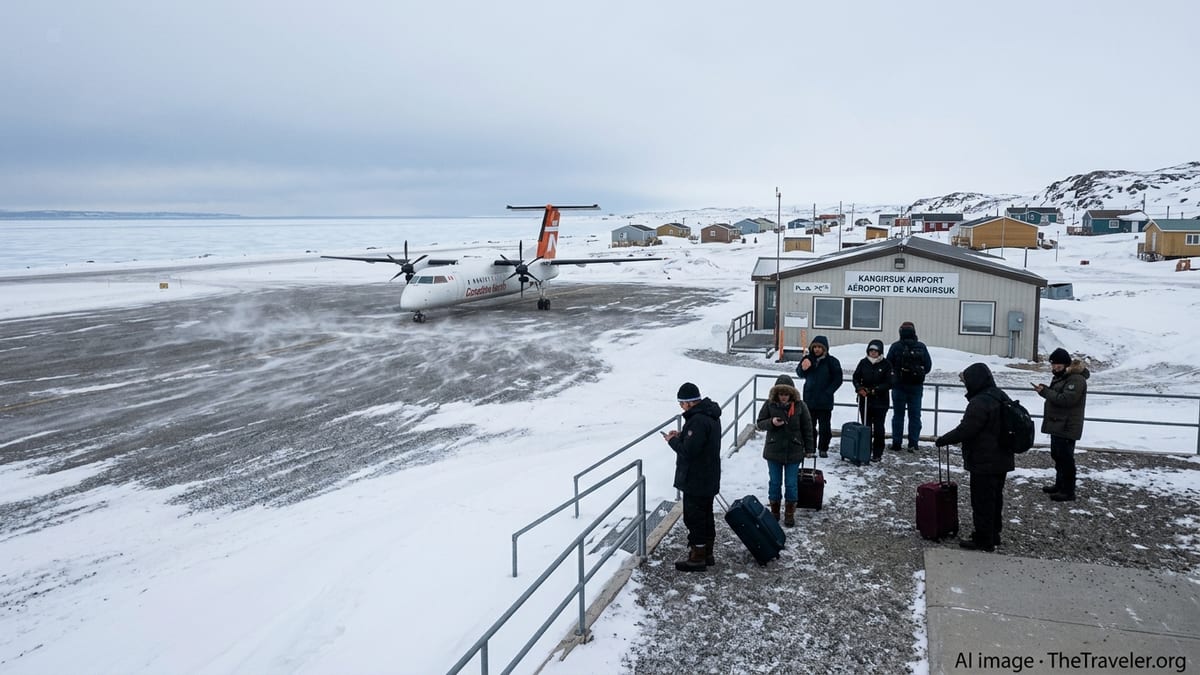
Travelers in the remote Nunavik community of Kangirsuk have been left in limbo after a series of Air Inuit disruptions, with one delayed service and six cancellations severing links to key southern gateways including Montreal, Quebec City, Toronto and Ottawa.
Get the latest news straight to your inbox!
Remote Nunavik Hub Cut Off From Southern Gateways
The recent wave of cancellations has highlighted just how dependent Kangirsuk is on its limited air links to the rest of Quebec and beyond. Publicly available schedule data shows only a handful of weekly services connecting the village with regional hubs, where onward flights to major Canadian cities originate. When those few lifelines are withdrawn, residents and visitors have no practical alternative by road or sea at this time of year.
According to published coverage of the disruptions, the affected flights were part of a sequence that normally feeds passengers from Nunavik into southbound services routed through Montreal and Quebec City, with through-connections to Toronto and Ottawa. With one departure delayed and six others fully canceled in close succession, travelers found themselves effectively isolated at Kangirsuk’s small airstrip, waiting for aircraft and crews to be reassigned.
The timing has compounded the impact. Late winter and early spring are periods when communities in northern Quebec still rely heavily on scheduled air services for medical appointments, school travel, and resupply, even as weather patterns remain volatile. Any extended operational gap can quickly spill over into missed connections in the south, additional overnight stays, and rearranged itineraries that stretch personal budgets.
While the number of disrupted flights may seem modest by big-city standards, each one represents a significant share of Kangirsuk’s weekly capacity. With no other commercial carrier serving the route on a regular basis, even a small cluster of cancellations effectively closes the village to through-travelers heading to or from Canada’s largest population centres.
Operational Pressures on Essential Northern Air Services
Air Inuit operates in one of the most challenging environments in North America, serving 14 Nunavik communities with a mixed fleet of turboprops and, increasingly, Boeing 737 combi aircraft. Company information about its fleet modernization program indicates that it has been working to boost reliability and capacity by introducing converted 737-800s capable of carrying both passengers and cargo on the same flight. These improvements, however, can only partially offset the constraints of extreme weather, short gravel runways, and limited ground infrastructure.
Recent schedule bulletins for the airline show that services to and from Kangirsuk remain relatively sparse compared with southern routes. That thin schedule leaves little room for maneuver when an aircraft is taken out of rotation for unscheduled maintenance or when crews time out amid rolling delays. In such cases, one cancelled leg can cascade into a string of disruptions across several northern communities in a single day.
Observers of Arctic and sub-Arctic aviation note that carriers such as Air Inuit balance a community-service mandate with tight operational margins. Fuel, maintenance, and staffing costs are high, while demand is concentrated in a narrow seasonal window. This makes the network more vulnerable to shocks than densely served southern corridors, particularly when storms or mechanical issues arise on days when aircraft are already heavily utilized.
In the current episode, the combination of one delayed flight and six cancellations has illustrated how quickly those vulnerabilities can translate into extended isolation for travelers on the ground, especially when there is no immediate spare aircraft available to restore the schedule.
Weather, Safety Protocols and Limited Alternatives
Although detailed cause-of-disruption reports have not been made public for every affected flight, historical patterns across northern Canada show that late winter operations are frequently challenged by high winds, blowing snow, low visibility and extreme cold. Published aviation data for similar regions indicate that carriers often err on the side of caution, upholding conservative safety margins when operating into short or gravel runways under marginal conditions.
In Kangirsuk’s case, any weather-related restrictions can rapidly lead to prolonged gaps in service because there is no road network linking the village to larger communities. Seasonal marine transport is not yet fully underway at this point in the calendar, leaving air travel as the primary option for travelers needing to reach southern medical centers, educational institutions or business appointments.
Travel rights frameworks in Canada provide certain protections when disruptions occur for reasons within an airline’s control, but weather-related cancellations fall largely outside these rules. Publicly available guidance on passenger rights emphasizes that carriers may not be obliged to offer hotel stays or financial compensation when safety or meteorological conditions are the primary drivers of a cancellation, even when the practical effect for remote travelers is extended isolation.
The limited availability of alternative routings compounds the problem. Unlike travelers in major hubs, passengers in Kangirsuk cannot simply rebook on another airline or choose an overland route. The lack of redundancy in the network means that once a series of flights disappears from the schedule, travelers must wait for new capacity to be scheduled or for the existing aircraft rotation to recover.
Wider Ripple Effects on Montreal, Quebec City, Toronto and Ottawa
The cancellations and delay at Kangirsuk have also had knock-on effects further south. The disrupted services were part of itineraries that would normally connect through Montreal and Quebec City, with many passengers holding through-tickets or onward bookings to Toronto and Ottawa. When the initial northern legs failed to operate, those downstream segments were left with empty seats, while affected travelers had to rearrange their plans from hundreds of kilometres away.
Airports in Montreal and Quebec City act as primary gateways for Nunavik, linking regional flights to the national network. Disruptions at the community level can therefore distort passenger flows into and out of these hubs, creating short-term imbalances in demand. Travelers who miss their connections often face rebooking fees, fare differences, or additional nights in airport hotels once they eventually make it south.
For Toronto and Ottawa, the impact is less visible in daily statistics but still meaningful for individual travelers with time-sensitive commitments. A missed medical appointment in a teaching hospital or a delayed return to work can carry financial and emotional costs that far exceed the price of a single ticket. Reports from previous disruption events in northern Canada suggest that some travelers resort to extending stays in the south or postponing essential trips altogether when reliability becomes uncertain.
These ripple effects underscore how tightly integrated northern and southern air networks have become, even as the level of redundancy and resilience remains uneven. A scheduling problem at a small Arctic airstrip can quickly translate into stranded passengers and empty seats thousands of kilometres away.
Community Dependence and Calls for More Resilient Connectivity
The episode at Kangirsuk is rekindling discussion about how best to strengthen air connectivity for remote communities. Commentators who follow northern transport policy note that airlines serving regions such as Nunavik are often the sole providers of both passenger and cargo capacity, making them critical for food supplies, medical evacuations and community mobility in addition to tourism and business travel.
Publicly available policy analyses highlight several potential avenues for improving resilience. These include targeted infrastructure investments to enhance runway conditions and navigation aids, support for fleet renewal that prioritizes aircraft with better performance on short or unpaved runways, and funding mechanisms that give carriers more flexibility to maintain spare capacity for irregular operations.
For travelers, the events in Kangirsuk are a reminder of the importance of planning for uncertainty when visiting remote northern destinations. Travel experts frequently recommend building extra buffer days into itineraries, purchasing flexible or refundable fares where possible, and ensuring that critical appointments in southern cities are scheduled with contingency time in mind.
As Air Inuit continues its fleet modernization and adjusts schedules across Nunavik, observers will be watching closely to see whether operational resilience improves. For the travelers currently stranded or delayed in Kangirsuk, the priority remains simple: getting a seat on the next available flight out, and restoring the fragile but essential link between this northern community and the major cities of Montreal, Quebec City, Toronto and Ottawa.