

More news on this day
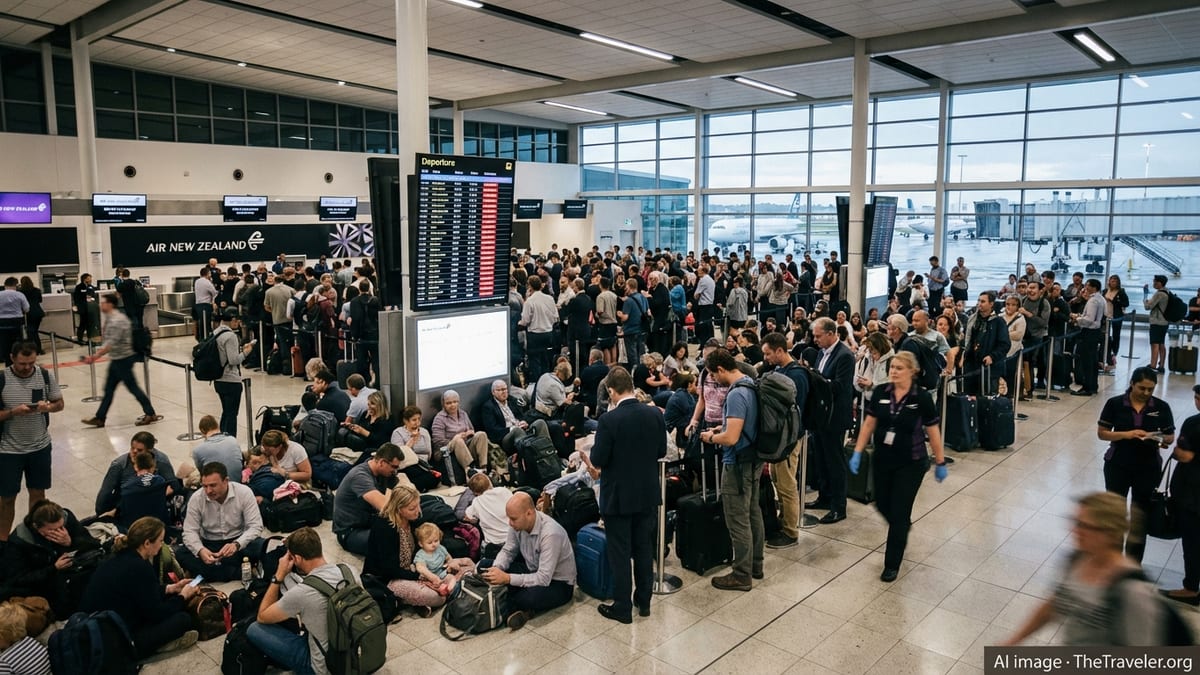
Hundreds of passengers were left stranded across New Zealand on Friday as Air New Zealand delayed 56 services and cancelled a further 15, disrupting key domestic routes from Auckland to Christchurch and rippling delays across the carrier’s wider network.
Major Domestic Corridors Brought to a Standstill
The latest disruption hit some of Air New Zealand’s busiest corridors, with Auckland to Christchurch among the worst affected. The route is a critical air bridge for business travellers, government workers and families, and operates at high frequencies throughout the day. With multiple rotations scrubbed or significantly delayed, departure boards at both ends of the route showed long stretches of red and amber status indicators.
Passengers reported lengthy queues at check-in counters and self-service kiosks at Auckland Airport, where staff worked to rebook travellers onto later services and identify spare seats on remaining flights. With load factors already high during the late-summer travel period, re-accommodation options were limited, leaving many passengers facing waits of several hours and, in some cases, overnight stays.
Christchurch Airport also experienced heavy congestion as delays compounded through the morning and early afternoon operational windows. Travellers connecting from Christchurch onward to Wellington, Queenstown and regional centres found themselves caught in a web of missed connections, short-notice gate changes and rolling departure time revisions.
Network Knock-On Effects Felt From Northland to the South Island
While headline impacts were most visible on trunk routes, the disruption extended well beyond the main Auckland to Christchurch corridor. Flights linking Auckland with Wellington, Dunedin and Queenstown reported significant schedule changes, while a number of regional services serving centres such as Rotorua, Napier and Palmerston North were delayed or cancelled outright as aircraft and crews fell out of position.
New Zealand’s domestic aviation network relies heavily on rapid aircraft turnarounds and tight sequencing to sustain frequency on low-volume regional routes. When a cluster of flights faces delay or cancellation on major city pairings, the ripple effect can quickly extend to smaller communities that depend on a limited number of daily services. Friday’s events once again highlighted how exposed regional travellers are when irregular operations strike at hub airports.
By early afternoon, some passengers attempting to reach smaller centres reported being advised to travel the following day, as available seats on remaining services were snapped up. Others turned to alternative ground transport, with intercity coach operators and car rental desks at Auckland and Christchurch experiencing a spike in last-minute demand.
Weather and Operational Strain Add to Ongoing Reliability Concerns
The disruption comes against a backdrop of heightened schedule volatility across New Zealand’s skies in recent weeks. Severe weather systems across the North Island earlier in the week brought high winds and heavy rain, temporarily curtailing operations at airports including Auckland and Wellington and forcing a spate of diversions, delays and outright cancellations.
While Friday’s pattern of 56 delays and 15 cancellations reflects a single reporting window, it feeds into a broader picture of stress on airline operations during the southern summer. From resource shortages and maintenance scheduling to increasingly erratic weather systems, carriers across the region have been grappling with a series of challenges that limit their ability to recover quickly once disruption takes hold.
For Air New Zealand, whose domestic network forms the backbone of the country’s air connectivity, any sustained run of irregular operations quickly becomes visible to travellers. Recent data and passenger accounts point to a series of disruption spikes since late 2025, with some days seeing dozens of cancellations and well over a hundred delays across multiple airports and operators. The latest figures will likely fuel renewed debate over how resilient the national carrier’s schedules are to shock events.
Stranded Travellers Face Long Queues and Limited Alternatives
On the ground, the human impact of Friday’s disruption was on stark display in crowded departure halls and at full check-in bays. Travellers spoke of spending hours in lines to obtain updated information or to secure accommodation vouchers and meal credits where policies allowed. With many affected flights departing later in the day, families with young children and older passengers were particularly vulnerable to the strain of extended waiting times.
Accommodation close to Auckland Airport tightened rapidly as evening approached, echoing scenes seen during previous disruption episodes when large clusters of flights were cancelled at short notice. Passengers arriving from other parts of the country, only to find their onward connections scrubbed, scrambled to secure scarce hotel rooms or sought space at nearby motels and guesthouses.
For international travellers using Auckland as a gateway, missed connections onto long-haul flights created further complications. Some passengers bound for destinations in North America, Asia and the Pacific were forced to rebook onto later departures or reroute through other regional hubs. With global capacity still finely balanced on many routes, same-day alternatives were far from guaranteed.
Air New Zealand Under Pressure to Explain and Compensate
The scale of Friday’s delays and cancellations is likely to intensify scrutiny on Air New Zealand’s operational planning and customer support systems. Travellers have increasingly taken to social and traditional media to voice frustration at repeated episodes of disruption, particularly when advance communication is perceived as limited or inconsistent across digital channels, call centres and airport staff.
New Zealand’s consumer protection framework and airline policies provide passengers with varying levels of recourse depending on the cause of disruption and the type of ticket purchased. In cases where delays or cancellations are within an airline’s control, affected travellers may be entitled to refunds, rebooking assistance and, in some instances, accommodation or meal support. However, when weather or air traffic control constraints are cited as the primary cause, compensation is typically more limited.
Friday’s events, coming so soon after other high-profile disruption days, are likely to renew calls from consumer advocates for clearer rules and more proactive assistance when passengers are stranded for extended periods. They also raise questions about whether existing contingency plans are robust enough for a market that depends heavily on air travel to connect communities spread over long distances and challenging terrain.
Airports and Ground Services Strain Under Peak-Period Loads
Airports across New Zealand have been candid in recent months about the challenge of managing sudden disruption against a backdrop of strong travel demand. Auckland Airport, the country’s main international gateway and a crucial domestic hub, has been operating through ongoing infrastructure upgrades and capacity enhancements designed to improve resilience in the medium term. In the short term, however, these projects can make the system more sensitive to operational shocks.
Ground handling teams, security staff and airport operations personnel were all tested by Friday’s surge in rebookings and schedule changes. Queues at security and bag-drop points fluctuated throughout the day as waves of delayed departures pushed passengers into compressed time windows. Airport managers emphasise that most services continue to operate, but acknowledge that passenger experience suffers significantly when even a minority of flights is heavily delayed or cancelled at once.
Regional airports such as Christchurch, Wellington and Queenstown also reported elevated operational pressure as they worked to absorb revised arrival and departure patterns. Gate availability, baggage handling, refuelling and catering all need to be re-sequenced when aircraft arrive well outside their scheduled slots, increasing the risk of further delay even once flying conditions improve.
Travellers Advised to Build Buffer Time and Monitor Status Closely
For travellers planning journeys in the coming days, aviation and travel experts are advising a more cautious approach to schedules on affected routes. Building additional buffer time into itineraries, particularly for those connecting onto international long-haul services, is being strongly recommended. Allowing several hours between domestic arrivals and overseas departures can offer a critical safety margin when network disruptions occur.
Passengers are also being urged to make full use of airline apps and airport information channels to monitor real-time flight status, gate changes and rebooking options. While staff at counters and call centres remain essential for complex changes and special assistance, digital tools can provide earlier notification of emerging issues and, in some cases, allow customers to self-service rebookings without joining long queues.
Travel insurers note that policies vary in how they respond to delays and cancellations, and encourage customers to review coverage details before departure. Documentation of disruption, such as confirmation emails and receipts for accommodation and meals, can be vital when lodging claims after a heavily disrupted trip.
Broader Questions Over Resilience in New Zealand Aviation
The Air New Zealand disruption is the latest in a series of events that have exposed the vulnerability of New Zealand’s domestic and short-haul aviation network to sudden shocks. A combination of constrained fleet capacity, tight crew rosters and infrastructure pressures means that a single disruptive day can take time to unwind, particularly when aircraft and staff are stranded away from their planned bases.
Industry observers point out that climate-related weather volatility is likely to place further pressure on operations in the years ahead, especially for an island nation whose airports are often exposed to coastal storm systems and strong wind patterns. Building greater resilience may require a mix of fleet investment, schedule adjustments, improved forecasting and enhanced coordination between airlines, airports, air traffic control and ground service providers.
For now, though, the immediate concern for travellers remains much more practical: how quickly stranded passengers can be moved to their destinations, and whether upcoming flights will operate as planned. As Air New Zealand works to restore its schedule after the latest wave of delays and cancellations, many passengers will be watching departure boards closely and hoping that Friday’s scenes are not repeated in the weeks to come.