

More news on this day
Air New Zealand and Queenstown Airport have marked International Women’s Day 2026 with a fully female-operated flight and ground operation, turning a routine domestic service into a high-visibility challenge to entrenched gender inequality in aviation.
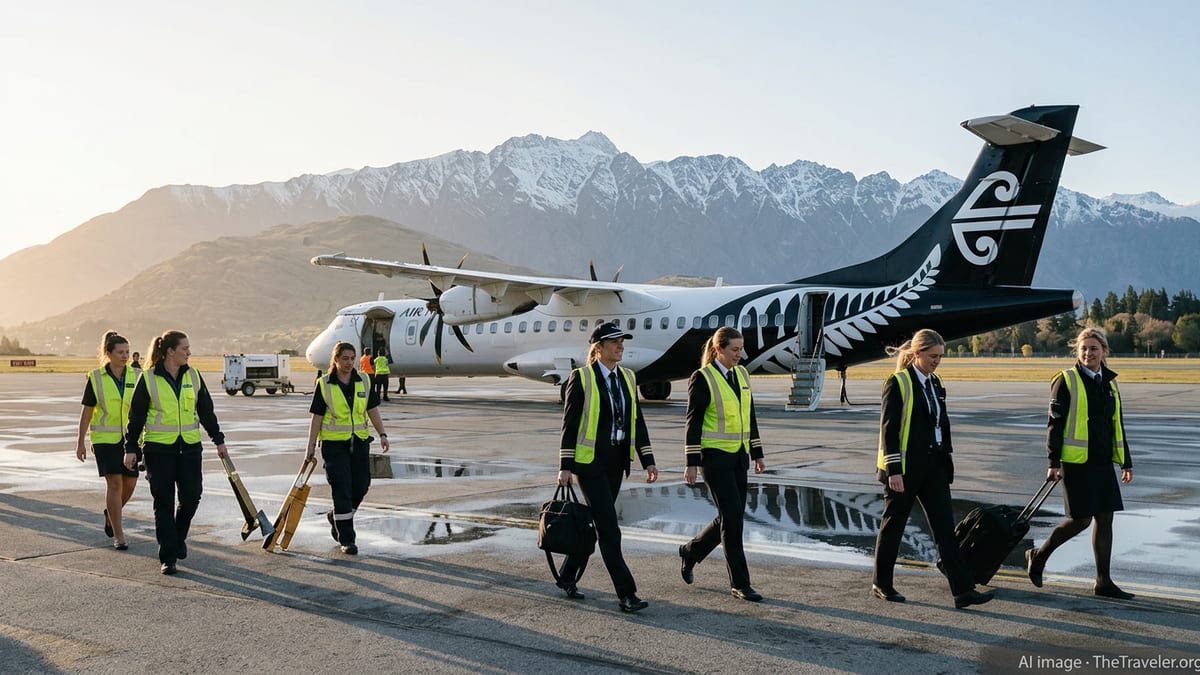
A Landmark Flight Over New Zealand’s Southern Alps
The showcase service, operated on Friday 6 March ahead of International Women’s Day, saw an Air New Zealand domestic flight crewed entirely by women in the flight deck and cabin, supported by all-women teams in dispatch, airfield operations and customer support at Queenstown Airport. The carrier and airport framed the operation as both a celebration of women already in the industry and a call to action for those who might never have considered aviation careers.
While Air New Zealand has previously run all-female crews on selected services during Women of Aviation Worldwide Week, this year’s initiative placed particular emphasis on including women in the less visible but critical operational roles that keep aircraft moving safely. From load control and engineering sign-off to air traffic coordination and ramp handling, women led every step associated with the flight’s turnaround.
Queenstown’s dramatic alpine setting provided a compelling backdrop. The airport is considered one of the country’s more challenging commercial destinations, with complex terrain and weather conditions demanding high levels of technical and operational skill. Positioning an all-women team at the centre of such an operation was an intentional signal that women are not only present in aviation, but capable of excelling at its most demanding tasks.
Passengers on board were told about the initiative as part of the pre-flight briefing, with many taking to social media afterward to highlight the sight of women in every visible role from check-in to the cockpit door. For organisers, that visibility was the point: to normalise the presence of women in roles still widely perceived as male dominated.
Shining a Light on Persistent Gender Gaps
Behind the celebratory tone lies a stark reality. New Zealand, like much of the world, continues to see extremely low female representation in technical and senior operational aviation roles. Recent national data cited by industry advocates indicates that women make up only a small fraction of airline pilots, with proportions broadly in line with the global average of about 5 percent. In engineering, ground operations leadership and air traffic control, women also remain significantly underrepresented.
Air New Zealand’s own diversity reporting acknowledges those gaps even as the airline highlights progress in areas such as leadership representation and pay equity. The carrier has obtained national gender accreditation and promotes internal networks such as WING, Women Inspiring the Next Generation, which was founded by female pilots to mentor and support women pursuing flying careers. Yet company leaders concede that shifting the dial in training pipelines and technical recruitment remains a long-term challenge.
Queenstown Airport Corporation, which manages the gateway to one of New Zealand’s busiest tourism regions, faces similar dynamics. While the company points to steady growth in female participation in customer service, safety and corporate roles, it acknowledges that specialised operational posts and senior technical management still skew heavily male. By collaborating with Air New Zealand on an all-women operational day, the airport aimed to make its own workforce diversity efforts more visible to the travelling public and local community.
Industry observers note that such one-day initiatives do not, on their own, resolve systemic barriers. However, they argue that they can play an important role in challenging lingering stereotypes about who “belongs” on the flight deck, in the operations centre or out on the tarmac directing aircraft.
From Symbolic Flights to Structural Change
The all-women operation at Queenstown Airport forms part of a wider strategy by Air New Zealand to grow a more diverse pipeline of pilots and aviation professionals. The airline’s Mangopare pilot cadetship and other early-career schemes are explicitly targeting recruits from underrepresented communities, including women and Māori and Pasifika candidates, to meet projected pilot demand over the coming decade.
Internally, the carrier has introduced gender-neutral uniforms and more flexible policies around appearance and dress, which women’s advocates say help dismantle outdated ideas about how female aviation professionals should look and behave. The company also says it is working to identify and remove subtle biases in selection and promotion processes, supported by regular gender pay reporting and workforce profiling.
Queenstown Airport, for its part, is tying events like the all-women flight to broader programmes with schools, training providers and local employers in the Southern Lakes region. Airport leaders are keen to highlight non-traditional pathways into aviation, such as operations planning, airfield safety, digital systems and sustainability roles, alongside the more high-profile jobs of pilot and flight attendant.
Both organisations stress that the goal is not only to recruit more women, but to ensure they remain and progress. That requires attention to workplace culture, flexible rostering for those with caregiving responsibilities, and clear advancement opportunities into supervisory and executive positions historically dominated by men.
Global Momentum and Local Leadership
The Queenstown initiative slots into a growing pattern of aviation events timed around International Women’s Day and Women of Aviation Worldwide Week. Airlines in Australia, Europe, North America and Asia have scheduled all-female-operated flights, airport tower shifts and maintenance teams to highlight the contribution of women across the industry.
Advocates say New Zealand is well placed to play a leadership role in that movement. The country has a strong tradition of women’s rights activism and a national conversation about workplace equality that increasingly encompasses sectors like transport and infrastructure. The presence of national organisations such as the New Zealand Association of Women in Aviation provides a platform for collaboration between airlines, airports, training schools and regulators.
Within that ecosystem, Queenstown’s all-women flight acts as a tangible example of what inclusive operations can look like on a busy commercial route. By pairing a major flag carrier with a high-profile regional airport, the initiative demonstrates that gender-inclusive teams can manage complex, safety-critical operations without disruption to schedules or service.
For local tourism operators, there is also a branding advantage. Showcasing diverse teams in one of the country’s most photographed destinations helps reinforce New Zealand’s image as an open and progressive place to visit and work, a message that resonates with increasingly values-driven international travellers.
Inspiring the Next Generation of Aviators
Organisers are clear that one of the primary aims of the all-women operation is to inspire girls and young women to see aviation as a realistic and rewarding career choice. Air New Zealand and Queenstown Airport staff involved in the flight have been scheduled to take part in school visits, community events and mentoring programmes in the weeks around International Women’s Day, sharing first-hand stories of their career journeys.
Pilots and engineers in particular are being encouraged to talk openly about the training, financial and lifestyle challenges they faced, as well as the satisfaction and sense of purpose they derive from their roles. Advocates say demystifying those pathways, and providing visible role models, is essential in countering the perception that aviation is “not for women.”
There is also a growing emphasis on intersectionality. Industry programmes increasingly recognise that women from different cultural, economic and regional backgrounds encounter barriers in distinct ways. Initiatives tied to events like the Queenstown all-women flight are therefore being designed to connect not only with urban students, but also with young people in rural and provincial areas who may live under flight paths but feel far removed from the industry.
As Air New Zealand and Queenstown Airport reflect on the success of their all-women operation, both say the real measure of impact will be seen in the years ahead. If more young women from across Aotearoa New Zealand step forward to train as pilots, engineers, controllers or operations leaders, the symbolic flight over the Southern Alps will have delivered on its bold promise to help reshape the gender balance of aviation.