

More news on this day
Air New Zealand has completed a record-setting series of electric aircraft flights spanning both main islands, capping a four-month demonstrator programme that aviation experts say positions the country at the forefront of a potential revolution in low-emissions regional travel.
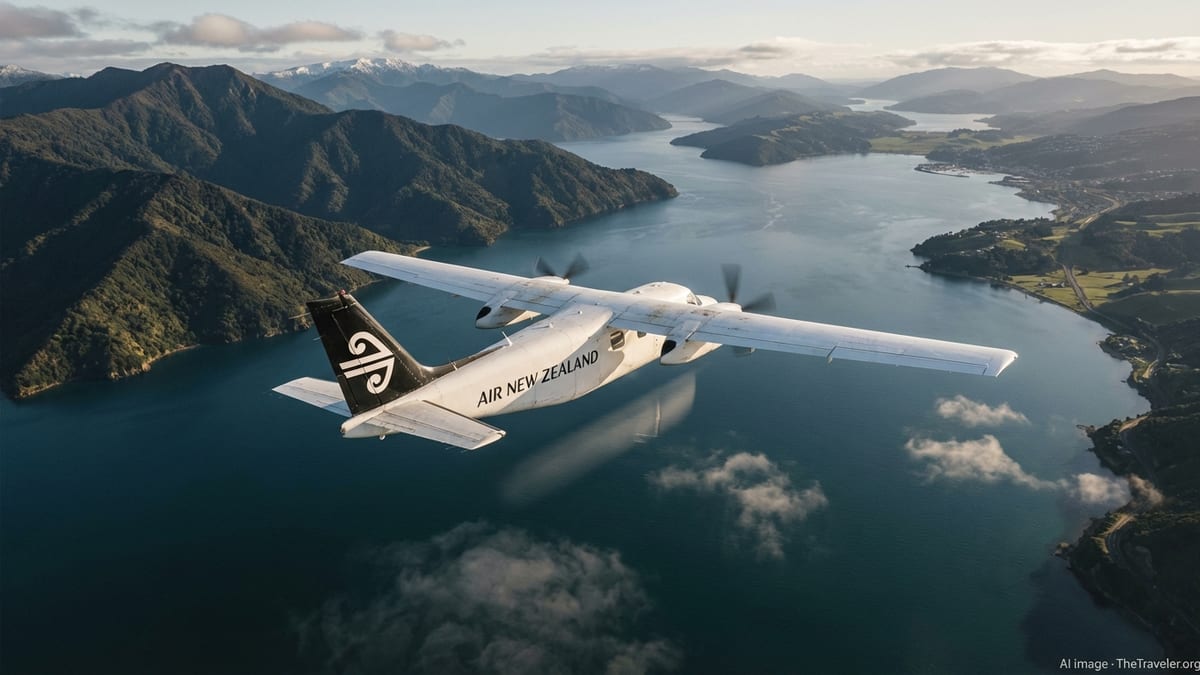
A Test Programme That Quietly Rewrote New Zealand’s Air Map
In recent months, New Zealanders looking up from beaches, vineyards and regional airports may have spotted something different in their skies. Instead of the familiar turboprop outline, an elegant high-wing electric aircraft bearing the Air New Zealand livery has been quietly tracing new routes over towns, farmland and the choppy waters of Cook Strait. Those flights formed the backbone of Air New Zealand’s Next Generation Aircraft Technical Demonstrator Programme, a four-month trial that has now concluded with more than 100 sectors flown across 12 airports and aerodromes nationwide.
The aircraft at the heart of the effort was the BETA Technologies ALIA CX300, a battery-electric design built in the United States and adapted for conventional take-off and landing. Brought to New Zealand in late 2025, it first flew from Tauranga before being based in Hamilton and later Wellington for extended testing on real-world routes. From short hops between provincial centres to challenging crossings between islands, each sortie was designed to stress-test not only the aircraft, but also ground operations, charging logistics and air traffic management.
For the airline, the goal was less about headline-grabbing firsts and more about generating hard data in real conditions. Engineers monitored battery performance in changeable weather, dispatchers tracked turn times around newly installed charging points, and pilots evaluated how the aircraft behaved in New Zealand’s famously turbulent regional corridors. By the time the trial wrapped up, Air New Zealand had quietly amassed one of the most comprehensive operational datasets for an electric aircraft anywhere in the world.
The breadth of the network flown is striking. Test routes stitched together provincial hubs and main centres in both the North and South Islands, effectively redrawing the mental map of what an electric regional network could one day look like. For regional communities that depend heavily on air links, it was also an early glimpse of how cleaner aviation might integrate seamlessly into their daily lives.
Record-Breaking Crossings and a New Era over Cook Strait
The most closely watched legs of the demonstrator programme were the flights over Cook Strait, the stretch of water that divides the North and South Islands and has long tested both pilots and aircraft. In December 2025, the ALIA CX300 completed what Air New Zealand described as New Zealand’s first low-emissions instrument flight rules operation, a milestone that signalled electric aircraft are maturing from fair-weather demonstrators into reliable assets capable of flying in cloud and poor visibility.
Subsequent sectors between Wellington and Blenheim repeatedly took the electric aircraft across the strait in real-world conditions, confronting the strong winds and rapidly changing weather patterns that define this maritime corridor. For pilots, flying the aircraft on instruments rather than relying on clear skies was a crucial confidence-builder, demonstrating that electric propulsion can be integrated into the same safety and regulatory frameworks that govern conventional fleets.
These Cook Strait crossings carried particular historical resonance. Just over a century after the first successful flight across the strait in a wood-and-fabric biplane, a battery-powered aircraft following a similar path offered a tangible symbol of how far aviation has evolved. Yet the purpose on board was familiar: connecting communities, carrying essential freight and maintaining a lifeline between islands.
Operationally, the flights also stretched the aircraft toward the upper end of its intended regional range. While BETA’s design has demonstrated test ranges of close to 500 kilometres overseas, Air New Zealand’s trial kept sectors shorter, closer to the 150 kilometre stage lengths the airline expects to operate when its first commercial electric service launches. Even so, regular low-emissions crossings over ocean and rugged terrain marked a record-setting demonstration of what a future electric route network could sustain.
From Demonstrator to Scheduled Service: Wellington to Marlborough First in Line
The demonstrator programme is more than a technical exercise; it is laying the groundwork for a scheduled electric service that is due to start in 2026. Air New Zealand has confirmed that Wellington and Marlborough’s Blenheim airport will anchor the first commercial route for its all-electric aircraft, a short but strategically significant hop that crosses from the capital to one of the country’s key wine regions.
The route will initially be operated as a cargo service in partnership with New Zealand Post, using the ALIA CTOL model that the airline formally ordered in 2023. The aircraft, which can carry several hundred kilograms of freight at speeds of up to around 270 kilometres an hour, is expected to operate at relatively low cruising altitudes on sectors similar in length to those flown during the test programme. For an airline under pressure to reduce emissions, shifting mail and parcels onto electric propulsion offers an immediate cut in carbon intensity without asking passengers to change their behaviour.
For Marlborough and the wider top-of-the-South region, being chosen as the launch pad for electric operations carries both symbolic and practical weight. The area’s economy is tightly bound to tourism and high-value exports, and local leaders have championed sustainability as a selling point. Hosting one of the world’s first scheduled all-electric airline routes gives airports and tourism operators a new story to tell visitors, one that aligns clean technology with the region’s natural landscapes and wine industry.
The choice of a short cross-strait route also reflects a pragmatic assessment of current technology. Battery-electric aircraft still face strict limits on range and payload, and New Zealand’s mountainous terrain and meteorological quirks pose added complexity. By beginning with regular, tightly controlled freight operations between two well-equipped airports, Air New Zealand aims to prove reliability and build regulatory confidence before expanding to passenger services or longer regional legs.
Mission Next Gen Aircraft: A National Testbed for Future Fleets
Behind the record-breaking flights sits Mission Next Gen Aircraft, the framework Air New Zealand launched to accelerate the arrival of low and zero-emissions aircraft in its regional network. The programme, first unveiled in 2022, is built on the premise that New Zealand’s compact geography, high share of renewable electricity and dense web of regional routes make it an ideal testbed for new propulsion technologies.
Rather than betting on a single solution, the airline has assembled a consortium of partners exploring battery-electric, hybrid-electric and hydrogen-powered aircraft. Alongside BETA Technologies, companies such as Eviation, VoltAero, Cranfield Aerospace, Airbus, ATR, Universal Hydrogen, Embraer and Heart Aerospace are contributing designs, engineering know-how and infrastructure concepts. Each brings a different technological pathway, from small all-electric commuter aircraft to hydrogen-powered turboprops more closely aligned with today’s regional fleets.
The demonstrator programme with the ALIA CX300 is one of the first visible outcomes of this portfolio approach. By flying a fully electric aircraft under real operating conditions, Air New Zealand has been able to test assumptions about turnaround times, charging infrastructure and maintenance demands. Similar trial phases are expected as other next-generation aircraft progress through development, with the airline targeting the replacement of its Q300 turboprop fleet from around 2030 with cleaner alternatives.
Government agencies and airports are closely watching the results. New generation aircraft will require new kinds of ground power, revised emergency procedures and potentially redesigned terminal layouts. Mission Next Gen Aircraft gives regulators and infrastructure providers a live laboratory in which to refine standards and investment plans, reducing risk when larger fleets eventually enter service.
Decarbonising a High-Emissions Corner of the Travel Economy
New Zealand’s aviation emissions problem is unusually acute. While aviation typically accounts for a few percentage points of national emissions elsewhere, local estimates suggest the figure is well into double digits once international and domestic flights are combined. With limited alternatives for long-distance travel and a tourism economy that relies on air access, the country faces a particularly difficult balancing act between connectivity and climate responsibility.
Air New Zealand’s electric programme is designed to address the part of the problem that can be tackled first: short-haul regional flying. Battery-electric aircraft are best suited to sectors under a few hundred kilometres, precisely the kind of hops that stitch together New Zealand’s provincial centres and provide tourists with access to remote destinations. Each tonne of freight or each passenger shifted from conventional turboprops to electric aircraft on these routes represents a meaningful cut in emissions intensity.
The airline has been clear that electric aircraft will complement, not immediately replace, its existing fleet. Sustainable aviation fuels are expected to play the dominant role on longer domestic and international services in the near term, with hydrogen and other novel propulsion systems further over the horizon. Yet the rapid progress made in bringing an electric aircraft into regular test operations suggests that regional decarbonisation could arrive sooner than many in the industry expected.
For travellers, the environmental story is likely to become part of the appeal. A short electric flight into a wine region, coastal town or adventure hub can be marketed as a lower-impact choice within an overseas trip that still carries a significant carbon footprint. Tourism operators are already exploring how to integrate the narrative of clean aviation into broader sustainability messaging, from eco-certified lodges to carbon-conscious tour packages.
Infrastructure, Regulation and the Challenge of Scaling Up
Behind every quiet electric take-off lies a complex web of infrastructure and regulation that must evolve quickly if the technology is to move beyond small-scale trials. During the demonstrator programme, Air New Zealand and BETA Technologies deployed mobile and semi-permanent charging solutions at key airports, testing how quickly the ALIA CX300’s batteries could be recharged between sectors in a normal operational rhythm.
Charging times of under an hour fit reasonably well within existing turnaround windows for regional aircraft, but airports and energy providers will need to ensure grid capacity can handle multiple electric aircraft charging in parallel. In some locations, particularly smaller aerodromes frequented by the demonstrator, on-site battery storage or dedicated renewable generation may be required to smooth demand and maintain resilience.
Regulators, too, face a learning curve. Certifying an electric aircraft for commercial operations requires new scrutiny of battery safety, thermal management and emergency procedures. The successful completion of low-emissions instrument flight rules operations during the trials provides a template for how electric aircraft can be integrated into established air traffic systems, but further work will be needed before passengers step on board scheduled services.
Scaling up from a single aircraft to a small fleet will test the robustness of every component in the ecosystem, from maintenance training pipelines to spare parts logistics. Air New Zealand executives acknowledge that decarbonising aviation is a long-term undertaking that will demand sustained investment and collaboration across industry and government. The demonstrator’s record of more than 100 flights is therefore being treated not as an endpoint, but as a proof point that the foundational pieces are starting to fit together.
A Template for Regional Aviation Worldwide
While the ALIA CX300’s flights took place entirely within New Zealand’s borders, the implications reach far beyond. Many countries face similar challenges in decarbonising regional aviation, particularly those with dispersed populations and tourism hot spots linked by short air routes. The logic of beginning with cargo, proving performance on a handful of carefully chosen routes, and only then moving toward passenger operations is likely to be closely studied by airlines and regulators elsewhere.
New Zealand’s advantage lies not only in its geography but also in its reputation as an early adopter of renewable energy and environmentally conscious tourism. By leveraging those strengths, Air New Zealand has created a living case study of how an incumbent carrier can work with new aerospace entrants to accelerate technological change. The partnership with BETA Technologies, and the broader Mission Next Gen Aircraft ecosystem, shows how established airlines and start-ups can align incentives to de-risk first-of-a-kind operations.
For regional communities and travellers, the most tangible impact in the coming years may be experiential rather than technical. Electric aircraft promise a quieter cabin, gentler take-offs and the novelty of flying on a route that leaves a smaller environmental mark. As more record-breaking flights are logged and additional airports join the network, the idea of boarding a battery-powered aircraft for a short hop across bays, vineyards and mountain ranges could shift from futuristic headline to everyday reality.
If that happens, New Zealand’s recent flurry of electric test flights will be remembered not simply as a technological trial, but as the moment a small country at the edge of the Pacific helped nudge global aviation onto a more sustainable trajectory.