

More news on this day
Nigeria’s largest carrier, Air Peace, is set to deepen its footprint across West Africa from April 1, 2026, with an expanded network linking Lagos to Abidjan, Dakar, Banjul, Accra, Monrovia and Freetown in a strategic move to position Nigeria’s commercial capital as the premier aviation hub of the subregion.
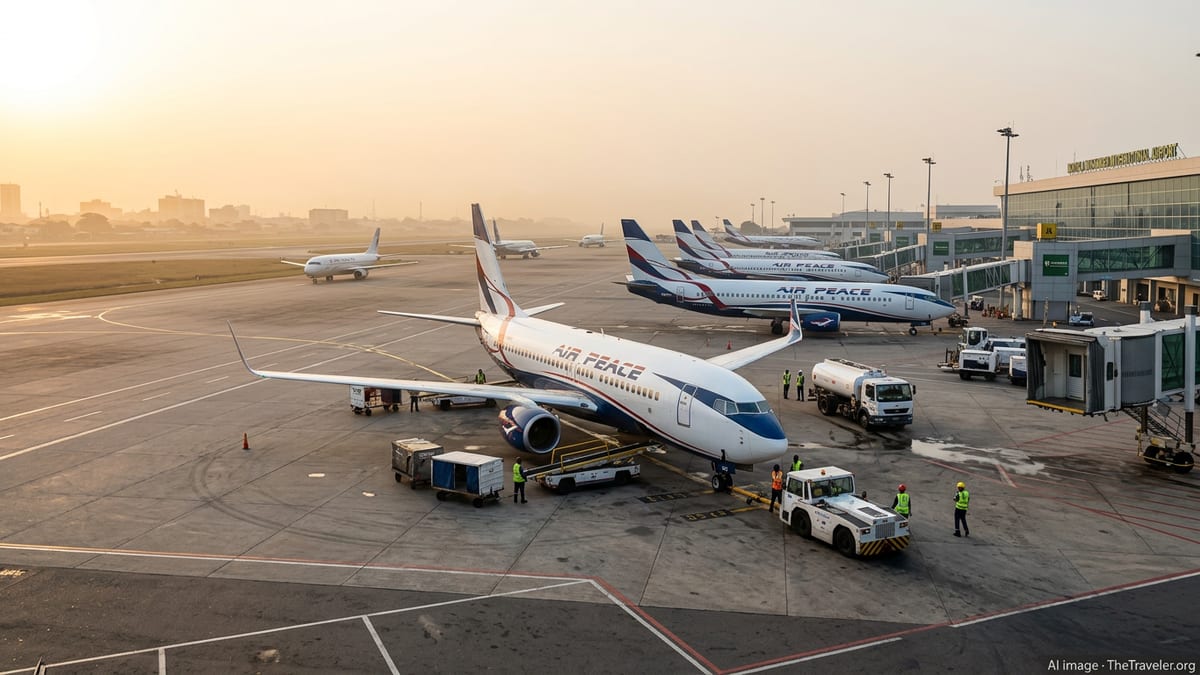
Expanded Regional Schedules Strengthen Lagos Network
Under new schedules announced this week, Air Peace will operate enhanced multi-stop rotations that knit together key political and commercial capitals across West Africa, all funnelling through its primary base at Murtala Muhammed International Airport in Lagos. The move upgrades existing regional services into a tighter, more frequent network designed to give business and leisure travellers additional same-day connection options.
The airline has outlined Lagos–Abidjan–Dakar–Banjul services and Lagos–Accra–Monrovia–Freetown patterns, among others, with outbound and inbound flights timed to maximise connectivity in Lagos. According to details released by the carrier, certain trunk segments such as Lagos–Accra and Lagos–Abidjan will see increased frequency and more consistent departure times, aimed at simplifying itinerary planning for corporate travellers and tour operators.
Executives at the carrier say the April 2026 changes reflect rising demand for point-to-point travel within West Africa, which has historically been constrained by limited direct links and reliance on European hubs for intra-African journeys. By reorganising the schedule and consolidating traffic over Lagos, the airline is seeking to capture a greater share of regional flows that currently leak to non-African competitors.
Positioning Lagos as West Africa’s Primary Aviation Gateway
The strategy underscores Nigeria’s long-stated ambition to turn Lagos into the main aviation gateway for West and Central Africa. With the region’s largest population and one of its biggest economies, Lagos already generates substantial origin and destination traffic, but has faced stiff competition from Accra, Dakar and Abidjan, which have moved faster in recent years to court global carriers and build hub credentials.
Air Peace is betting that a dense regional network radiating from Lagos can tilt that balance. By offering same-carrier itineraries from secondary capitals like Banjul, Monrovia and Freetown into Lagos, then onward to long-haul services operated either by Air Peace or partner airlines, the Nigerian hub seeks to present a compelling alternative to backtracking through Europe or the Middle East.
The carrier’s recently deepened interline cooperation with a major Gulf airline, which allows tickets combining West African regional legs on Air Peace with onward connections via Lagos to long-haul services, further enhances this proposition. Travellers from cities such as Dakar or Freetown will be able to check in once and connect seamlessly in Lagos to intercontinental destinations, improving Nigeria’s competitive edge as a transfer point.
Aviation analysts note that hub development is driven as much by network density and schedule reliability as by terminal infrastructure. They argue that if Air Peace can sustain regular frequencies on these new and expanded routes and align them with banked departure waves in Lagos, the city could consolidate its role as the natural connecting point for West African passengers heading to Europe, the Middle East and the Americas.
Implications for Trade, Business Travel and Tourism
The reinforced Lagos-centered network is expected to have significant implications for trade flows and business connectivity within the Economic Community of West African States. Many of the cities now more tightly connected to Lagos are national capitals or commercial hubs, hosting regional headquarters for banks, energy companies, multilateral agencies and fast-growing technology firms.
Shorter travel times between Lagos and cities like Abidjan, Dakar and Accra could make it easier for executives to manage cross-border operations and attend meetings across multiple markets within a single week. The addition and rationalisation of flights to Banjul, Monrovia and Freetown, which have traditionally suffered from thin connectivity, may also support investment missions, infrastructure projects and development programmes that depend on regular air links.
Tourism stakeholders in the region point to the growing interest in multi-country West African itineraries that combine coastal capitals, heritage sites and beach destinations. More predictable and frequent services between Lagos and other littoral cities could enable tour operators to package Lagos with historic sites in Senegal, island escapes in Cape Verde via Dakar connections, or cultural festivals in Ghana and Sierra Leone, using the new Air Peace schedules as a backbone.
For small and medium-sized enterprises, expanded connectivity may reduce the cost and complexity of moving goods and people across borders. With many intra-African shipments still carried in aircraft bellies rather than dedicated freighters, additional frequencies can translate into more capacity for high-value, time-sensitive cargo such as pharmaceuticals, electronics and fashion items.
Competitive Dynamics in a Crowded West African Skies
Air Peace’s move comes amid intensifying competition for regional dominance in West Africa. Carriers based in Ghana, Senegal, Togo and other neighbouring markets have built up their own regional networks in recent years, sometimes using more modern fleets and benefiting from aggressive state backing. International airlines from Europe and the Middle East also continue to carry a large share of West African passengers, even on journeys that begin and end within the continent.
By sharply expanding schedules that touch Abidjan, Dakar, Banjul, Accra, Monrovia and Freetown in one coordinated timetable, Air Peace is challenging rival African carriers that use these cities as mini-hubs. The airline’s strategy appears focused on harnessing Nigeria’s large outbound market, the strength of Lagos as a commercial magnet and its growing portfolio of long-haul and interline partnerships to pull traffic back onto Nigerian metal.
Industry observers will watch closely how quickly the market responds once the new schedules go live in April 2026. Key questions include whether corporate travel managers shift contracts to take advantage of the denser Lagos-centric network, and whether passengers accustomed to transiting through European gateways will be persuaded by shorter total journey times and potentially lower fares on fully African itineraries.
Regulatory stability, airport service quality and on-time performance in Lagos will also be critical factors. While the expanded network strengthens the commercial logic of using Lagos as a hub, sustained investment in ground handling, passenger processing and air traffic management will be required to avoid congestion and ensure that promised connection times are consistently met.
Infrastructure, Partnerships and the Road Ahead
The April 2026 schedule changes are part of a wider evolution in Nigeria’s aviation sector, which has seen recent investments in terminal upgrades, as well as new long-haul routes and commercial partnerships. Air Peace’s growing fleet, including larger widebody aircraft for intercontinental services, is central to its hub strategy, enabling the airline to feed regional traffic into higher-capacity long-haul departures from Lagos.
Partnerships are another pillar. The expanded interline arrangement with a Gulf carrier, along with talks with other international airlines, is designed to give West African passengers a broader menu of onward destinations without sacrificing the convenience of a single booking and coordinated baggage handling. In turn, foreign carriers gain access to secondary West African markets via Lagos, without having to deploy their own aircraft on thin regional routes.
Looking ahead, the sustainability of Lagos’s hub ambitions will depend on the airline’s ability to maintain financial discipline while growing its network, and on continued support from Nigerian aviation authorities in areas such as slot allocation, safety oversight and the streamlining of passenger formalities. If these elements align, Air Peace’s expanded West African schedules from April 2026 could mark a turning point in the long-running contest over which city emerges as the true aviation capital of the subregion.
For travellers, the immediate impact will be measured in flight options and connection times rather than strategic positioning. But for Nigeria and its neighbours, the decision to tighten the air links between Lagos, Abidjan, Dakar, Banjul, Accra, Monrovia and Freetown underscores how aviation is increasingly central to the region’s economic integration story.