

More news on this day
Two Asian carriers at very different stages of their corporate lives, South Korea’s Air Premia and Thailand’s flag carrier Thai Airways, are both making assertive moves in long haul markets, reshaping how travelers connect between Asia, Europe and North America in 2026 and beyond.
Get the latest news straight to your inbox!
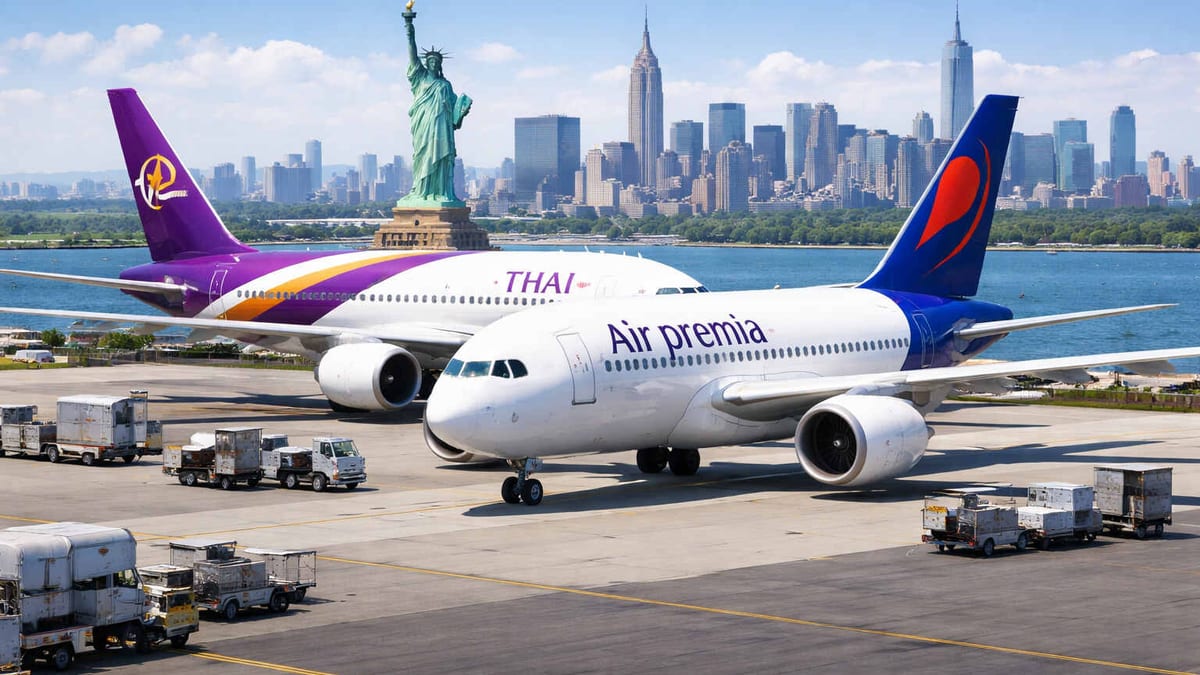
Air Premia Accelerates Long Haul Growth While Trimming Weak Routes
Air Premia, a relatively new hybrid long haul airline based in Seoul, has been expanding around a single aircraft type, the Boeing 787-9 Dreamliner. Publicly available information shows that the carrier has steadily grown its fleet and, as of early 2026, continues to position itself as a value-focused option on transpacific and other long range routes using this fuel-efficient widebody.
Industry coverage indicates that Air Premia’s recent growth has not been linear. Reports from South Korean media in late March 2026 describe a wave of temporary suspensions and cancellations on several marquee North American sectors, including Incheon to Los Angeles, Honolulu, San Francisco and New York. These adjustments appear to be tied to sharply higher fuel surcharges and cost pressures, prompting the airline to rebalance capacity on its longest, most fuel‑intensive flights.
For travelers, this combination of rapid expansion and selective retreat means that Air Premia can offer attractive fares and a relatively new cabin product on active routes, but schedules on marginal long haul city pairs may be less predictable than those of larger, legacy competitors. Anyone holding or considering tickets on seasonal or low frequency routes should monitor schedule updates closely and be prepared for time or day-of-week changes as the airline fine-tunes its network.
At the same time, Air Premia’s commitment to a modern 787-9 fleet gives it a structural advantage on fuel burn and onboard comfort. The Dreamliner’s lower cabin altitude, improved humidity and larger windows can make ultra long flights more tolerable, especially in premium economy, the class where the airline concentrates much of its product differentiation.
Thai Airways Emerges From Restructuring With a Long Haul Ambition
Thai Airways, by contrast, is an established full service carrier that has spent the past several years in court‑supervised rehabilitation. According to publicly available financial and regulatory filings, the airline was cleared to exit its formal rehabilitation program in June 2025 after meeting key performance and governance milestones, including stronger earnings and a recapitalization.
That exit has unlocked a new strategic phase for the Bangkok-based airline. Company presentations and management reports released in early 2026 describe a “Silk Hub” plan that puts long haul connectivity at the center of its growth strategy, with Bangkok positioned as a transfer gateway linking Europe, Australia and high‑volume regional markets such as India. Long haul flying is explicitly framed as a core profit driver in these documents.
Thai Airways is also steadily rebuilding and refreshing its fleet to support this pivot. New-generation widebody aircraft are being added from mid‑2026 to replace older jets, with the goal of reducing fuel consumption, improving reliability and introducing more competitive cabins on intercontinental routes. For passengers, the rollout of newer aircraft typically means upgraded business class seats, improved in‑flight entertainment and better overall comfort on flights that often exceed 10 hours.
As the airline rebuilds, it is simultaneously managing strong demand and higher costs. Travel forums and local business media in March 2026 highlight that Thai Airways plans ticket price increases in the range of 10 to 15 percent to offset fuel and operational expenses. Long haul travelers may therefore see fewer extreme low fares on nonstop Thai Airways flights, but can expect a more financially stable airline with a clearer network strategy.
Route Restarts and New Links Reshape Asia–Europe Flows
One of the most visible pieces of Thai Airways’ long haul strategy is the restoration of former European links. Travel industry reports from early 2026 show that the airline intends to resume direct service between Bangkok and a major Dutch gateway from July 2026, ending a gap of nearly three decades without its own nonstop presence in that market. The move signals confidence in demand between Thailand and the Benelux region and underscores Europe’s importance within the carrier’s network.
Elsewhere in Europe, Thai Airways has been deepening partnerships rather than launching entirely new destinations on its own metal. Specialist route trackers report that the airline has expanded codeshare cooperation with TAP Air Portugal, extending Thai’s reach into additional European cities via Lisbon without immediately committing its own aircraft to every point. This hybrid of organic growth and partnership-driven expansion is central to how the airline is rebuilding long haul connectivity while managing fleet constraints.
These developments align with Thailand’s broader tourism strategy. The Tourism Authority of Thailand has outlined plans to attract more long haul visitors in 2026, particularly from Europe, the Americas and the Middle East, with official targets suggesting that long haul markets could generate hundreds of billions of baht in revenue if conditions remain stable. Thai Airways’ decision to restore and strengthen long haul links can be seen as a commercial response to that national push.
For European travelers, the practical outcome is a growing menu of one‑stop and nonstop options to reach Thailand. Nonstop Thai Airways services should appeal to those prioritizing convenience and Thai-language service, while codeshare and alliance connections offer additional frequencies and departure points for flexibility on price and timing.
Competitive New Aircraft and Cabins Aim to Reframe the Long Haul Experience
Both Air Premia and Thai Airways are leaning heavily on next‑generation aircraft to redefine passenger expectations on long journeys. Air Premia operates an all Boeing 787-9 fleet on its long haul routes, a type widely recognized in industry analysis for its lower fuel consumption and improved cabin environment. Thai Airways, meanwhile, is phasing in new long haul aircraft from 2026 as part of its post‑restructuring fleet renewal.
From a traveler’s perspective, this convergence on modern widebodies matters. Newer aircraft typically enable airlines to install lie‑flat business class seats with direct aisle access, more spacious premium economy cabins and updated in‑flight entertainment systems. Thai Airways already showcases fully flat business class seats with enhanced privacy on several long haul types, and future deliveries are expected to standardize that experience across more of the network.
Air Premia, while operating on a hybrid model that blends elements of low‑cost and full service, has focused on a generous premium economy product and a relatively simple cabin configuration. Industry profiles of the airline describe a cabin layout that prioritizes pitch and comfort in premium economy, supported by the 787’s inherent cabin environment advantages. Economy-class passengers, especially on overnight sectors between Asia and North America, may find the combination of newer aircraft and typically lower fares compelling.
At the same time, both airlines must balance these hardware investments with the reality of rising fuel and operational costs. The decision to adjust surcharges, trim weaker routes or raise base fares reflects this tension. Travelers should expect more dynamic pricing and potentially sharper seasonal swings in availability on popular long haul city pairs, even as the aircraft themselves become more comfortable and efficient.
What Long Haul Travelers Need to Watch in 2026
For passengers planning trips that involve Air Premia or Thai Airways, a few practical themes stand out. First, schedule stability is becoming more fluid. Air Premia’s recent route suspensions in North America illustrate how newer, smaller long haul operators can quickly adjust capacity in response to costs or demand shifts. Booking flexible tickets, avoiding tight onward connections on separate tickets and checking departure status regularly are increasingly important with such carriers.
Second, fare patterns are likely to diverge between the two airlines. Thai Airways, pursuing a strategy centered on hub strength and long haul premium demand, has signaled a willingness to raise prices where demand allows, especially on nonstop European and Australian routes. Air Premia, competing more directly on price and operating a leaner product, may still undercut legacy rivals on comparable sectors, but with a greater risk of seasonal or ad‑hoc changes.
Third, connectivity and partnerships are becoming as important as individual routes. Thai Airways’ expanded codeshares in Europe and renewed Category 1 safety standing with United States regulators open the door to deeper cooperation with foreign airlines and potentially new long haul corridors in the coming years. Travelers may find that the most efficient itineraries between secondary cities in Europe or North America and Thailand now involve a mix of Thai Airways and partners rather than a single‑airline ticket.
Finally, both airlines sit at the intersection of broader policy and tourism moves. Thailand’s long haul visitor strategy and South Korea’s competitive transpacific market dynamics will shape where capacity is added or cut. For travelers, staying informed about these shifts can translate into better choices on routing, timing and cabin product when planning the next intercontinental trip.