

More news on this day
South Korea’s Air Premia is emerging as a disruptive force in long-haul travel, using fewer, larger seats on its Boeing 787-9 fleet to offer a roomier, more comfort-focused alternative to traditional economy cabins.
Get the latest news straight to your inbox!
A Hybrid Model Built Around Space, Not Maximum Capacity
Publicly available information shows that Air Premia operates a single-type fleet of Boeing 787-9 aircraft, but with a notably sparse layout compared with many full-service and low-cost rivals. Instead of squeezing in more than 330 seats, its typical configuration tops out at around 309 seats, trading density for personal space and wider aisles on long-haul routes.
The airline positions itself as a “hybrid service carrier,” combining aspects of low-cost pricing with full-service inclusions such as in-flight meals, checked baggage and seatback entertainment. Reports indicate that this model is designed to keep fares competitive while elevating comfort standards above those found in standard long-haul economy cabins.
By limiting capacity and standardizing on a roomy two-cabin layout, Air Premia is effectively betting that traveler demand is shifting away from ultra-dense layouts toward a more balanced equation of price and comfort. The strategy also simplifies fleet planning and crew training, with every aircraft optimized for the same style of service.
Wide Premium Seating as the Flagship Experience
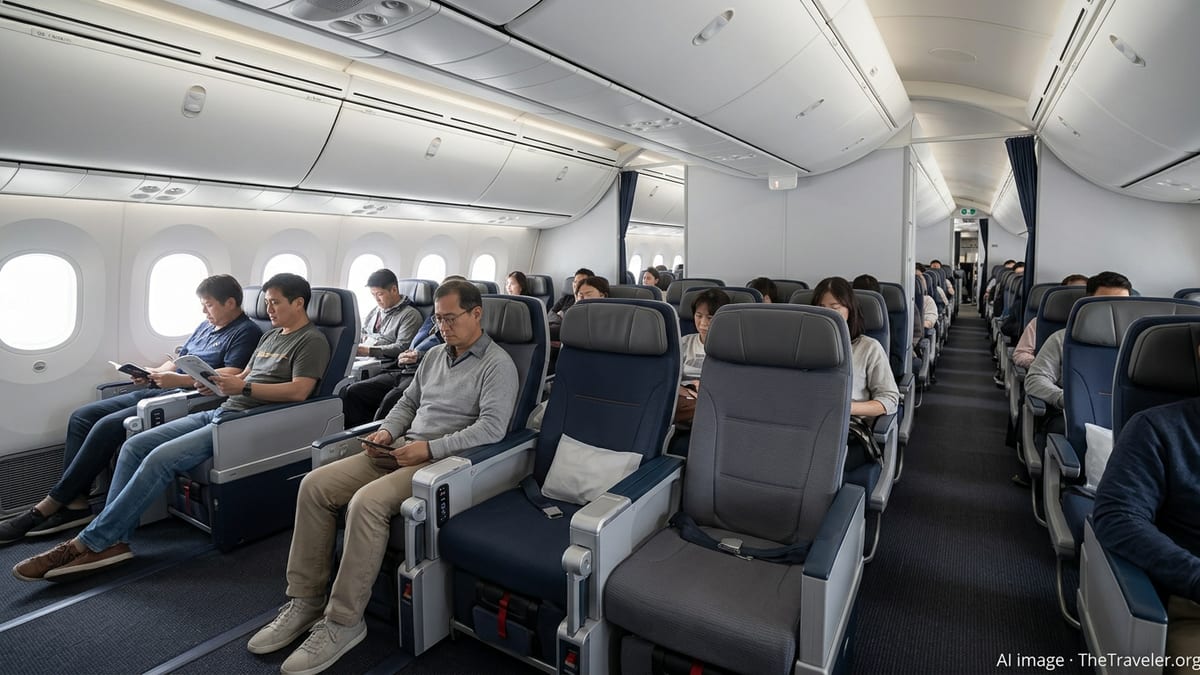
Air Premia’s signature product is its premium economy cabin, branded as “Premia 42” or “Wide Premium” in marketing materials. According to seat maps and product descriptions, this cabin features 56 seats arranged in a 2-3-2 layout, providing a noticeably wider experience than the 3-3-3 layout used in the main cabin.
Published data on the airline’s seating indicates that the premium cabin offers generous legroom, with seat pitch in the low-to-mid 40-inch range, significantly exceeding the 31 to 34 inches typically associated with standard economy on many long-haul carriers. The seats are based on designs from Recaro, a manufacturer better known for high-performance automotive and safety seating, bringing more sculpted support and adjustable headrests to the long-haul environment.
Passengers in this cabin are provided with enhanced amenities on intercontinental flights, including upgraded catering, complimentary alcoholic beverages on many routes, larger personal screens and added baggage allowance. The result is a product that targets travelers who are willing to pay more for comfort but remain priced out of traditional business class.
Roomier Economy With Fewer Passengers Per Dreamliner
Comfort upgrades are not confined to the front of the aircraft. Air Premia brands its main cabin as “Economy 35,” a reference to the seat pitch that is advertised at approximately 35 inches. This is a notable improvement over the 31 to 32 inches often found in standard long-haul economy, and it gives even budget-conscious travelers additional knee room and recline on flights that can exceed 10 hours.
The airline’s 787-9s are configured with about 253 economy seats in a 3-3-3 layout, which is relatively low-density for the type. Many competing carriers fit more seats into the same airframe by trimming pitch and tightening lavatory and galley space. Air Premia’s approach keeps total passenger numbers down and provides a more spacious cabin environment, with slightly wider aisles and less of a crowded feel during boarding and meal services.
Seatback entertainment, power outlets and device charging options are available throughout the aircraft, helping long-haul passengers manage work, streaming and connectivity. Reports from travelers and independent reviews highlight the ability to stretch out, shift positions and move about the cabin more easily compared with denser configurations on similar routes.
Targeting Key Long-Haul Markets With a Comfort Pitch
Network information and schedule filings show that Air Premia has focused its long-haul services on high-demand routes linking Seoul Incheon to major gateways such as Los Angeles, New York, San Francisco and Frankfurt, alongside regional connections to cities including Tokyo, Bangkok, Da Nang and Hong Kong. Additional seasonal and leisure-focused routes, such as Honolulu, have been added as the fleet has grown.
Rather than competing head-to-head on sheer frequency or global alliance connectivity, the airline is using its cabin product as a core differentiator. The promise of extra legroom, upgraded premium economy seating and more manageable cabin loads is central to its pitch for travelers weighing options across Asia–North America and Asia–Europe corridors.
According to published coverage, adjustments to the schedule over recent seasons reflect a strategy of matching capacity carefully with demand while keeping the 787-9 as the platform for all long-haul flying. This allows Air Premia to market a consistent onboard experience, regardless of route or time of year, which is a contrast to carriers that mix multiple aircraft types and varied cabin standards on similar sectors.
A Test Case for the Future of Long-Haul Economy
Air Premia’s model arrives at a moment when many global airlines are increasing the share of premium seats on their long-haul fleets and rethinking how to balance yield with passenger comfort. As more travelers compare not just fares but seat dimensions, pitch and in-flight amenities, airlines that offer larger personal space may gain an advantage on key trunk routes.
Industry observers note that Air Premia’s 309-seat layout on the 787-9, including 56 premium economy seats, positions the carrier at the forefront of this shift. Fewer passengers per aircraft can limit total revenue per flight, but it also opens opportunities to attract higher-yield travelers who value rest, sleep and productivity on overnight journeys.
If the airline’s comfort-first strategy continues to resonate with passengers in markets such as the United States and Europe, it could encourage larger incumbents to revisit their own approach to economy and premium economy design. For now, Air Premia offers a live test of whether wider seats, fewer passengers and a more generous long-haul cabin can set a new standard in the highly competitive world of international travel.