

More news on this day
India has joined a widening network of Asian markets in a new interline partnership between South Korea’s hybrid carrier Air Premia and Thai Airways, a tie-up that is expected to significantly expand one-stop travel options between Southeast Asia, South Asia, and the Americas.
Get the latest news straight to your inbox!
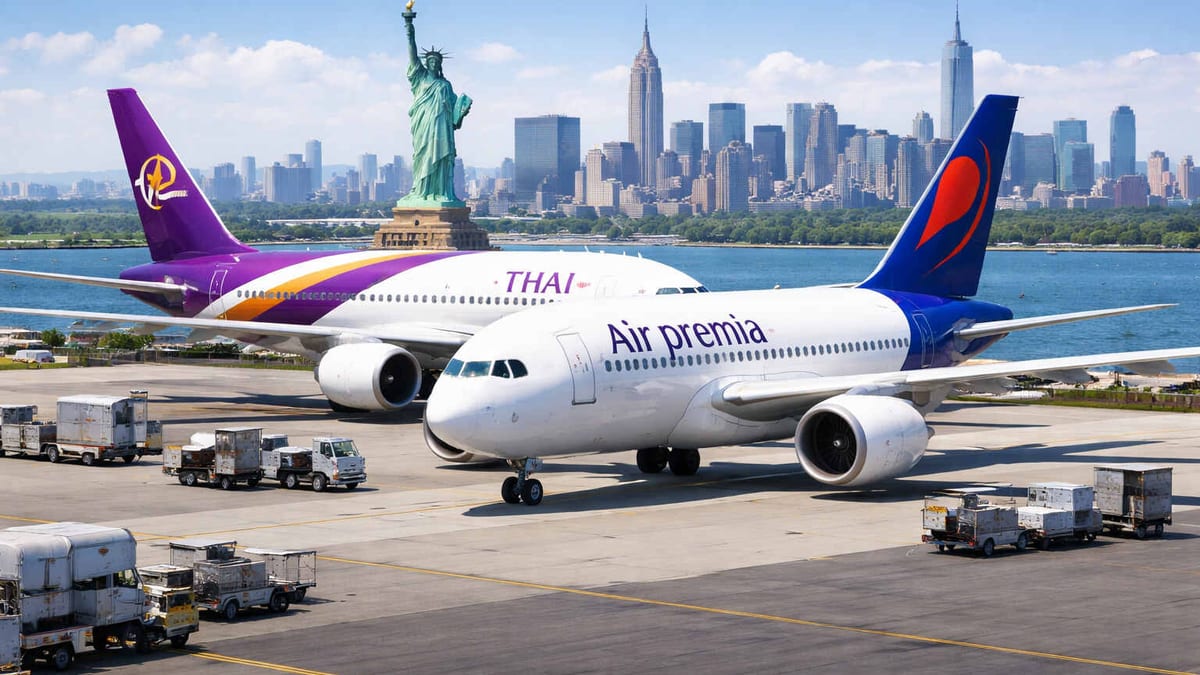
Interline Partnership Goes Live With Broad Asian Footprint
According to information released in late March, Air Premia and Thai Airways have launched an interline partnership that connects Air Premia’s long haul services from Seoul to the Americas with Thai Airways’ regional network across Thailand, Southeast Asia, and India. The joint transportation is scheduled to begin at the end of March, creating through-ticketing and baggage connectivity for passengers traveling across the two carriers’ networks.
Publicly available details show that Thai Airways will feed traffic from its Bangkok hub to Air Premia’s flights to North America, while Air Premia will in turn offer connections to Thai Airways services into key Asian markets. This arrangement is designed to give travelers more options when flying between cities that previously required self-connecting itineraries or more circuitous routings.
The partnership deepens an existing relationship between the two airlines. Thai Airways has already provided ground handling services to Air Premia at Bangkok’s Suvarnabhumi Airport since 2022, supporting the Korean carrier’s Boeing 787 operations. The new interline agreement extends this cooperation from airport services into the commercial and customer-facing side of the business.
Air Premia, positioned between full service and low cost models, has been steadily adding long haul capacity from Seoul to destinations in the United States. By plugging these routes into Thai Airways’ extensive Asian network, the carrier gains access to a much wider pool of origin and destination markets without deploying its own aircraft across the region.
India Added to a Growing List of Connected Markets
The latest phase of the partnership specifically highlights India alongside Japan, Vietnam, Singapore, Indonesia, Malaysia, and the United States as key markets that will benefit from the new connectivity. Published information on the deal indicates that Thai Airways will offer connections from Bangkok to major Indian gateways such as New Delhi, Mumbai, and Chennai, where passengers will be able to link onto Air Premia’s transpacific and transoceanic flights via Seoul.
This effectively positions India as part of a tri-hub corridor built around Bangkok, Seoul, and multiple points in North America. Travelers from Indian metros gain an additional one stop option to cities like Los Angeles, San Francisco, and Newark by combining Thai Airways and Air Premia on a single ticket. For passengers in the opposite direction, the cooperation opens more straightforward access to Indian business and leisure centers through a mix of North America–Seoul–Bangkok–India itineraries.
The inclusion of India is notable given the country’s rapidly expanding outbound and inbound travel demand. Air traffic between India and both Southeast Asia and North America has been growing, supported by rising incomes, diaspora travel, and increased tourism. By joining Japan, Vietnam, Singapore, Indonesia, Malaysia, and the United States in Air Premia’s new interline network, India is now positioned as one of the principal growth markets targeted by the partnership.
For Indian travelers, the appeal lies in the possibility of competitive fares and additional schedule options compared with more traditional routings over Gulf hubs or established North Asian carriers. For both airlines, India’s large and relatively underpenetrated long haul demand represents an opportunity to fill seats and diversify traffic flows beyond their home markets.
Bangkok and Seoul Strengthen Their Role as Transpacific Gateways
The cooperation reinforces Bangkok’s status as a regional connecting hub and adds Seoul as a bridge between Asia and the Americas. Thai Airways already links Bangkok with major Southeast Asian cities, including Kuala Lumpur, Singapore, Jakarta, and Hanoi, as well as domestic destinations such as Phuket and Chiang Mai. With the new agreement, these points are effectively brought into Air Premia’s transpacific network.
Travelers from Southeast Asian cities can now route via Bangkok to Seoul and onward to the United States and other points in the Americas served by Air Premia. In the opposite direction, passengers arriving from North America can connect through Seoul and Bangkok to reach secondary Southeast Asian destinations that may not have direct long haul service.
This strategy mirrors a broader regional trend in which mid-size and recovering legacy carriers in Asia are turning to partnerships rather than launching their own long haul routes. Thai Airways has been rebuilding its international footprint following restructuring, relying on a mix of joint ventures, codeshares, and interline agreements to expand its reach without committing substantial new widebody capacity on every corridor.
For Air Premia, the tie-up offers access to a well-established Southeast Asian hub with strong brand recognition and local sales presence. The Korean airline has a relatively small fleet but is adding capacity and routes, making network partnerships an efficient way to fill aircraft and grow market share on long haul sectors to and from the United States.
Competitive Implications for Southeast Asia–Americas Travel
The new partnership enters an increasingly competitive landscape for travel between Southeast Asia and the Americas. Large Gulf and East Asian carriers continue to dominate many flows, while North American airlines compete aggressively for transpacific traffic. The Air Premia–Thai Airways interline arrangement offers an alternative to these established players, especially for price-sensitive travelers willing to connect via Seoul and Bangkok.
One potential impact is greater fare competition on certain city pairs where the new routing provides a viable substitute for existing one stop options. For example, travelers heading from Jakarta or Kuala Lumpur to the west coast of the United States could now compare itineraries via Bangkok and Seoul with those via Tokyo, Hong Kong, or Middle Eastern hubs. Additional choice may encourage airlines across the region to refine schedules, pricing, and product offerings.
The tie-up may also appeal to niche segments such as diaspora travelers, students, and small business passengers whose priorities include flexible routings and access to multiple secondary cities rather than only non-stop trunk routes. By combining Thai Airways’ regional coverage with Air Premia’s long haul services, the partnership is structured to capture these fragmented but high-growth traffic flows.
Observers are watching how the cooperation will integrate with frequent flyer programs, distribution platforms, and possible future codeshares. For now, the interline arrangement primarily focuses on through-ticketing and baggage transfer, but its development may influence how alliances and independent carriers respond on overlapping routes between Southeast Asia, India, and North America.
Part of Thai Airways’ Broader Partnership Strategy
The Air Premia agreement aligns with Thai Airways’ broader strategy of using partnerships to rebuild its long haul relevance. In recent years the Thai flag carrier has expanded cooperation with several international airlines, including joint ventures and codeshares that extend its reach to Europe, the Middle East, and other parts of Asia. The interline deal with a growing Korean hybrid carrier adds another layer to this network-based approach.
Industry analyses of Thai Airways’ restructuring highlight a shift toward asset-light expansion, where the airline prioritizes partnerships, fleet modernization, and selective route launches rather than rapid capacity growth. By partnering with Air Premia on transpacific connectivity, Thai Airways gains access to additional North American capacity without deploying its own aircraft on new long haul routes.
For Air Premia, alignment with a regional full service carrier strengthens its proposition as it competes with established players on long haul routes. The airline has been investing in new aircraft and expanding services to the United States, and cooperation with Thai Airways offers a way to build traffic density and brand visibility across Southeast Asia and India.
As markets between South Asia, Southeast Asia, and the Americas continue to recover and grow, both carriers are positioning themselves to capture traffic flows that may previously have defaulted to larger global network airlines. India’s inclusion in the latest phase of their cooperation underscores the central role that the country, alongside Japan, Vietnam, Singapore, Indonesia, Malaysia, and the United States, is expected to play in the evolving geography of Asia–Americas air travel.