

More news on this day
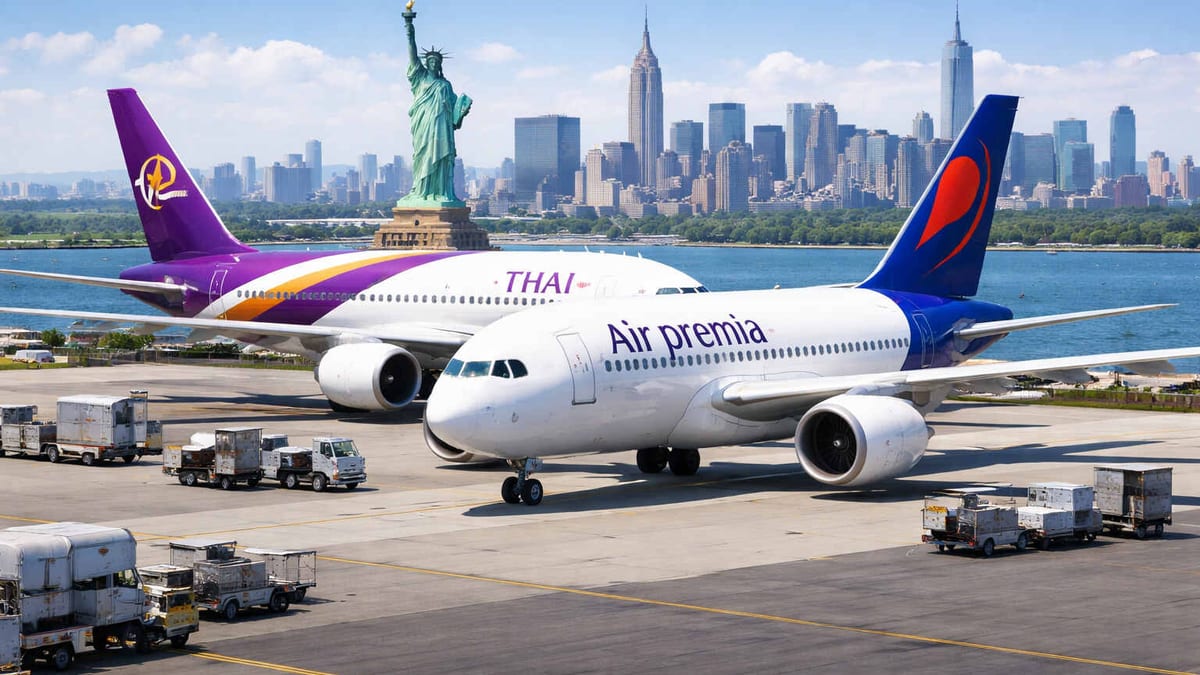
Air Premia and Thai Airways have launched a new interline partnership designed to streamline travel from Thailand, Malaysia, Singapore, Indonesia, Vietnam, and India to major United States gateways via Seoul Incheon, signaling a fresh push to capture fast-growing transpacific demand.
Get the latest news straight to your inbox!
Interline Partnership Targets Growing Transpacific Demand
The partnership, announced in late March 2026, creates joint transportation options that link Thai Airways’ regional and medium-haul network with Air Premia’s long-haul services to the United States. Publicly available information shows that joint ticketing under the interline arrangement is scheduled to begin on March 30, enabling passengers to travel on a single itinerary across both airlines.
Under the agreement, Thai Airways routes from Bangkok and other Southeast Asian cities will connect over Seoul Incheon to Air Premia flights bound for Los Angeles, New York, San Francisco, and Honolulu, as well as a planned service to Washington, D.C. Reports indicate that the move is aimed at tapping into rising demand for travel between Southeast Asia, India, and North America at a time of sustained tourism recovery and growing business links.
The structure of the deal is particularly significant given that Thailand currently has no nonstop passenger flights to the United States. By leveraging Air Premia’s transpacific capacity, Thai Airways gains indirect access to the U.S. market while focusing its own fleet on Asia, Europe, and Oceania, where it maintains a large network.
For Air Premia, a hybrid carrier that combines elements of low-cost and full-service business models, the arrangement represents a chance to strengthen its position at Incheon as a transit hub. The airline already serves several Asian destinations and is using partnerships to widen its catchment area far beyond South Korea’s borders.
Seamless One-Stop Journeys From Southeast Asia and India
According to published coverage, the interline cooperation will extend beyond Thailand to feed traffic from neighboring markets, including Malaysia, Singapore, Indonesia, Vietnam, and India, into Air Premia’s U.S.-bound network. Thai Airways operates from Bangkok Suvarnabhumi to key regional cities such as Kuala Lumpur, Singapore, Jakarta, and Hanoi, and also serves major Indian gateways including New Delhi, Mumbai, and Chennai.
With the new setup, passengers on Thai Airways from these cities can connect via Bangkok and onwards to Seoul, where they transfer to Air Premia flights to North America. The single-ticket structure typically allows through check-in of baggage and coordinated itineraries, which reduces connection complexity compared with separate bookings on different airlines.
Industry reports suggest this type of one-stop itinerary is increasingly attractive to travelers from Southeast Asia and India who are seeking alternatives to traditional transit hubs in the Middle East or Europe. The Incheon routing adds another option, particularly for passengers whose final destinations are on the U.S. West Coast or East Coast cities already in Air Premia’s schedule.
Travel trade coverage indicates that tourism boards in Thailand and other Southeast Asian countries are watching these developments closely, viewing improved long-haul connectivity as a lever to draw more visitors from North America while also supporting outbound leisure and business travel.
Bangkok, Phuket, and Chiang Mai Gain Wider U.S. Access
The collaboration is expected to be especially impactful for Thailand’s main tourist gateways. Reports note that Bangkok, Phuket, and Chiang Mai will all benefit from enhanced access to U.S. cities as their Thai Airways flights connect to Air Premia services at Incheon. This could prove timely as Thailand targets higher-spending long-haul visitors to balance its tourism mix.
Bangkok Suvarnabhumi already functions as a major regional hub, and Thai Airways operates multiple daily services on the Bangkok–Incheon route alongside Air Premia’s own flights. The higher combined frequency gives travelers more flexibility in planning connections to North America, which is often a critical factor for both business travelers and time-sensitive leisure passengers.
For Phuket and Chiang Mai, which traditionally rely heavily on regional and charter traffic, the possibility of smoother one-stop access to U.S. markets may encourage more year-round, higher-yield visitors. Travel industry observers point out that resort destinations see tangible benefits when airlines and partners simplify long-haul journeys with coordinated schedules and baggage handling.
Local tourism stakeholders are also expected to monitor booking patterns as the interline product rolls out, particularly for the upcoming peak travel seasons. Performance on these routes could help determine whether further capacity or additional city pairs are added under the cooperation.
Competitive Dynamics Across Southeast Asia and India
The Air Premia–Thai Airways partnership enters an increasingly competitive arena, as carriers across Asia intensify efforts to link Southeast Asia and India with North America. Major Gulf airlines, as well as East Asian hubs, already serve this traffic, while U.S. and Canadian airlines offer their own connection options via North American gateways.
Analysts note that interline arrangements such as this one allow airlines to respond more quickly to demand without immediately committing additional widebody aircraft or inaugurating new nonstop sectors. For Thai Airways, which has focused its post-restructuring strategy on network optimization and financial stability, utilizing partner capacity for U.S. access aligns with a cautious expansion approach.
For Air Premia, attracting connecting passengers from Thai Airways could help boost load factors on long-haul U.S. routes and strengthen its case for further expansion in the Americas. Publicly available information shows that the airline has been steadily building its long-haul portfolio from Incheon, and additional feed from Southeast Asia and India may support more consistent year-round operations.
In markets such as India, Vietnam, and Indonesia, where demand to the United States has grown alongside economic and diaspora links, the new Incheon-based connection provides another routing choice. Travel agents and online booking platforms are likely to play an important role in showcasing these itineraries to price- and time-sensitive travelers weighing multiple options.
What the Partnership Means for Travelers
For passengers, the practical implications of the interline deal are centered on simplicity and choice. With joint ticketing, travelers can typically book a single itinerary that covers regional flights on Thai Airways and long-haul segments on Air Premia, rather than assembling separate bookings and rechecking luggage at transfer points.
According to information released through industry channels, the agreement is expected to allow through check-in of baggage to the final destination on eligible itineraries, as well as coordinated handling in the event of delays or disruptions. While specific fare products and conditions will vary by route and booking channel, the integrated structure generally improves the overall travel experience compared with fragmented point-to-point bookings.
The partnership also underscores the strategic role of Seoul Incheon as a connecting hub for traffic between North America and Southeast Asia or India. As airlines continue to rebuild and recalibrate networks in the wake of the global travel downturn, such interline cooperations give carriers flexibility to test new flows and respond to shifting passenger preferences.
Travel industry observers will be watching how quickly the new Air Premia–Thai Airways itineraries gain traction and whether the partners deepen their cooperation through expanded schedules or additional commercial arrangements. For now, the launch of the interline deal adds another option for travelers moving between the United States and a wide swath of cities across Thailand, Southeast Asia, and the Indian subcontinent.