

More news on this day
Air Serbia is reshaping the passenger journey at Belgrade Nikola Tesla Airport by expanding the use of new self-service check-in kiosks, giving travelers faster and more flexible ways to start their trip.
Get the latest news straight to your inbox!
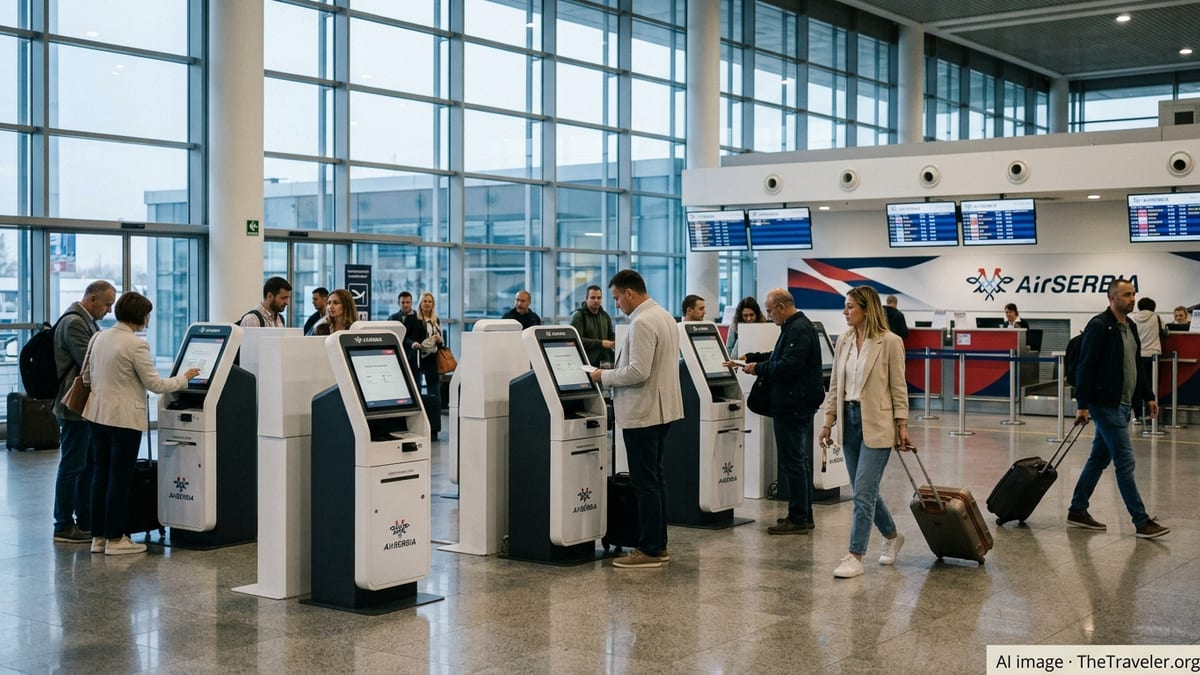
New Generation Kiosks Take Center Stage in Belgrade
Publicly available information shows that Air Serbia is rolling out an enhanced self-service check-in experience at its Belgrade hub, supported by a new generation of kiosks integrated into the airport’s common-use infrastructure. Positioned near the carrier’s main check-in and premium zones, the devices are intended to relieve pressure on traditional counters during peak hours and provide an additional option for time-pressed travelers.
Specialist provider Easier reports that Air Serbia is using its ALISS self-service application on common-use self-service kiosks at Belgrade Nikola Tesla Airport, allowing the airline to deliver branded check-in across shared machines. The software layer is designed to work on CUSS hardware operated by the airport, which has been investing in modern self-service systems to support rising passenger volumes.
Information published by Belgrade Airport and industry outlets indicates that the new kiosks are being installed across key landside areas of the terminal, including positions opposite Air Serbia’s premium check-in zone. This layout is intended to keep self-service options close to conventional desks, so passengers can easily move between staff-assisted and kiosk-based services depending on their needs.
According to recent coverage in regional aviation media, the expanded kiosk network is part of a wider upgrade of Belgrade’s terminal facilities, which has included new check-in islands, reconfigured security lanes and updated passenger information systems. Within this broader modernization program, Air Serbia’s self-service push is emerging as a central element of the airport experience for the airline’s growing customer base.
What Passengers Can Do at the New Kiosks
Technology provider documentation and airline guidance indicate that Air Serbia’s self-service kiosks are designed to handle core departure tasks that would traditionally require a visit to the counter. Passengers can start the check-in process by identifying themselves with a booking reference, ticket number or loyalty profile, then confirm their flight details and generate a boarding pass for same-day departures.
The ALISS platform described by Easier allows travelers to select or change seats during check-in, within the limits of the fare purchased and the airline’s seating policies. This aligns the kiosk experience with Air Serbia’s online and mobile check-in tools, giving passengers a consistent set of options regardless of the channel they choose.
Air Serbia’s public check-in information notes that kiosks at Belgrade open 24 hours before departure for most routes, giving travelers more flexibility over when they complete formalities. Reports indicate that once a boarding pass has been issued at a kiosk, passengers with hand baggage only can proceed directly to security and passport control, while those with checked bags can head to dedicated bag-drop positions.
Industry analyses of common-use self-service systems suggest that the kiosks can support multiple airlines, but at Belgrade they are increasingly tailored to Air Serbia’s branding and workflow. This approach helps ensure that travelers recognize the service as part of the national carrier’s offering, even though the underlying hardware is shared across the airport.
Reduced Queues and a Smoother Flow Through the Terminal
Airport planning documents and aviation trade coverage emphasize that the expanded self-service network in Belgrade is intended to ease congestion, particularly during early morning and evening departure peaks. By shifting part of the check-in workload away from staffed counters, the kiosks help shorten queues for passengers who still require in-person assistance, such as families with special service requests or travelers on complex itineraries.
Common-use self-service technology described by international aviation standards bodies is designed to improve the overall flow of passengers from curb to gate. At Belgrade Nikola Tesla Airport, this translates into fewer bottlenecks at the front of the terminal and a more even distribution of travelers across security and border control points as they complete check-in at different times.
Observers of Belgrade’s recent terminal expansion note that Air Serbia’s kiosk strategy fits with the airport’s broader move toward automation, which already includes electronic border controls and upgraded digital signage. By encouraging more passengers to use self-service for routine tasks, both the airline and the airport can focus staff resources on resolving disruptions and assisting travelers with specific needs.
Travel advice platforms that track passenger experiences at Belgrade report that self-service options are particularly valuable during high season, when the airport handles a mix of local travelers and connecting passengers from across Air Serbia’s network. In this context, the new kiosks are presented as a practical tool for reducing stress at the start of the journey.
Integration With Online Check-In and Premium Services
Air Serbia’s official guidance highlights that self-service kiosks complement its existing online and mobile check-in channels rather than replacing them. Travelers can still obtain boarding passes up to 48 hours before departure via the airline’s digital platforms, and then use the airport’s facilities primarily for baggage handling and security formalities.
For premium and business-class travelers, the new kiosks are closely linked to an upgraded check-in environment at Belgrade. Recent business coverage describes how Air Serbia has introduced a dedicated premium zone, and the positioning of kiosks nearby allows higher-yield customers to choose between fast, assisted service at a staffed counter or an independent self-service route, depending on their preference.
According to information made available by Belgrade Airport, the self-service devices are connected to the hub’s centralized IT systems, meaning that boarding passes printed at the kiosks are fully synchronized with departure control and gate operations. This integration helps reduce discrepancies between channels and supports smooth boarding processes at the gates.
Analysts who follow the carrier’s development point out that Air Serbia is using Belgrade as a testbed for digital improvements that could later extend to other airports in its network where suitable infrastructure exists. The self-service platform at the hub is therefore seen as both a direct benefit for local passengers and a foundation for wider modernization of the airline’s customer journey.
What This Means for Travelers Heading Through Belgrade
For passengers, the most visible change is the growing number of branded Air Serbia kiosks across the departure hall, signaling more choice in how to manage pre-flight formalities. Travelers comfortable with technology can complete check-in and seat selection in a few steps, often in less time than it takes to queue for a staffed desk, while less frequent flyers still have the option of traditional counter service.
Travel information sites recommend that passengers departing Belgrade with Air Serbia arrive with enough time to explore these new options, especially during busy periods. Those with simple itineraries and only cabin baggage may find that a quick stop at a kiosk, followed by security and passport control, delivers a noticeably shorter airport experience.
As Belgrade Nikola Tesla Airport continues to grow as a regional hub and Air Serbia expands its route network, the enhanced self-service environment is positioned as an important part of keeping the terminal efficient and manageable. The airline’s collaboration with technology partners and the airport’s common-use systems signals an ongoing shift toward more automated, passenger-driven processes at its home base.
While traditional check-in will remain essential for certain categories of travelers, the expanding kiosk network at Belgrade reflects a broader trend across global aviation, where self-service tools are becoming a standard expectation rather than a novelty. For Air Serbia customers, that trend is now firmly embedded at the heart of their journey through the carrier’s main hub.