

More news on this day
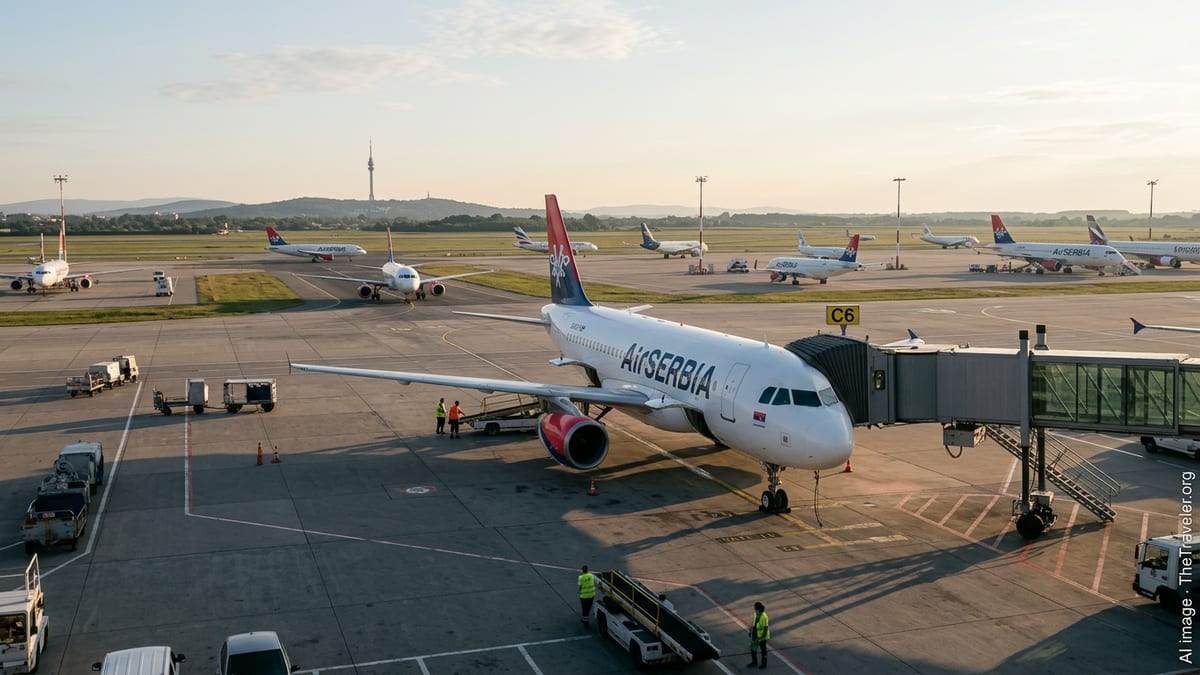
Air Serbia is gearing up for a landmark Summer 2026 season, rolling out new routes to Greece, Azerbaijan, Canada, Spain and Norway alongside increased frequencies that will significantly deepen Belgrade’s role as a fast-growing transfer hub between Europe, North America and emerging markets.
Get the latest news straight to your inbox!
Six New Destinations Anchor an Ambitious 2026 Strategy
Building on several consecutive years of growth, Air Serbia has confirmed six new direct routes for 2026 that will be split between the peak summer and winter schedules. For the warmer months, the carrier is adding Santorini in Greece, Baku in Azerbaijan and Toronto in Canada, all operated from its Belgrade base and designed to capture both leisure and business demand. The mix underscores the airline’s strategy of pairing classic holiday islands and cultural hotspots with major economic centers and long-haul connectivity.
The winter timetable will bring three additional destinations into the network: Tenerife and Seville in Spain, along with Tromsø in Norway. Together, they broaden Air Serbia’s reach to the Atlantic-facing Canary Islands, deepen access to southern Spain and open a new door into the Arctic north. With services already loaded into reservation systems and tickets on sale, the airline is clearly betting on sustained demand through 2026, rather than a one-off summer spike.
By announcing both summer and winter developments in a single wave, Air Serbia is giving travelers, tour operators and corporate travel buyers more time to plan. The approach also signals confidence in year-round traffic flows, as Belgrade positions itself as a convenient and cost-competitive connecting point for passengers traveling between Central and Eastern Europe, the Mediterranean, the Caucasus and North America.
Greece, Azerbaijan and Canada: A New Triangle of Opportunity
Among the summer additions, Greece, Azerbaijan and Canada stand out as strategic pillars. Santorini, due to launch in late April 2026, taps into enduring appetite for Greek island getaways, where demand has remained strong even during periods of broader market uncertainty. By adding direct seasonal flights, Air Serbia is offering regional travelers an alternative to congested western European hubs and giving inbound visitors from Greece a smooth connection to the Balkans, Central Europe and beyond via Belgrade.
Baku, the capital of Azerbaijan, is scheduled to join the network in early May 2026. This route strengthens links between southeastern Europe and the energy-rich Caspian region, adding options for business travelers while also supporting growing tourism interest in the Caucasus. The connection is expected to feed traffic in both directions, with Belgrade serving as a convenient stopover for passengers heading to western Europe and for Balkan travelers accessing Central Asia and the South Caucasus.
The long-haul highlight is Toronto, which will restore a non-stop air bridge between Serbia and Canada after more than three decades. Set to start in late May 2026 with widebody aircraft, the Belgrade–Toronto service is aimed at the sizable Serbian and Balkan diaspora in Canada, as well as at business travelers and Canadian tourists looking for new gateways into southeastern Europe and the Mediterranean. The route also enhances North American access to Greece and other regional leisure markets by enabling one-stop connections through Belgrade during peak holiday periods.
Spain and Norway Extend the Network to Sun and Snow
On the winter side of the schedule, Air Serbia’s choices in Spain and Norway reflect a deliberate push to smooth out seasonality. Tenerife provides a reliable escape for sun-seekers during the European winter, with its mild year-round climate and established tourism infrastructure. Direct flights from Belgrade will give travelers in the Balkans and neighboring countries easier access to the Canary Islands without relying on traditional western European hubs, a move that could strengthen the airline’s competitive position in the off-peak months.
Seville, planned for launch at the end of September 2026, broadens the carrier’s footprint in southern Spain at the shoulder between summer and winter. As a historic Andalusian city that combines strong city-break appeal with access to wider regional attractions, Seville is well placed to attract both leisure visitors and conference traffic. Its addition complements Tenerife by offering a mainland Spanish option that remains attractive well beyond the high summer window.
Tromsø, scheduled to debut in mid-December 2026, opens an entirely new frontier for Air Serbia. Located above the Arctic Circle, the Norwegian city has emerged as a sought-after base for Northern Lights tourism and winter adventure travel. The new connection is expected to draw passengers from across southeastern Europe who might previously have required multiple stops to reach northern Norway. At the same time, Norwegian travelers gain a direct link into the Balkans and onward connections to warmer destinations on Air Serbia’s network.
Capacity Growth and Frequency Increases Across the Summer 2026 Network
Beyond the headline-grabbing new routes, Air Serbia is also planning a substantial densification of its existing Summer 2026 network. The airline has put almost 3.9 million seats on sale for the season, representing an increase of nearly 6 percent compared with the previous year and translating into roughly 2,000 additional flights over the course of the schedule. The expansion will primarily benefit core European and regional routes that feed traffic into Belgrade from key catchment areas.
Several established destinations are due to receive extra weekly frequencies, particularly those with strong leisure demand and proven year-round performance. While specific adjustments vary by month, the overall pattern is one of thickening connectivity on high-demand city pairs, rather than broad but thin coverage. That strategy reflects lessons learned over multiple summer seasons, in which the airline has tested new markets, trimmed underperforming routes and redeployed capacity to more resilient segments.
The increase in flights is also tied to anticipated fleet optimization, with Air Serbia continuing to balance narrowbody and regional aircraft across its European network. Higher frequencies on trunk routes mean more convenient departure times and shorter connection windows for transfer passengers. For transatlantic travelers heading to or from Toronto, for example, additional flights to popular Balkan and central European cities should make one-stop itineraries via Belgrade more attractive against competing hub options.
Belgrade’s Growing Role as a Regional Transfer Powerhouse
All of the new Summer 2026 routes reinforce Belgrade’s position as a rising transfer hub at the crossroads of Europe. By connecting Greece, Azerbaijan, Canada, Spain and Norway with a single connecting point, Air Serbia is building a web of city pairs that did not previously have viable or efficient one-stop options. The carrier’s focus on schedule coordination is increasingly important, particularly for time-sensitive corporate travelers and long-haul passengers who expect seamless transfers.
Industry observers note that Air Serbia’s expansion comes as several European competitors recalibrate their networks and, in some cases, retreat from marginal routes. That creates opportunities for agile mid-sized airlines to step in with targeted new services and stronger regional coverage. In this context, the 2026 surge is not just about adding destinations, but about staking a claim in markets where demand remains robust but supply has been uneven or overly concentrated at traditional megahubs.
For travelers, the result is a more diverse set of options linking secondary and tertiary cities to long-haul corridors. A passenger from Santorini or Baku heading to Toronto, for instance, will be able to complete the journey with a single, coordinated stop in Belgrade. Similarly, winter holidaymakers from the Balkans can pair a Tromsø aurora-chasing adventure with a Tenerife beach escape, all within one airline’s network. As Summer 2026 approaches, Air Serbia’s latest moves suggest that the carrier intends to keep pressing its network advantage, using carefully chosen new routes and higher frequencies to unlock a level of global access that would have been difficult to imagine from Belgrade just a decade ago.