

More news on this day
AirAsia is stepping up warnings about fake customer service accounts spreading across social media, urging travellers to use only its verified digital platforms and official support tools when booking flights, managing reservations or seeking help with disrupted journeys.
Get the latest news straight to your inbox!
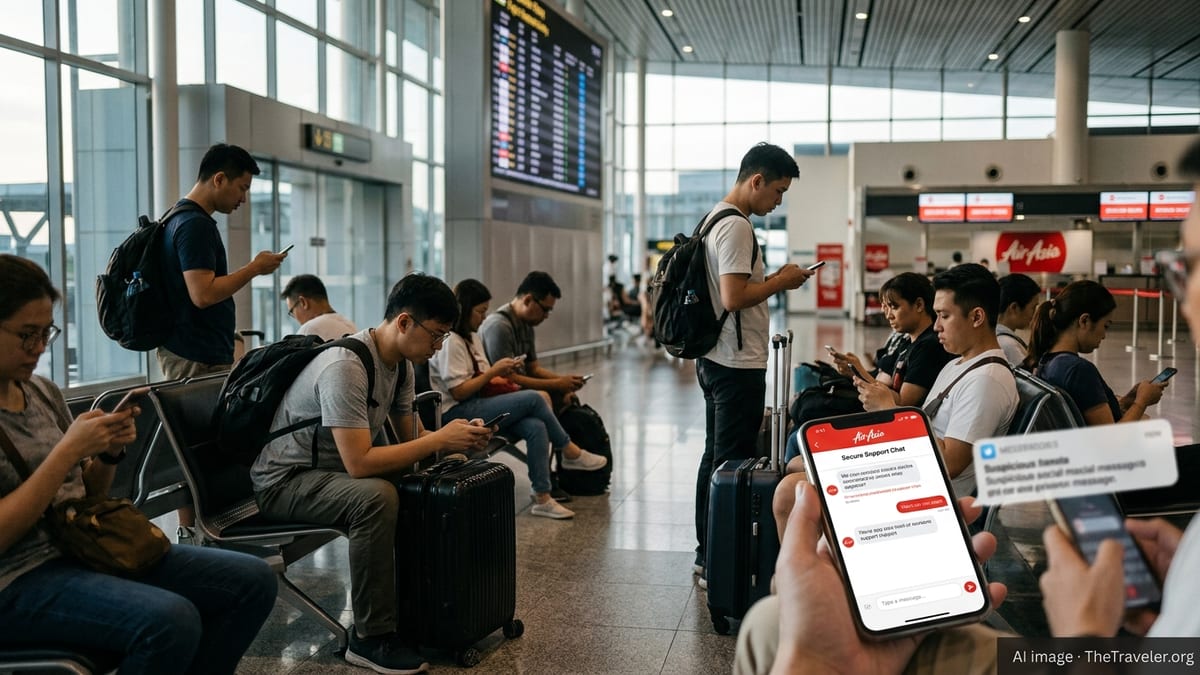
Rising Wave of Impersonation Scams Targeting Travellers
Recent advisories and published coverage indicate that budget-conscious travellers in Southeast Asia are increasingly being targeted by criminals who pose as AirAsia representatives on social platforms. These impostor accounts typically appear in comments under promotional posts or operate as lookalike pages and messaging profiles, offering assistance with bookings, refunds or flight changes.
Reports describe a pattern in which scammers quickly respond to frustrated customers posting about delays, cancellations or payment issues, then invite them into private messages. Once contact is made, victims are often directed to share personal data, card details or one-time passcodes, or to make transfers to personal bank or digital wallet accounts under the pretext of “service fees” or “ticket processing charges.”
According to regional news coverage, AirAsia and its affiliated brands have repeatedly reminded the public that transactions are honored only when processed through official channels. Advisory notices highlight that heavily discounted offers promoted via unverified pages, groups or individual profiles are a red flag for fraud, particularly when they require direct transfers outside standard payment gateways.
Travel industry observers note that these scams are emerging alongside a broader trend of airline impersonation, where fraudsters mirror logos and color schemes to create convincing profiles. The Federal Trade Commission in the United States has reported similar tactics used against travelers of various carriers, showing that the problem is part of a wider global pattern rather than confined to one airline or market.
How Fake Customer Service Profiles Operate on Social Media
Publicly available information points to several recurring tactics used by those misusing the AirAsia name. On platforms such as Facebook, Instagram and X, phony pages often copy the airline’s branding and repost official marketing images to appear legitimate. Some run sponsored posts targeting users who recently searched for flights, while others simply reply to real passengers on the airline’s verified pages, hoping to redirect conversations into private channels.
Once communication moves to private messages, the fraud typically escalates. Victims may be told that a booking can only be confirmed if a “manual verification fee” or “fare top-up” is paid via bank transfer, mobile wallet or gift cards. In other instances, impostors send links to external sites that mimic AirAsia’s digital environment but are controlled by scammers, aiming to capture login credentials, passport numbers and payment information.
Regional coverage has also described cases in which bogus agents on messaging apps claim to represent partner travel agencies. They promote package deals that appear to be tied to AirAsia flights, sometimes using forged business registrations to bolster credibility. Travellers have reported turning up at airports to discover that their reservation numbers cannot be found in the airline’s system, revealing only at check in that they have been duped.
Security analysts advise that the speed and personalization of these interactions are central to their effectiveness. With many travelers already stressed by time-sensitive changes, a message that appears to come from a helpful “customer care” profile can feel reassuring, making it easier for scammers to bypass normal caution and obtain sensitive details.
AirAsia’s Verified Digital Support and Secure Contact Points
In response to the rise in impersonation attempts, AirAsia has promoted a digital-first support model centered on its official mobile app, website and in-platform virtual assistant. Public guidance stresses that customers should start all service requests by logging into a verified AirAsia account and using support options built into the platform, rather than relying on unsolicited direct messages or third-party intermediaries.
According to the airline’s published materials, the app and web portal are designed to handle common needs such as booking changes, seat selection, add-ons and basic disruption management without requiring travelers to disclose card data or passwords over chat. Payment flows are embedded within the airline’s secure payment page, and any additional charges are displayed transparently at checkout rather than requested via personal accounts.
AirAsia’s social media community guidelines, made publicly available, underline that the company will not ask users to share financial details, one-time passwords or complete transactions through private messages. Instead, social channels are positioned as information and engagement spaces that redirect users back to the official app, website or authorized travel partners when a transaction or detailed account support is required.
Travelers with complex cases who still need human assistance are generally instructed, through public advisories, to reach out via contact information provided within the airline’s own platforms or to seek help at airport service counters. This approach is framed as part of a broader effort to reduce the visibility of personal data in informal channels where it can be intercepted or misused.
Guidance for Travellers to Stay Safe While Booking and Rebooking
Consumer protection agencies and aviation commentators recommend that AirAsia customers treat any unsolicited message offering booking help, refunds or compensation as suspicious, particularly if it arrives through personal accounts that are not clearly verified. Before engaging, travelers are encouraged to check profile names, spelling, follower counts and verification markers, and to compare messaging against information published on the airline’s official platforms.
When in doubt about a promotion or assistance offer, travellers are advised to close the conversation and independently open the AirAsia app or website, rather than clicking on links shared through social media or message threads. If a deal or itinerary is legitimate, it should be visible when searching directly through the airline’s booking system or through clearly identified authorized agents.
Experts further highlight the importance of monitoring bank and card statements after any online purchase. Unexpected small “test” charges or unfamiliar merchant descriptions can signal that payment details have been compromised, whether through fake travel agents, spoofed sites or malicious links clicked in social feeds. In such cases, customers are urged to contact their bank immediately and change passwords associated with their travel accounts.
For frequent flyers and first-time travellers alike, the core message is consistency: book, manage and seek support for AirAsia flights only through recognized, secure digital channels. As peak travel seasons approach in key AirAsia markets, industry observers note that this vigilance can make the difference between a smooth low-cost journey and an expensive detour into fraud and identity theft.