

More news on this day
An airBaltic Airbus A220-300 undergoing maintenance in Riga has been written off after a severe hangar fire, marking the first hull loss of the A220 type and raising new questions about ground safety and operational resilience for one of Europe’s most A220‑dependent airlines.
Get the latest news straight to your inbox!
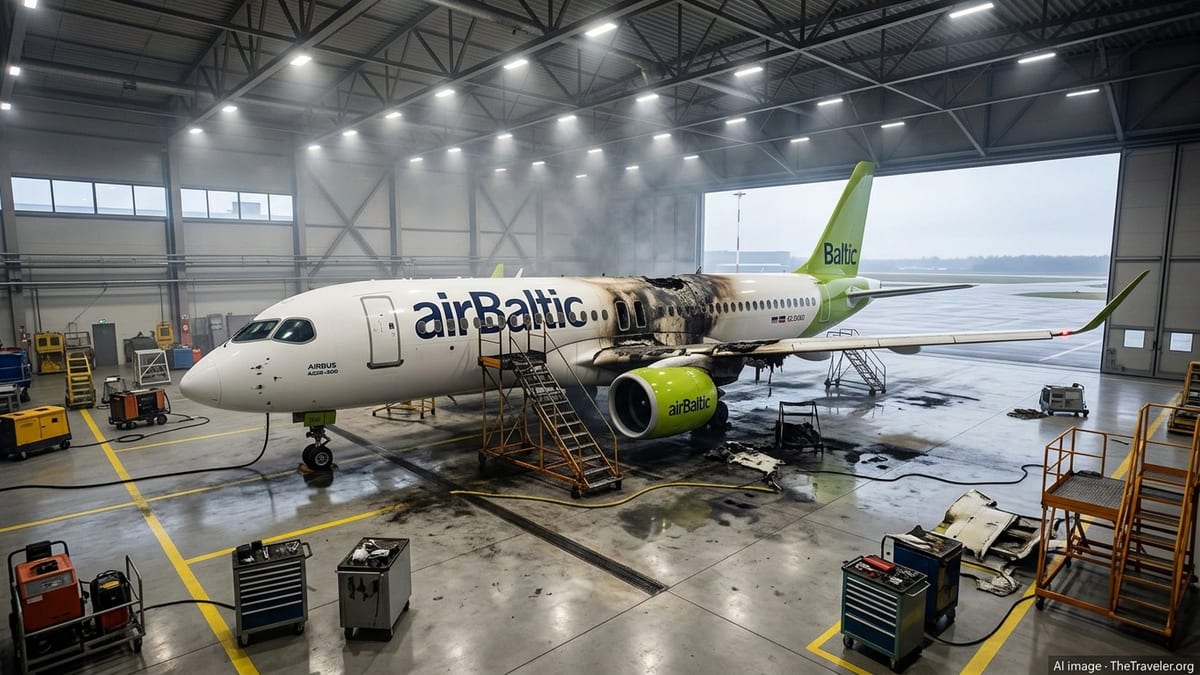
What Happened During the Riga Hangar Fire
Publicly available information indicates that the incident occurred at Riga International Airport while the aircraft was in a maintenance hangar for scheduled work. Reports describe a fire breaking out around the center section of the airframe during a ground run of the auxiliary power unit, a small engine that supplies electrical power and air when the main engines are shut down.
Images and descriptions circulating in industry coverage show heavy damage to the fuselage and wing-root area, with scorching and structural deformation significant enough that the aircraft has been declared beyond economic repair. No passengers were on board at the time, and no serious injuries among ground personnel have been reported in the material currently available.
The aircraft involved is identified in fleet databases as an airBaltic Airbus A220-300, registration YL-AAO, one of the newer examples in the carrier’s single-type jet fleet. The aircraft had been operating normal commercial services before being withdrawn for maintenance.
Latvian and international aviation safety bodies are expected to review the circumstances as part of a standard occurrence investigation. Early reports focus on the sequence surrounding the APU run and subsequent fire, but as of now there is no official public finding regarding root cause.
Why This Is a Milestone for the Airbus A220 Program
According to aircraft safety databases and compiled fleet records, this event represents the first recorded hull loss of an Airbus A220 worldwide. A hull loss is defined as damage so severe that repair is not economically viable, even if parts of the aircraft remain intact.
The A220 family, which entered commercial service in 2016 after its origins as the Bombardier CSeries, has built a reputation for strong fuel efficiency and favorable passenger comfort. Until this Riga incident, the global fleet had not experienced a write-off, despite isolated engine and technical events that prompted inspections and short-term groundings on some operators.
Industry reports emphasize that this fire occurred on the ground during maintenance, not during passenger operations. While any hull loss is a notable event for a relatively young aircraft type, aviation analysts generally distinguish between operational accidents and maintenance or storage-related damage when assessing an aircraft’s safety record.
For travelers, the key point is that there is no indication of an in-flight safety issue linked to this specific event. Regulators and manufacturers typically respond to such occurrences with technical recommendations or procedural refinements if investigations highlight any systemic vulnerabilities.
Impact on airBaltic’s Operations and Fleet Strategy
airBaltic is one of the world’s most A220-focused airlines, operating an all-A220-300 jet fleet on routes across Europe, the Middle East, and parts of North Africa. The loss of a single aircraft may appear modest in numerical terms, but it arrives on top of extended engine maintenance challenges that have already constrained capacity.
In recent seasons, public statements and local media coverage have detailed how prolonged turnaround times for Pratt & Whitney geared turbofan engine overhauls forced airBaltic to ground several A220s and cancel thousands of flights across its network. Those constraints have led to schedule trimming, wet-leasing of substitute aircraft from partner carriers, and a renewed emphasis on careful fleet planning.
With one hull written off, airBaltic now faces an additional gap in a fleet that was already stretched by maintenance-related downtime. The airline has promoted its investment in new hangars and in-house maintenance capability at Riga as a way to better control turnaround times and support its growing A220 fleet, and this incident places fresh attention on those facilities and procedures.
For passengers, the most visible effects may be limited to occasional aircraft substitutions, minor retimings, or reduced frequencies on certain routes, especially during peak seasonal periods when spare capacity is thin. Booking data and schedule filings will show over time whether airBaltic adjusts its network to compensate for the permanent loss of this airframe.
What Maintenance Investigators Are Expected to Examine
Ground incidents of this kind typically prompt a detailed technical and procedural review. The focus is likely to include how the auxiliary power unit was being operated, the configuration of fuel and electrical systems at the time, and overall hangar safety measures such as fire detection, suppression systems, and emergency response protocols.
Investigators customarily look at maintenance task cards, staff training and certification records, and the sequence of events leading to the first visible signs of fire. They may also assess whether any recent technical directives from Airbus, engine manufacturer Pratt & Whitney, or aviation authorities had a bearing on the work being performed.
Available reporting does not currently suggest that this fire is linked to the broader issues affecting the A220’s geared turbofan engines, which have centered on premature wear and mandatory inspections rather than fire risk in normal use. However, any common threads, even indirect ones such as configuration during extended ground runs, are likely to be examined.
Once an official investigation is complete, authorities typically publish recommendations that can include changes to maintenance procedures, updates to training, or modifications to equipment. For airlines, such findings often result in revised checklists or additional safeguards when performing high-power runs or other higher-risk tasks inside hangars.
What Travelers Should Know If They Are Booked on airBaltic
For passengers holding airBaltic tickets in the coming weeks and months, the Riga hangar fire is unlikely to alter the basic travel experience. The loss of one aircraft may contribute to tighter capacity on some routes, but there has been no suggestion of systemic safety concerns affecting day-to-day A220 operations.
Travelers may still encounter some schedule adjustments driven by the ongoing engine maintenance situation rather than this specific incident. Publicly available timetable and booking information already reflects a network that has been trimmed to match the number of serviceable aircraft, with airlines across the region taking similar steps in response to global engine shop bottlenecks.
Those who are particularly sensitive to aircraft type can typically see the planned model for each flight at the time of booking or in their reservation details. However, substitutions are common in commercial aviation, and carriers usually reserve the right to swap equipment as needed for operational reasons.
Overall, this first-ever A220 hull loss is significant primarily for manufacturers, regulators, and airline planners. For most travelers passing through Riga or flying on airBaltic, the practical impact will be limited to how effectively the airline manages its fleet, maintenance capacity, and contingency planning in the wake of an already demanding period for its A220 operations.