

More news on this day
Latvian carrier airBaltic closed 2025 with record revenue and passenger numbers, reinforcing its role as the Baltic region’s leading airline and positioning the company for an aggressive expansion strategy in 2026.
Get the latest news straight to your inbox!
Record 2025 Revenue and Passenger Milestones
Publicly available financial information shows that airBaltic generated revenue of about 779 million euros in 2025, its highest annual total to date and an increase of roughly 4 percent compared with 2024. Industry coverage notes that this performance came despite persistent cost pressures and capacity constraints affecting airlines across Europe.
Traffic statistics released through industry outlets indicate that the airline carried approximately 5.2 million passengers on its own network in 2025 and a total of around 8.7 million passengers when including wet-lease and charter activities. That total volume, spread across more than 47,000 scheduled flights, is described in published reports as the highest in the company’s three-decade history.
While the carrier has not yet fully returned to sustained profitability, published summaries of the 2025 results highlight a significantly reduced net loss compared with previous years. Analysts note that this improvement reflects both stronger demand and tighter cost control after a period of heavy investment in fleet renewal and network rebuilding.
Compared with 2024, when airBaltic carried roughly the same number of passengers on its core network but at a lower revenue base, the 2025 figures suggest that the company was able to lift yields in key markets while maintaining high load factors on its most important routes.
Expanded Network and ACMI Growth
Operational data reported by aviation news outlets show that airBaltic operated around 133 routes to more than 80 destinations in nearly 40 countries during 2025. The network remained strongly centered on the airline’s home base in Riga, supported by additional operations from Tallinn, Vilnius and seasonal bases across Europe to capture leisure demand.
Alongside its scheduled network, airBaltic continued to scale its ACMI activity, operating in the region of 30,000 flights on behalf of other airlines in 2025. According to published coverage, this segment delivered an important share of revenue growth, providing a buffer against seasonal swings in point to point demand and helping to optimize utilization of the Airbus A220 fleet.
Industry analyses describe 2025 as a year in which the carrier focused less on pure route proliferation and more on deepening connectivity across existing markets, particularly to Western Europe and the Mediterranean. Frequencies were adjusted during the year to respond to shifting demand patterns and capacity limitations at several European hubs, while maintaining strong connectivity from the Baltic capitals to major business and leisure centers.
Reports also indicate that operational challenges, including airspace restrictions and disruptions at certain regional airports, weighed on punctuality and added to costs. Even so, the airline maintained growth in both flights and passenger volumes compared with 2024, pointing to resilient underlying demand on its core flows.
Fleet Investments and Onboard Innovation
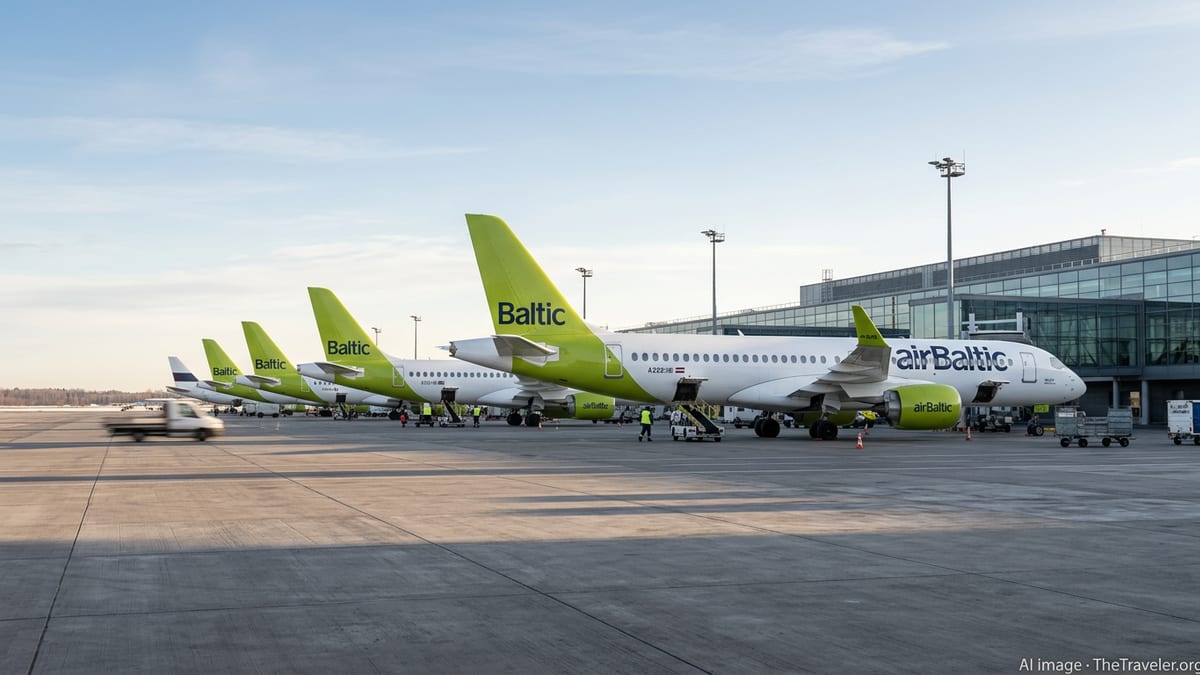
airBaltic’s fleet strategy remained a central driver of its 2025 performance and future plans. The carrier continued to operate an all-Airbus A220-300 fleet, one of the youngest in Europe, with further deliveries scheduled into 2026. Public documents describe this single-type strategy as a key contributor to fuel efficiency, maintenance savings and operational flexibility.
Industry coverage highlights that new aircraft arriving in late 2025 and early 2026 are expected to support additional frequencies and seasonal routes, while also expanding the pool of jets available for ACMI contracts. The A220’s range and economics enable the airline to serve both dense intra-European routes and thinner markets that might not sustain larger aircraft.
Beyond the airframe, airBaltic has also invested in the onboard product as it prepares for the next phase of growth. Reports indicate that the airline is rolling out high-speed Starlink satellite connectivity across the fleet, with a wider deployment expected during 2026. This upgrade is positioned as a differentiator in the competitive European short-haul market, particularly for business travelers and digitally focused leisure passengers.
Cabin enhancements, including refreshed interiors and a continued focus on buy-on-board catering, are described in trade publications as incremental but important steps toward reinforcing the brand’s positioning as a value-focused yet quality-conscious regional carrier.
Financial Trajectory and IPO Readiness
airBaltic’s management has repeatedly pointed to a potential initial public offering as a key medium-term objective, and 2025’s results are widely interpreted as a step toward that goal. According to summaries of the airline’s interim financial statements, the company generated sufficient operational cash flow to support its activities while narrowing its net loss over the year.
Analysts following the Baltic aviation market note that the combination of record revenue, improved load factors and a modern, fuel-efficient fleet has started to reduce the financial drag associated with earlier pandemic-era losses and support measures. At the same time, the airline continues to carry a meaningful debt burden and remains exposed to volatility in fuel prices and regional demand.
Commentary in European aviation media suggests that the airline’s shareholder structure, led by the Latvian state, would likely remain a central consideration in any future listing. Market observers indicate that the earliest realistic window for an IPO would be in 2026, contingent on stable macroeconomic conditions and continued operational performance.
In that context, the 2025 figures are viewed less as an endpoint and more as evidence that the airline’s business model is scaling toward consistent profitability. The challenge for 2026 and beyond will be sustaining growth while keeping cost inflation, competitive pressure and geopolitical risks in check.
Positioning for Unstoppable Expansion in 2026
Forward-looking statements and guidance published alongside the 2025 results point to an even more ambitious year in 2026. The airline expects higher revenue, supported by additional A220 deliveries, expanded ACMI commitments and a denser network from its Baltic bases. Travel demand across Europe is forecast by industry bodies to remain strong, offering a supportive backdrop for further growth.
airBaltic plans to capitalize on this environment by deepening connectivity from Riga, Tallinn and Vilnius to major European hubs, while also adding or restoring routes in Southern Europe and the Caucasus region where demand has recovered. The airline’s strategy appears to prioritize markets where its A220 fleet can offer both schedule flexibility and unit cost advantages over competitors.
Reports also underline the role of digital and ancillary revenue initiatives in the 2026 plan. With the rollout of high-speed onboard connectivity, the airline is expected to expand its portfolio of paid services, from seat selection and baggage to in-flight entertainment and partnerships, in line with broader trends across the low-cost and hybrid carrier segment.
Industry observers suggest that if airBaltic can sustain its 2025 trajectory, maintain disciplined capacity growth and avoid major operational disruptions, 2026 could mark a turning point in which record revenue and passenger volumes translate into durable profitability. That outcome would not only strengthen the airline’s case for an eventual listing, but also further consolidate its status as a pivotal connector between the Baltic states and the rest of Europe.