

More news on this day
Latvian carrier airBaltic has reported record revenue and passenger numbers for 2025, marking a pivotal year of growth that positions the airline for an accelerated expansion strategy in 2026.
Get the latest news straight to your inbox!
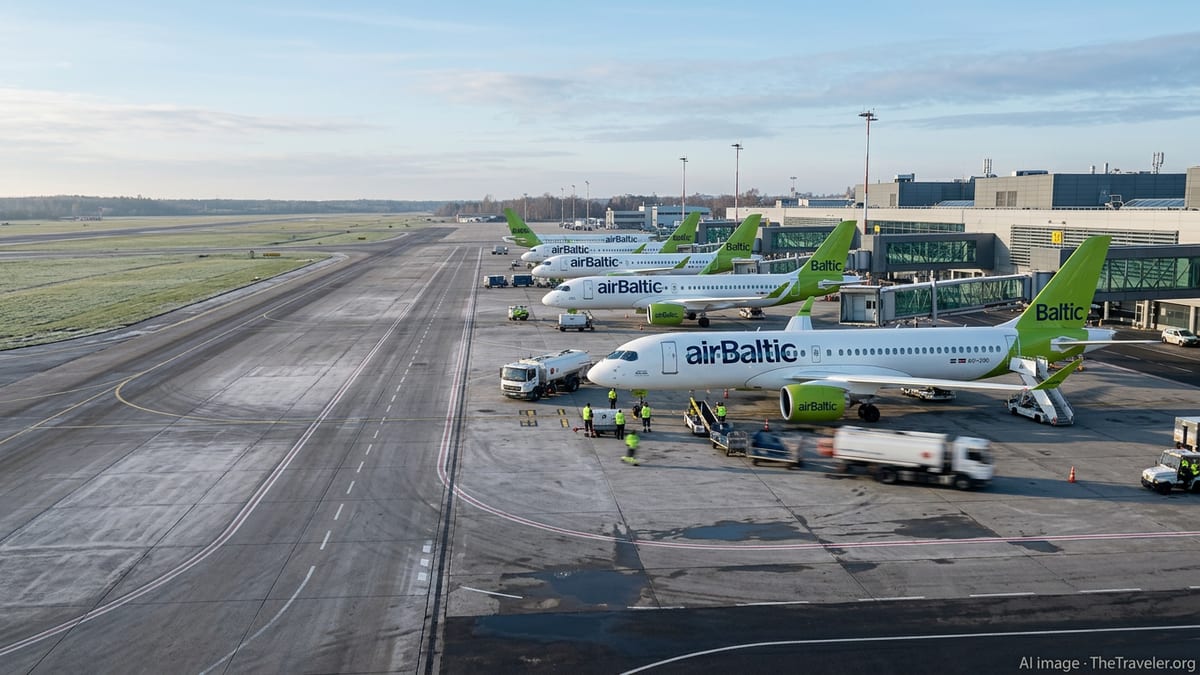
Record 2025 Performance Caps Multi‑Year Growth Run
Publicly available financial information shows that airBaltic generated approximately 779 million euros in revenue in 2025, its highest annual total to date and a modest increase on the previous year’s record. The carrier also transported more passengers than ever before, with reports indicating more than 5.2 million travelers on its own network and around 8.7 million passengers in total, including wet-lease operations.
Industry coverage notes that the airline simultaneously narrowed its net loss in 2025, continuing a trend of financial recovery after the pandemic and subsequent cost pressures. While profitability remains a key medium-term target, the combination of higher revenue, rising load factors, and controlled losses is viewed as a foundation for more sustainable growth.
The 2025 outcome builds on a strong 2024, when airBaltic already delivered all-time highs in both revenue and passenger numbers. Year-on-year momentum in both metrics has been supported by expanding capacity, new routes from Baltic bases, and a growing contribution from ACMI flying for other European airlines.
According to airline industry analyses, this multi-year performance has moved airBaltic firmly back into a growth phase, with management guidance and investor presentations pointing to further capacity increases and network diversification in 2026.
Passenger Growth Underpins Network and Market Share
Passenger traffic has become the central driver of airBaltic’s recent performance. Data presented in the company’s latest annual report and summarized by aviation media show that total passenger numbers rose by double digits between 2023 and 2024, followed by further growth in 2025 to more than five million passengers on its own services. Including ACMI and charter operations, the total number of travelers carried reached close to nine million in 2025.
Reports indicate that airBaltic flew more than 47,000 flights in 2025 across a network that connected the Baltic capitals of Riga, Tallinn, and Vilnius with over 80 destinations. The carrier also continued to build its presence from Tampere in Finland, further strengthening its position as a regional connector between Northern Europe and the wider continent.
Analysts note that this rising passenger base has helped airBaltic secure a larger share of traffic at key Baltic gateways, particularly Riga, where the airline already acts as the primary hub operator. Additional frequencies on popular leisure routes and improved connectivity to major European hubs have further supported demand.
Publicly reported on-time performance metrics and a simplified single-type fleet are also cited as factors that have helped airBaltic attract both business and leisure customers. Higher customer satisfaction and repeat traffic, in turn, are contributing to stronger yields and improved unit revenue.
ACMI, Fleet Strategy, and Ancillary Revenue Drive the Top Line
Behind the topline revenue growth, airBaltic continues to refine a business model that blends traditional point-to-point services with a significant ACMI, or wet-lease, operation. Travel industry reports for 2025 highlight that the carrier operated around 30,000 ACMI flights during the year, providing aircraft, crew, maintenance, and insurance to other airlines across Europe.
This ACMI segment has become a key revenue pillar, supplying relatively stable demand during peak seasons and helping to optimize utilization of the airline’s Airbus A220-300 fleet. By balancing contracted ACMI flying with its own scheduled network, airBaltic has been able to deploy capacity flexibly in response to seasonal and macroeconomic shifts.
The airline’s single-type fleet strategy around the Airbus A220-300 continues to be presented as a competitive advantage. Industry coverage points to lower fuel burn, reduced maintenance complexity, and a more consistent onboard product as factors that support both cost efficiency and passenger appeal. The carrier has been steadily taking delivery of additional A220s, with further aircraft scheduled in 2026 to support growth.
Ancillary revenue is another contributor to the record 2025 results. Publicly available information on airBaltic’s performance indicates growing income from services such as seat selection, baggage, onboard sales, and partner arrangements. Coupled with the introduction of high-speed satellite connectivity across the fleet, these initiatives are expected to support higher yields in 2026.
Setting the Stage for Ambitious Expansion in 2026
Financial presentations and recent investor-focused briefings on airBaltic’s 2025 results outline an ambitious growth trajectory for 2026. The airline plans to further increase capacity, supported by additional Airbus A220 deliveries and a continued emphasis on both regional connectivity and ACMI partnerships.
According to published outlooks, airBaltic expects another rise in passenger numbers in 2026, targeting incremental growth on its Baltic routes and selective expansion into new markets. Network plans reported by aviation media include additional connections from Riga, Tallinn, Vilnius, and Tampere to Southern European leisure destinations and key Western European hubs.
At the same time, the airline intends to deepen its ACMI footprint, leveraging its young, fuel-efficient fleet as a solution for carriers facing capacity constraints or fleet renewal delays. Analysts suggest that this could provide a buffer against potential economic softness in parts of Europe, while still allowing airBaltic to grow overall flying activity.
Cost discipline remains a central theme in the 2026 strategy. Publicly available commentary around the 2025 results highlights ongoing efforts to manage fuel, labor, and airport expenses, alongside investments in digitalization and training. These measures are aimed at converting record revenue and passenger volumes into sustained profitability.
Risks, Opportunities, and the Wider European Context
airBaltic’s record 2025 and projected 2026 expansion are unfolding against a broader European aviation backdrop marked by capacity growth and lingering cost pressures. International forecasts for the airline sector point to improving profitability across the industry in 2025 and 2026, but also underline vulnerabilities related to fuel prices, geopolitical tensions, and consumer demand.
For airBaltic, reliance on connecting traffic through the Baltic region and exposure to regional economic conditions present ongoing risks. Aviation analysts also highlight the operational complexity of balancing a rapidly growing ACMI operation with the needs of an expanding in-house network.
At the same time, the airline’s focused fleet strategy, strong position in underserved niche markets, and growing brand recognition in Northern and Central Europe are seen as significant advantages. Continued investment in passenger experience, including onboard connectivity and product upgrades, is expected to reinforce competitive positioning.
As 2026 unfolds, airBaltic’s record revenue and passenger growth in 2025 have created a platform for what many observers describe as one of the more dynamic expansion stories among Europe’s mid-sized carriers. How effectively the airline converts that momentum into durable profitability will be closely watched across the region’s aviation and travel sectors.