

More news on this day
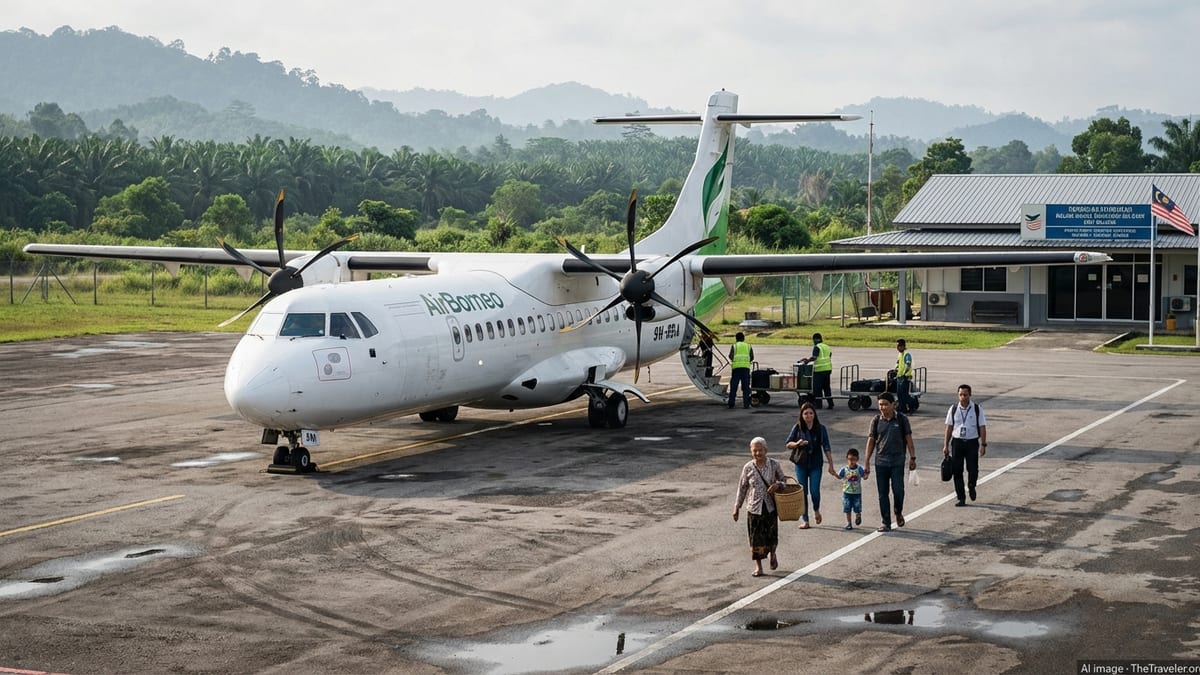
AirBorneo has placed a landmark order for eight new ATR turboprop aircraft as part of a sweeping plan to modernise rural air travel across East Malaysia, signaling a new phase for essential connectivity in Sarawak, Sabah and Labuan and anchoring the young state-owned carrier’s long-term growth strategy.
More News
- Caribbean Travel to U.S. Upended by New Visa Freezes and Expanded Bans
- Mexico Restores E-Visas for Brazilians, Paving the Way for Borderless Tourism
- Philippine Airlines Joins Regional Carriers Powering Southeast Asia’s Tourism Boom
Strategic ATR order unveiled at Singapore Airshow
The order, announced on 3 February 2026 on the opening days of the Singapore Airshow, covers five ATR 72-600s and three smaller ATR 42-600s, with purchase rights for an additional four aircraft. Deliveries are scheduled between 2027 and 2029, aligning with AirBorneo’s gradual fleet renewal and network optimisation plans.
The deal formalises a strategic partnership between AirBorneo and European turboprop manufacturer ATR, which has long provided the backbone of rural air connectivity in Borneo through earlier-generation aircraft. AirBorneo is already operating ATR 72-500s on government-backed Rural Air Services routes, and the latest –600 series will become the core of its future regional fleet.
While the financial value of the order has not been publicly disclosed, industry estimates suggest a substantial multi-hundred-million-dollar commitment at list prices, underlining the Sarawak government’s intent to develop a robust, long-term regional airline with a clear public service mandate. The order was finalised in late 2025, shortly before AirBorneo’s formal launch as Sarawak’s first state-owned carrier.
From MASwings to AirBorneo: a new chapter for rural air services
The ATR order is closely tied to the wider restructuring of East Malaysia’s regional aviation landscape. AirBorneo emerged after the Sarawak government acquired MASwings from Malaysia Aviation Group in 2025, taking over its network of subsidised Rural Air Services that link remote communities with main urban centres.
On 1 January 2026, AirBorneo assumed full legal and operational control of these services, effectively replacing MASwings as the primary operator of rural routes in Sarawak, Sabah and the federal territory of Labuan. The new airline inherited eight ATR 72-500s and six De Havilland Canada DHC-6-400 Twin Otters, many of which are more than a decade old and increasingly expensive to maintain.
Rural Air Services are a critical part of Malaysia’s aviation policy in Borneo, providing lifeline connections to interior towns and coastal settlements that are often unreachable by road during monsoon seasons or at all. For Sarawak, with its vast territory and scattered settlements along rivers and forested valleys, maintaining reliable air links is as much a social necessity as an economic one.
AirBorneo’s leadership has framed the fleet renewal as a central pillar in its transformation from a rebranded operator into a modern regional airline that can meet evolving passenger expectations while preserving the essential public service role historically played by MASwings.
What the new ATR 72-600 and 42-600 bring to Borneo skies
The decision to invest in both the ATR 72-600 and ATR 42-600 reflects AirBorneo’s need to serve a diverse mix of routes, from relatively busy links between regional hubs to thin, low-density sectors connecting isolated airstrips. The 72-seat ATR 72-600 will handle higher-demand routes, while the smaller, roughly 48-seat ATR 42-600 is suited to shorter or less frequented sectors where runway length or demand is more constrained.
Both variants belong to ATR’s latest –600 series, which features updated avionics, improved navigation systems and a redesigned cabin. The manufacturer highlights better fuel efficiency, lower operating costs and significantly reduced carbon emissions per passenger-kilometre compared with regional jets, an increasingly important factor as governments and airlines look to decarbonise short-haul travel.
For passengers, the new aircraft promise quieter cabins, refreshed interiors and a more consistent onboard experience, particularly important on routes that may be the only viable means of travel between remote communities and essential services such as hospitals and administrative centres. The aircraft are also configured to support medical stretcher operations, reinforcing their role as airborne lifelines in medical evacuations and emergency situations.
Crucially for Borneo’s demanding operating environment, the ATR family is designed for short takeoff and landing capabilities, enabling operations from shorter and sometimes challenging runways that serve many rural communities. This performance characteristic has been a key reason behind the long-standing presence of ATR aircraft in East Malaysia and underpins AirBorneo’s decision to stay with the type while upgrading to the latest standard.
Modernising an ageing fleet and expanding capacity
Industry data indicate that AirBorneo’s inherited ATR 72-500 fleet averages more than 16 years in age, while its Twin Otters are also well into mid-life. As aircraft grow older, maintenance costs trend upward and reliability can be harder to manage, particularly in environments with high humidity, frequent tropical storms and demanding schedules across dispersed airfields.
The arrival of the ATR –600 series from 2027 will allow AirBorneo to progressively retire or redeploy its older 72-500s and rationalise its fleet around a smaller number of modern, fuel-efficient types. This in turn should improve operational resilience, reduce unplanned maintenance disruptions and support more predictable scheduling on rural routes that communities rely on for travel, freight and access to services.
By combining the ATR 72-600 and 42-600 in one family, AirBorneo can also better “right-size” capacity to match demand. Higher-density routes such as Kuching to Miri or Kota Kinabalu to smaller regional centres can be served with the larger aircraft, while thin or seasonally variable routes into interior airfields may be more economically flown with the smaller variant, all while benefiting from common pilot training, maintenance procedures and spare parts.
The purchase rights for four additional aircraft provide the airline with flexibility to expand capacity further as demand grows or as older aircraft are phased out, without committing to firm deliveries before market conditions justify it. This option is particularly relevant as the Sarawak government and AirBorneo explore broader regional ambitions beyond the core Rural Air Services mandate.
Boosting connectivity, tourism and economic development
Improved rural air connectivity has direct implications for East Malaysia’s wider economic and social development. More reliable and comfortable flights can encourage local travel, stimulate domestic tourism and support small businesses in remote communities that depend on visitors for income. They also underpin critical supply chains for time-sensitive goods, such as fresh produce and medical supplies.
Tourism authorities in Sarawak and Sabah have long emphasised the role of air links in opening up ecotourism destinations, national parks and cultural sites located far from major highways. Renewed fleets and enhanced service reliability can make it easier for tour operators to design itineraries that include more remote destinations, knowing that air services are less prone to cancellations or lengthy delays due to technical issues.
The new aircraft also align with Malaysia’s objective to expand connectivity within the Brunei Darussalam, Indonesia, Malaysia and Philippines East ASEAN Growth Area, a subregional initiative aimed at stimulating trade, investment and tourism in the broader Borneo and southern Philippines region. AirBorneo’s agreement with ATR explicitly references future opportunities beyond the domestic Rural Air Services network, hinting at the possibility of new cross-border routes as regulatory and market conditions allow.
For local communities, the most immediate benefit is expected to be more dependable, comfortable flights and a stronger assurance that essential air services will be sustained over the long term under the stewardship of a state-owned airline whose mandate is closely aligned with regional development goals.
Environmental and efficiency gains for short-haul operations
The ATR order also carries environmental significance. Turboprops are widely regarded in the industry as one of the most efficient aircraft types for short-haul routes, often burning substantially less fuel per passenger than comparable regional jets over distances of a few hundred kilometres. This makes them particularly suitable for East Malaysia’s dense network of short sectors.
ATR has promoted its –600 series as a lower-emission solution for regional aviation, highlighting reductions in fuel burn and carbon dioxide emissions alongside improvements in noise performance. For Sarawak and Sabah, where environmental preservation and sustainable tourism are increasingly prominent policy themes, operating a modern turboprop fleet supports narratives around greener connectivity.
While AirBorneo and ATR have not detailed specific fuel-burn targets for the new fleet, the move to latest-generation aircraft is expected to yield tangible reductions in operating costs. Those savings could help keep Rural Air Services financially viable under public service obligation frameworks, while also easing pressure on government subsidies required to maintain unprofitable but essential routes.
The compatibility of ATR aircraft with emerging sustainable aviation fuel initiatives also positions AirBorneo to participate in future decarbonisation programs as supply and infrastructure for alternative fuels gradually develop in Southeast Asia.
Challenges ahead for implementation and service reliability
Despite the optimism around the ATR deal, AirBorneo still faces a complex implementation challenge. Deliveries will not start until 2027, meaning the airline must continue to operate and maintain its existing fleet for at least another year while ensuring service reliability on routes that communities often consider non-negotiable lifelines.
Pilot training and maintenance preparation for the new types will require significant investment in human capital and infrastructure. Although the ATR 72-500 and ATR 72-600 share broad commonality, the latest avionics and systems will require updated procedures, simulators and technical training to fully realise the benefits of modernisation.
Integrating the smaller ATR 42-600 into the fleet will also demand careful network planning, particularly where runway performance, payload limits and route economics intersect. AirBorneo will need to balance government expectations around coverage and frequency with the commercial realities of operating in a region where yields can be thin and demand volatile.
Nonetheless, the order is being widely read as a strong vote of confidence in AirBorneo’s strategy and the Sarawak government’s determination to build a resilient, service-oriented regional airline that is better equipped to navigate these challenges than its predecessor.
FAQ
Q1. What exactly has AirBorneo ordered from ATR?
AirBorneo has placed a firm order for eight latest-generation turboprop aircraft from ATR, comprising five ATR 72-600s and three ATR 42-600s, along with purchase rights for four additional aircraft that could be exercised at a later date.
Q2. When will the new ATR aircraft be delivered?
The deliveries are scheduled between 2027 and 2029, allowing AirBorneo to phase in the new aircraft gradually while it continues operating its current fleet on Rural Air Services routes.
Q3. Which parts of Malaysia will benefit from these new aircraft?
The new ATR fleet is intended primarily for Rural Air Services in East Malaysia, covering routes across Sarawak, Sabah and Labuan, where air travel is essential for connecting remote and underserved communities.
Q4. Why did AirBorneo choose turboprops instead of regional jets?
Turboprops like the ATR 42-600 and 72-600 are more efficient on short sectors, can operate from shorter runways and offer lower fuel burn and emissions than comparable regional jets, making them particularly well suited to Borneo’s short-haul, rural routes.
Q5. What will happen to AirBorneo’s existing ATR 72-500 aircraft?
The new –600 series aircraft are expected to progressively replace the older ATR 72-500s that AirBorneo inherited from MASwings, which are on average more than 16 years old and costlier to maintain, though the transition will take place over several years.
Q6. How will passengers notice the difference on board?
Passengers can expect quieter, more modern cabins, improved seating and lighting, and a smoother overall experience thanks to updated avionics and systems that support more reliable operations and better schedule performance.
Q7. Will the new aircraft improve flight reliability to remote airstrips?
The ATR –600 series has strong short takeoff and landing performance and is optimised for regional and rural operations, which should support more consistent services into challenging airfields, provided infrastructure and weather conditions allow.
Q8. Does this order mean new routes will be launched?
In the near term, the focus is on modernising existing Rural Air Services routes, but the inclusion of purchase rights and a flexible mixed fleet gives AirBorneo scope to consider new domestic and potentially regional routes in the future.
Q9. How does this deal relate to MASWings ceasing operations?
The ATR order is part of AirBorneo’s transition from the former MASWings operation into a modernised state-owned airline; the new carrier has taken over MASWings’ Rural Air Services network and is now investing in a next-generation fleet to operate it.
Q10. What are the broader benefits for East Malaysia’s economy?
By strengthening rural air connectivity, the new fleet is expected to support tourism, enable more reliable access to healthcare and education, facilitate trade for small businesses in remote areas and underpin long-term development plans across Sarawak, Sabah and Labuan.