

More news on this day
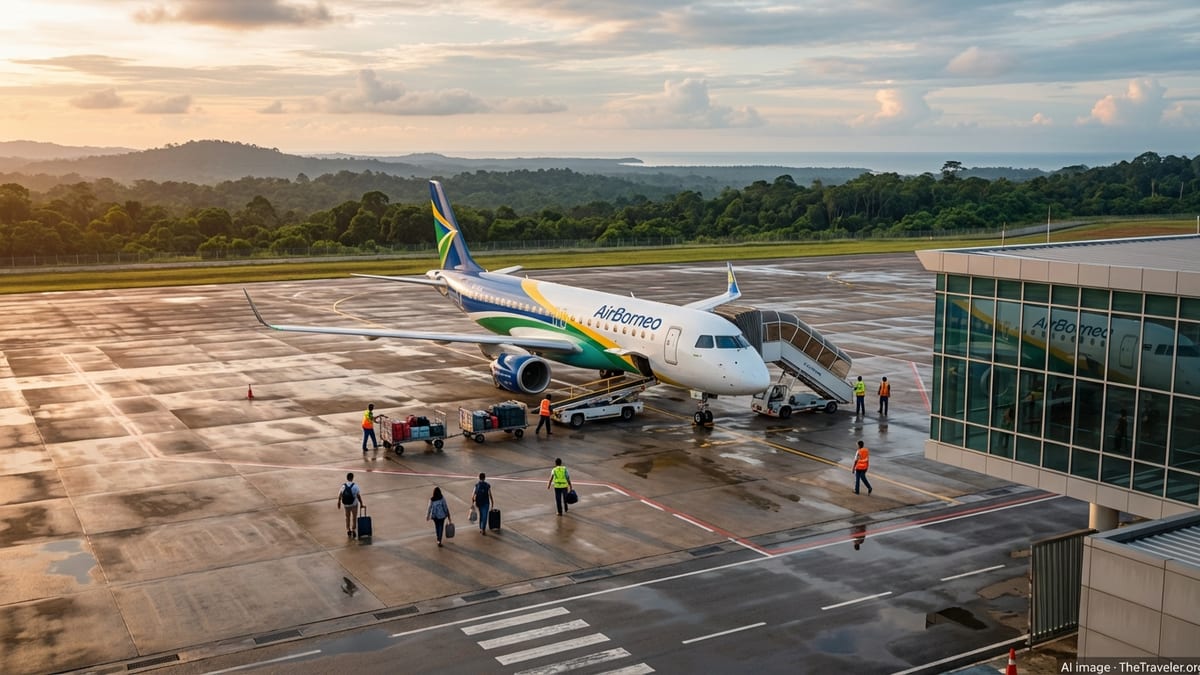
As Sarawak’s new state-owned airline AirBorneo accelerates preparations for full jet operations in July 2026, the carrier is positioning artificial intelligence at the heart of its strategy to remake how Malaysians and international visitors move around Borneo, promising smarter schedules, smoother journeys and a fresh competitive jolt to the region’s crowded skies.
A State Airline With a Digital-First Mandate
AirBorneo formally emerged from the Sarawak government’s acquisition of MASwings, with the new brand taking over rural and regional services across East Malaysia from January 1, 2026. The move marked the first time a Malaysian state has taken direct control of a commercial airline, underscoring Sarawak’s ambition to determine its own aviation destiny and sharpen links between its vast interior and the wider region.
In the early weeks of 2026, AirBorneo assumed MASwings routes and staff while maintaining existing fares and schedules, focusing on continuity for passengers in Sarawak and Sabah who rely heavily on air links. Initial flights operated under the new livery from Kuching to destinations such as Mukah and Tanjung Manis, using ATR72 and Twin Otter turboprop aircraft as the airline settled into its transition phase.
Behind the scenes, however, the carrier’s leadership has signalled that this is not simply a rebadging exercise. AirBorneo’s mandate from the Sarawak government is to move quickly beyond a traditional regional airline model, building a data-driven operation that can support everything from subsidised rural air services to future international links. That goal is shaping how it recruits, invests and designs its technology stack ahead of the expansion to jet services in mid-2026.
For travellers in Sarawak and Sabah, the impact of a state-owned airline with digital ambitions could be far-reaching. The government views AirBorneo as a tool not only for connectivity but also for economic development, tourism growth and skills training in aerospace and data fields, positioning Kuching as a growing aviation hub for the island of Borneo.
IBM Partnership Puts AI at the Core of Operations
On February 23, 2026, AirBorneo and IBM Malaysia announced a wide-ranging collaboration to build what both sides describe as an integrated, AI-enabled digital backbone for the new airline. Under the agreement, AirBorneo will deploy IBM integration platforms to automate and connect critical business processes, airline applications and data flows, laying the foundation for real-time decision making as the network grows.
IBM’s technology will be used to knit together disparate systems, from reservations and inventory to crew management and maintenance, enabling a level of visibility that many legacy carriers are still struggling to achieve. By centralising and securing data exchange, AirBorneo aims to monitor operations across Sarawak and Sabah in near real time, quickly identifying emerging bottlenecks and responding dynamically to disruptions such as weather or airport congestion.
AirBorneo’s chief executive Megat Ardian Wira Mohd Aminuddin has framed the partnership as a way to leapfrog older models of airline IT, arguing that a young carrier without decades of legacy systems can design its processes around AI from day one. That includes using predictive tools to optimise fleet deployment, anticipate passenger demand, and fine-tune fuel usage, which is a critical cost factor on shorter regional routes.
For IBM, the tie-up is a showcase of how cloud, integration and artificial intelligence can be embedded in aviation from the ground up rather than bolted on later. For AirBorneo, it is an opportunity to embed automation deeply into everyday work while still giving human staff oversight and the ability to intervene, an important balance as airlines worldwide grapple with how far to trust algorithms in safety and service-critical environments.
From Turboprops to Jets: July 2026 as a Turning Point
While AirBorneo’s first months of operation are focused on turboprop services within Sarawak and Sabah, the airline has set July 2026 as the target for entering full jet operations. Sarawak Premier Abang Johari Openg has publicly tied that milestone to a broader vision of direct international connectivity, including routes to Singapore and destinations such as Jeju Island in South Korea.
The move from ATR and Twin Otter aircraft to jets will reshape the airline’s network. Jet operations will allow for longer sectors and higher frequencies on trunk routes such as Kuching to Kuala Lumpur or Kuching to Singapore, and they open the door to new regional links around Borneo, including future services to Indonesia’s new capital Nusantara. Officials have indicated that these connections are central to the state’s plan to capture a larger share of tourism and investment flows across the island.
AI will play a prominent role in managing this more complex fleet mix. Integrating turboprop and jet operations presents planning challenges, from slot coordination to crew rostering and maintenance sequences. AirBorneo intends to use predictive analytics to simulate different schedule scenarios, identify where jets deliver the greatest impact on travel times and revenue, and avoid leaving smaller communities underserved as capacity shifts to higher-demand routes.
For travellers, the July 2026 rollout of jets should translate into shorter flight times on key routes and a greater choice of itineraries linking Sarawak and Sabah to major regional hubs. The airline will be under pressure to manage that growth while maintaining reliability on rural air service obligations, many of which are lifelines for communities without alternative transport options.
Smarter Journeys for Passengers in Sarawak and Sabah
Beyond fleet and route plans, AirBorneo is promising to use artificial intelligence to improve the experience of actually flying around Borneo. The carrier is building digital engagement tools designed to guide passengers through an often fragmented journey that can include small airstrips, weather-sensitive routes and tight connections between turboprop and jet flights.
On the customer-facing side, the airline is working on AI-enabled chat and self-service channels that will handle common queries, rebookings and disruptions. Executives insist that lessons have been learned from other carriers where passengers criticised opaque, unhelpful automated systems. AirBorneo’s architecture is being built to allow escalation to human agents and to give frontline staff access to the same underlying data that AI tools use, to avoid contradictory information.
The airline also aims to experiment with more personalised offers and notifications, such as suggesting alternative connections during monsoon-related delays or flagging the best time to book for popular holiday periods within Borneo. With a relatively compact network initially, AirBorneo has the opportunity to train its models on highly specific local patterns, from seasonal demand spikes in Miri and Kota Kinabalu to weather disruptions in interior airstrips.
For rural travellers, many of whom are less accustomed to digital channels, the impact of AI may be felt indirectly through more punctual operations and clearer communication at the airport. The state government has stressed that AirBorneo’s technology drive must not come at the expense of accessibility, and that physical ticketing and on-the-ground support will remain part of the mix as digital tools are rolled out.
Transforming Rural Air Services With Data
One of AirBorneo’s most sensitive responsibilities is operating rural air services across Sarawak and Sabah under a public service obligation framework. These routes, many of them short hops between remote airfields, are often uneconomic on commercial terms but essential for health care, education and trade in outlying communities.
Historically, such services have been planned on the basis of broad estimates and political commitments rather than granular data. AirBorneo’s leadership argues that AI can change that by providing a continuous picture of load factors, weather disruptions, cargo patterns and seasonal peaks, allowing the airline and the state government to refine where subsidies are directed and how schedules are structured.
By analysing years of MASwings operational data alongside new information captured in real time, the airline can identify which routes might benefit from slightly larger aircraft, which can be combined or adjusted, and where additional flights during harvest or holiday periods would deliver outsized social value. Predictive models can also help anticipate infrastructure needs at small airstrips, such as resurfacing or lighting, by tracking patterns of stress and usage.
For communities in the interior of Sarawak and Sabah, these changes may manifest as more reliable connections to regional centres like Kuching, Miri, Kota Kinabalu and Sandakan, and better alignment between flight schedules and essential services. Officials are careful to say that technology will not replace consultation with local leaders, but they see data as a way to make those conversations more precise and outcomes more transparent.
Competitive Ripples Across Malaysia’s Aviation Market
AirBorneo’s emergence as a digitally ambitious state airline is already altering the dynamics of Malaysia’s aviation sector. By taking control of regional routes in East Malaysia and tying them to an AI-enabled operating model, Sarawak is signalling that it expects higher efficiency and service standards than have sometimes characterised secondary networks.
Larger carriers that dominate the peninsula-based market, including low cost operators, face the prospect of a more agile competitor on routes touching Borneo. While AirBorneo is initially focused on consolidating its inherited network, its planned jet operations from July 2026 could allow it to contest traffic flows between Kuching, Kota Kinabalu and major cities such as Kuala Lumpur and Singapore, as well as exploring future links to Indonesia’s Nusantara and beyond.
The use of AI to manage pricing and capacity could give AirBorneo an edge in matching supply to demand across a sprawling geography where demand can be highly uneven. At the same time, regulators and consumer groups will be watching closely to ensure that algorithmic revenue management does not erode the commitment to affordable fares that the Sarawak government has repeatedly emphasised as a core objective of the new airline.
Regionally, AirBorneo’s push may encourage other governments and carriers in Southeast Asia to revisit their own digital strategies, particularly as new infrastructure such as Nusantara International Airport comes online and competes for traffic. For travellers, increased competition and more sophisticated planning tools could ultimately mean more options and better resilience when trips do not go as planned.
Training a New Generation for AI-Enabled Aviation
AirBorneo’s technology-first strategy is also shaping how Sarawak invests in human capital. The state has linked the airline’s growth to a wider goal of building skills in aerospace and digital fields, from aircraft maintenance and engineering to data analytics and software integration.
Training centres and academies in Sarawak are preparing new cohorts of technicians, pilots and operations specialists who will work alongside AI systems rather than being replaced by them. Courses cover traditional technical disciplines as well as exposure to data tools, safety management systems and the basics of algorithmic decision making, reflecting the reality that line staff will increasingly interact with digital dashboards and predictive alerts.
Within AirBorneo itself, the IBM partnership includes a focus on change management and staff training so that employees understand how automated systems arrive at recommendations and where human judgment remains essential. The airline’s leaders argue that this is critical to maintaining trust, both internally and with passengers, as AI becomes more visible in decisions about delays, rerouting or capacity cuts.
If successful, the model could turn Sarawak into a regional centre for aviation skills on Borneo, attracting students and professionals from neighbouring states and countries. That would feed back into the airline’s own growth plans, ensuring a pipeline of talent familiar with both the technical and cultural specificities of flying in and out of Sarawak and Sabah.
Tourism and Connectivity on the Eve of a New Era
As the calendar moves toward AirBorneo’s planned jet debut in July 2026, tourism operators in Sarawak and Sabah are recalibrating their own strategies around the promise of more direct and data-informed air links. From eco-lodges in the interior to beach resorts on the coasts, businesses are anticipating that improved schedules and connectivity will make it easier to sell multi-stop itineraries within Borneo and tie them more seamlessly to international gateways.
The airline’s ambitions for routes to Singapore, South Korea and eventually Indonesia’s new capital feed into a narrative of Borneo as a more accessible, interconnected destination rather than a series of isolated markets. AI-driven demand forecasting should help the carrier and its partners identify which emerging destinations in Sarawak and Sabah are ready for more frequent service, and where promotional efforts might be needed to stimulate traffic.
For local residents, the changes may be felt in small but cumulative ways. More reliable flights can make it easier for students to travel for education, for families to access specialist medical care, and for entrepreneurs to move goods and people around the island. The challenge for AirBorneo will be to balance those social objectives with the commercial realities of running an airline, even one backed by a state determined to see it succeed.
What is clear is that AirBorneo is not simply another regional carrier entering a crowded market. By weaving artificial intelligence into its operations from day one and tying its growth to the development of Sarawak and Sabah, the airline is attempting something rarer in global aviation: using a new digital toolkit to rethink what a public service airline can deliver for the people it serves.