

More news on this day
For travelers who rarely see what happens behind the hangar doors, the development of Airbus’s new A350F freighter has revealed an unusual scene: engineers pouring 180 liters of water into an aircraft structure to help prove that one of its most critical components, the main cargo door, is ready for the rigors of global freight service.
Get the latest news straight to your inbox!
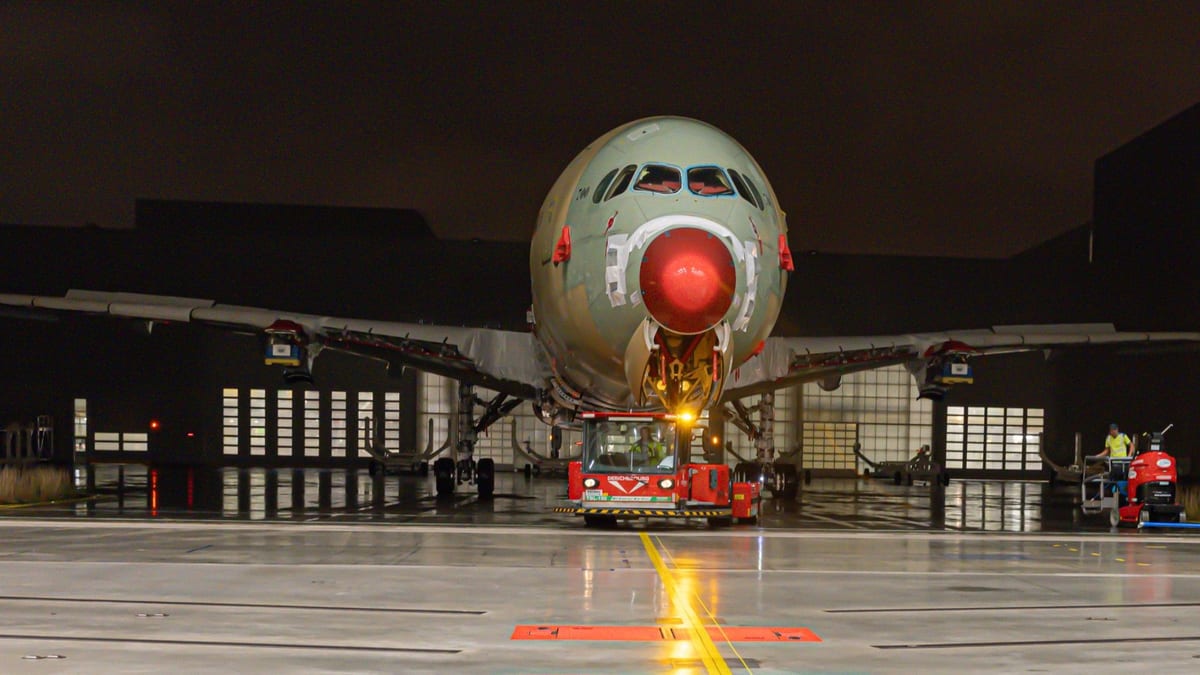
Image by Simple Flying
A New Freighter Taking Shape
The A350F is Airbus’s latest move in the long-haul cargo market, a dedicated freighter variant derived from the A350 passenger family. Publicly available programme data indicates that the aircraft is designed to carry up to around 111 tonnes of payload while offering significantly lower fuel burn and emissions than current-generation freighters. The model is being pitched toward airlines seeking to modernize their fleets ahead of tighter carbon rules later this decade.
Assembly of the first A350F test aircraft is advancing through 2025, with initial fuselage sections and wings already completed and transported to Toulouse. Airbus is building two dedicated test airframes to support a multi‑year flight and certification campaign currently expected to run through 2026 and 2027. These aircraft will verify the structural, performance and handling characteristics specific to the freighter, including its enlarged main deck cargo door and reinforced floor structure.
Facts and figures released for potential customers highlight some of the key selling points. The A350F is expected to be up to 46 tonnes lighter than competing large widebody freighters, while still offering a range suited to intercontinental routes that underpin the modern express and e‑commerce economy. For passengers, these developments may not be immediately visible, but the aircraft stands to influence which carriers move their online purchases and high‑value goods between continents.
As orders accumulate from cargo specialists and combination carriers, the A350F is emerging as one of the central aircraft programmes to watch for anyone following how global trade and aviation sustainability intersect in the skies.
The 180-Liter Water Test Explained
Amid the structural work that typically defines any new aircraft programme, one particular test has drawn attention for its simplicity: using about 180 liters of water to validate part of the A350F’s design. According to technical discussions and published descriptions of Airbus test practices, the water is not used as a coolant or a fuel substitute, but as a controllable way to simulate pressure and detect any microscopic leaks in a closed structure around the freighter’s cargo door area.
In essence, engineers create a sealed test rig replicating a portion of the fuselage structure where the large main deck door is installed. By filling the space with a measured volume of water, in this case roughly equivalent to a large household bathtub, they can apply a known load and closely inspect how the structure behaves. Water’s incompressible nature makes it ideal for this type of assessment, as any deformation, seepage or unexpected movement shows up quickly.
Unlike high‑pressure hydraulic benches or purely digital simulations, water tests offer a relatively low‑tech but extremely visual confirmation that seals, fittings and surrounding composite or metal reinforcements are performing as intended. Because the A350F incorporates an extra‑large main deck door compared with passenger variants, the local stresses around that opening are higher, and regulators require convincing evidence that such a modification does not compromise the integrity of the fuselage.
For observers used to seeing sophisticated wind tunnels and high‑performance computing clusters driving aircraft design, the image of water gently rising in a test fixture may appear almost quaint. Yet tests of this kind remain part of the toolbox that bridges the gap between advanced computer models and the physical realities of a hard‑working cargo aircraft.
Why Cargo Doors Demand Extra Scrutiny
Cargo doors are among the most structurally demanding features on any widebody airframe, and that challenge grows when an aircraft is built primarily for freight. While a passenger aircraft balances the needs of cabin windows, multiple doors and underfloor holds, a freighter devotes most of its upper fuselage to a single large opening designed to swallow standard containers and pallets. For the A350F, published material describes an extra‑large rear main deck door, with a clear opening wide enough to speed handling at busy cargo hubs.
Such a door interrupts the smooth load path of the fuselage, which must bear pressurization loads, bending during flight and ground handling forces. Engineers use a combination of additional frames, stringers and localized reinforcements around the cut‑out to redirect these stresses, ensuring the surrounding structure remains within approved limits throughout the aircraft’s life.
The 180‑liter water test is only one element in a broader matrix of evaluations aimed at this area. Static structural tests apply extreme loads to a full‑scale fuselage section, while fatigue tests cycle components thousands of times to simulate years of service. Digital twins and finite‑element models predict how the door and its surround will respond to everything from rough runway operations to rapid depressurization scenarios. The water test, in this context, serves as a targeted, empirical cross‑check on specific joints and seals that are difficult to judge in isolation on a computer screen.
For cargo operators planning to use the A350F intensively on round‑the‑clock schedules, such scrutiny is critical. Any unexpected issue with a main cargo door can lead to delays, grounded aircraft and, in worst‑case scenarios, safety risks. By investing in multiple layers of testing, including the seemingly modest 180‑liter procedure, Airbus aims to demonstrate that its new freighter’s most distinctive feature is also among its most robust.
What It Means for Air Cargo and Travelers
While the A350F will not carry holidaymakers or business travelers directly, its development has implications for how journeys and goods connect. Many long‑haul belly‑cargo networks rely on passenger widebodies that also transport freight beneath the cabin floor. As airlines rebalance their fleets, dedicated freighters like the A350F can shoulder more of the heavy lifting for parcels, temperature‑sensitive pharmaceuticals and high‑value components that underpin global supply chains.
Efficiency improvements promised by the A350F programme could also influence ticket prices and route choices. If airlines can rely on lower‑emission, lower‑cost freighters to handle cargo demand, they may be able to optimize passenger fleets more precisely around traveler flows rather than freight constraints. For aviation hubs aiming to reduce noise and emissions, new‑generation freighters offer a path to maintain cargo throughput with fewer, cleaner flights.
The water test itself is unlikely to feature in marketing brochures or airport terminal displays, yet it symbolizes a broader reality of modern aircraft development. Behind every new route announcement or livery unveiling lies a series of highly specific investigations into how structures behave under stress, often using deceptively simple tools. For the A350F, the 180 liters of water that help validate its cargo door strength are a reminder that aviation’s future still depends on carefully measured experiments in the here and now.
For travelers watching the evolving landscape of air transport, the progress of the A350F illustrates how the industry is reshaping the balance between passenger and freight operations, with engineering details like water‑filled test rigs quietly steering the next chapter of global aviation.