

More news on this day
Airbus is examining the possibility of setting up a final assembly line for ATR regional aircraft in India, a step that would significantly expand the manufacturer’s industrial footprint in the country and signal a new phase in India’s push to localise aircraft production.
Get the latest news straight to your inbox!
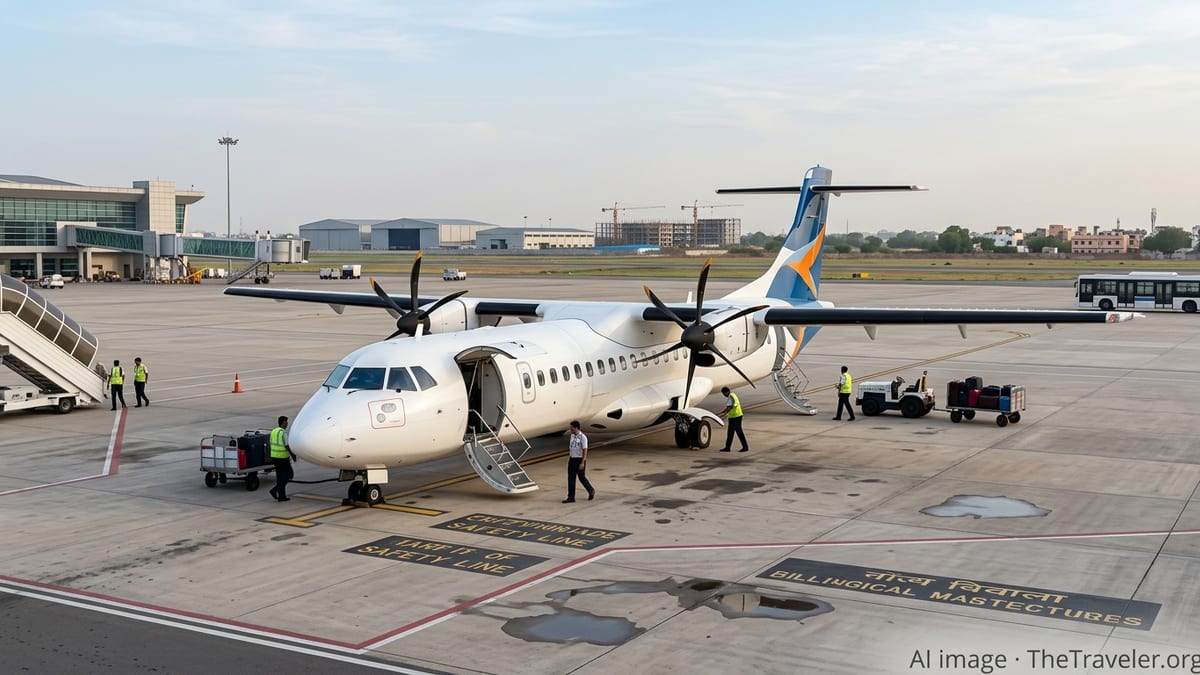
A new chapter for regional aircraft manufacturing
Recent coverage of the ATR turboprop programme indicates that Airbus is evaluating options for a final assembly line in India for the popular regional aircraft family. The discussions are understood to be at an exploratory stage, focused on assessing industrial partners, logistics, and long term demand for regional connectivity across the Indian subcontinent.
The ATR 72 and ATR 42 aircraft are widely used by carriers in India and South Asia on short haul routes linking smaller cities to major hubs. Establishing final assembly on Indian soil would align with New Delhi’s emphasis on domestic value creation and with Airbus’s broader strategy of positioning India as a key pillar of its global manufacturing and engineering network.
Analysts note that any such facility would most likely begin with aircraft destined for Indian operators, before potentially expanding to serve neighbouring markets in South and Southeast Asia where regional turboprop demand remains resilient.
Building on Airbus’s expanding Indian industrial base
The contemplation of an ATR final assembly line comes as Airbus deepens its existing manufacturing footprint in India across both fixed wing and rotary wing platforms. Publicly available information shows that the company already partners with Tata Advanced Systems on a final assembly line for C295 military transport aircraft in Vadodara, Gujarat, and on a forthcoming final assembly line for H125 civil helicopters in Karnataka.
In parallel, Airbus has awarded major aerostructures work to Indian suppliers, including contracts for helicopter fuselages and metallic components for its commercial jet family. These projects are part of a deliberate shift from India as primarily an engineering and services hub to a location where complete aircraft are assembled for domestic use and export.
Industry observers suggest that adding ATR final assembly to this portfolio would create synergies in supply chains, workforce training, and certification processes. It would also reinforce India’s standing as a multi platform aerospace manufacturing centre, rather than a site limited to niche or offset related production.
Implications for Indian carriers and regional connectivity
For India’s airlines, local ATR final assembly could eventually translate into shorter delivery lead times, closer technical support, and a deeper pool of locally trained maintenance personnel. Regional carriers operating under the government’s connectivity schemes have relied heavily on ATRs to link underserved airports, and a domestic assembly line could align aircraft deliveries more closely with evolving route plans.
Travel sector analysts point out that India’s aviation growth is increasingly shifting beyond the largest metros, with secondary and tertiary cities emerging as important leisure and business destinations. A predictable supply of regionally assembled turboprops would support airlines looking to open thin routes where narrowbody jets are not economical.
There could also be branding value for carriers marketing “made in India” aircraft to passengers, particularly on routes serving emerging tourist circuits and pilgrimage destinations that are actively promoted by regional governments.
Competition, partnerships and the global context
The prospect of ATR final assembly in India also needs to be seen against a backdrop of intensifying global competition in regional aircraft manufacturing. Other manufacturers have signalled interest in locating assembly lines in India in partnership with local conglomerates, seeking to tap both the rising domestic market and the political emphasis on self reliance in high technology sectors.
For Airbus and ATR, choosing India would extend a production model in which major sections are built across multiple countries before final assembly near key customer bases. The approach can help hedge currency risks, align with offset requirements, and create political goodwill in large markets that are poised to order substantial fleets over coming decades.
However, analysts caution that any decision will depend on a careful assessment of long term airline demand, the stability of policy incentives, and the ability of partners to deliver complex industrial projects on schedule. The success of existing Indian final assembly lines for the C295 and H125 will likely be watched closely as benchmarks.
What it could mean for travellers
Although decisions on industrial location are largely driven by economics and policy, the outcome could have tangible effects on travellers. A robust pipeline of ATR aircraft assembled in India would support denser regional networks, more frequent flights on shorter routes, and potentially greater competition between carriers on emerging city pairs.
Tourism boards across India have been highlighting lesser known heritage towns, coastal stretches, and wildlife destinations that currently require lengthy road or rail journeys. If airlines can secure additional turboprops more efficiently, they may be more willing to experiment with seasonal or year round services to such locations, improving access and shortening travel times.
For now, Airbus’s evaluation of an ATR final assembly line in India remains under review. Yet the very fact that the option is being considered underscores how central India has become to the future of global regional aviation, and how industrial decisions far from the runway can shape tomorrow’s travel maps.