

More news on this day
Air travelers planning spring and summer trips are confronting a dramatically more expensive sky, as overlapping wars from the Middle East to Eastern Europe push up fuel costs, force lengthy detours and fracture key tourism corridors worldwide.
Get the latest news straight to your inbox!
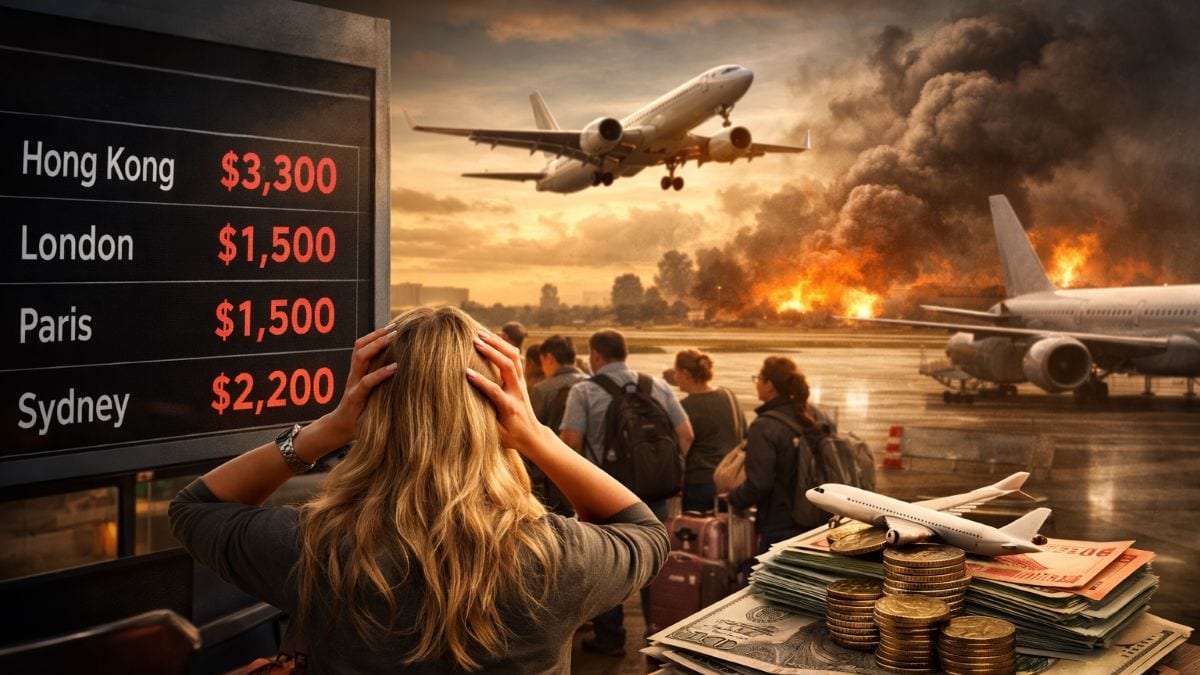
Jet Fuel Shock Sends Airfares Surging
Publicly available industry data shows that the latest escalation in the Iran conflict has triggered one of the sharpest jet fuel spikes in years, with benchmark prices reportedly jumping from around 2.50 dollars to more than 4 dollars per gallon in a matter of days. Analysts note that fuel is typically the single largest operating cost for airlines, often accounting for a quarter or more of total expenses, so such a sudden increase feeds almost directly into ticket prices.
Reports from aviation and business outlets indicate that carriers are responding by adding fuel surcharges, trimming marginal routes and pushing up base fares, particularly on long haul services where higher burn rates are most acute. Trade publications focused on travel and tourism describe a pattern in which headline fares for certain international routes have more than doubled compared with pre conflict levels, and in extreme cases surged several fold when capacity was abruptly cut.
Some mainstream financial and travel coverage has highlighted individual routes where headline fares rose by more than 500 percent compared with 2024 levels during peak demand windows after the war began. These outsized jumps are generally linked to very tight last minute inventories following mass cancellations, but they underscore how exposed passengers have become to geopolitical price shocks.
At the same time, major US and European airlines are still reporting strong advance bookings, suggesting that resilient demand is allowing carriers to pass a large share of these new costs on to travelers. Market commentary notes that this combination of robust demand and energy driven cost pressure is creating what many consumers now experience as a rolling airfare crisis rather than a brief spike.
Closed Airspace and Forced Detours Reshape Routes
The direct conflict zone is not the only factor driving up prices. The closure or partial shutdown of several large Middle Eastern hubs that collectively handle a significant share of global air traffic, along with restrictions around Iranian, Iraqi and Israeli airspace, has forced airlines to redraw flight paths between Europe, Asia and Africa. Flight tracking analysis cited in recent reports shows detours adding two to four hours to some intercontinental sectors.
Longer routes mean higher fuel burn, additional crew time and more air navigation charges, all of which are reflected in fares. Studies examining earlier disruptions over Russia and Ukraine found operating cost increases of roughly 20 to 40 percent on certain Europe Asia routes once carriers began avoiding Russian and Ukrainian skies. Experts now warn that layering new Middle Eastern no fly zones on top of those existing closures compounds the structural cost burden on global aviation.
Operational data compiled by industry analysts indicates that more than ten thousand flights linked to Gulf and Levant hubs have been canceled or heavily rerouted since late February 2026. With key connection points constrained, travelers heading between Europe and Asia are increasingly funneled through alternate hubs in Southeast Asia, adding both time and expense. Travel data firms describe fare increases of 15 to 25 percent on some of these substitute routings, even before additional fuel surcharges are applied.
The rerouting pressure is also spilling into secondary markets that were not directly involved in the conflicts. Airlines based in regions far from the front lines are reallocating aircraft to high yielding detour corridors, reducing capacity on leisure routes and tightening seat supply ahead of the northern hemisphere summer season. This shift is helping to lift prices even on flights that do not cross conflict zones.
Tourism Corridors from the Gulf to the Mediterranean Stall
Tourism dependent economies across the Middle East are facing a sudden reversal after several years of rapid post pandemic growth. Economic analysis published in early March estimated that arrivals to the region, which had been expected to grow strongly in 2026, could instead fall by more than 10 percent under current war scenarios. The same assessments warn of steeper declines if hostilities widen or become protracted.
Destinations such as the United Arab Emirates, Saudi Arabia and Gulf city states had positioned themselves as global transit and leisure hubs, with tourism contributing double digit shares of gross domestic product in some cases. New conflicts and drone related incidents near major airports and waterfront resorts have introduced a level of perceived risk that is already reflected in cancellations and in government organized repatriation flights for foreign visitors caught in the turbulence.
Farther west, the lingering economic impact of the Gaza war continues to weigh on tourism flows into Israel and neighboring countries. Official visitor statistics for 2024 already revealed a collapse in arrivals compared with the previous year, and travel trade reports suggest that many tour operators have yet to fully reinstate their programs for 2026. The combination of elevated security concerns and sharply higher airfares is encouraging potential visitors to shift toward alternative Mediterranean or long haul beach destinations.
These regional setbacks are feeding into a broader realignment of global tourism corridors. Analysts tracking booking data note that demand is tilting toward destinations perceived as geopolitically stable and reachable on more direct routings, even when those destinations are relatively expensive. In practice, this means that parts of Southern Europe, North America and some Asia Pacific markets are absorbing demand that might otherwise have flowed through Middle Eastern gateways.
Household Travel Budgets Squeezed Worldwide
The war driven airfare surge is landing on households that were already grappling with years of elevated inflation. Consumer research cited in recent travel and economic reports suggests that many families are cutting trip length, trading down from international to domestic travel, or postponing visits altogether as ticket prices climb. Some are turning to alternative modes such as rail on shorter regional routes, particularly in Europe and parts of Asia where high speed networks are well developed.
Price comparison platforms and online travel agencies have documented sharp jumps in advertised fares for peak holiday periods, especially around Easter and the northern summer. Coverage from European outlets indicates that, in some markets, there are currently no major destinations where Easter 2026 airfares have remained unchanged since before the latest Middle Eastern escalation. While increases for short haul European leisure routes are described as moderate, long haul itineraries touching conflict affected airspace are markedly more expensive.
For travelers in emerging markets, the combination of rising fares, weaker currencies and broader economic uncertainty is particularly painful. Industry watchers warn that outbound tourism from price sensitive regions could stagnate or contract if current conditions persist, reversing the pre 2020 trend in which growing middle classes in Asia, Latin America and parts of Africa became a central driver of global travel growth.
At the same time, wealthier travelers are increasingly absorbing higher prices in exchange for flexibility and perceived safety, sometimes paying premiums for itineraries that avoid certain hubs or carriers. This divergence risks deepening the divide between those who can continue to fly regularly in a more volatile world and those for whom international air travel becomes an occasional luxury.
Airlines Navigate Between Profitability and Public Backlash
Airlines now operate in a narrow space between geopolitical risk and public frustration. Financial updates cited in major news coverage show that many large carriers expect to remain profitable in 2026 despite higher fuel bills, helped by strong demand and capacity constraints that support pricing power. Investors generally view fare increases as a rational response to extraordinary cost pressures and route disruption.
From a traveler perspective, however, the optics are more difficult. Social media and consumer advocacy groups highlight eye catching examples of tickets priced several times higher than in previous years and accuse airlines of opportunistic behavior. Industry analysts counter that a significant portion of the increase is tied to fuel markets, insurance premiums, war risk surcharges and contingency planning for further disruptions.
Airlines are also reliant on national regulators and international aviation bodies to manage rapidly changing security assessments and airspace closures. When threats emerge suddenly, carriers often err on the side of caution, suspending routes and consolidating flights in ways that reduce available seats. The resulting shortage can lead to dramatic, if temporary, price surges on remaining services, particularly for last minute travelers who have little choice but to pay.
Looking ahead, strategic decisions about fleet deployment, hedging strategies and network design will determine how lasting the current airfare shock proves to be. If conflicts in the Middle East and Eastern Europe remain unresolved, or if new flashpoints emerge, the combination of longer routes, higher baseline fuel costs and elevated geopolitical risk premiums could keep pressure on ticket prices well beyond the current travel season.