

More news on this day
Air travelers are confronting a new kind of sticker shock as surging fuel prices, airspace closures and mass flight cancellations linked to the escalating Iran conflict push global airfares sharply higher, threatening to derail a fragile tourism recovery.
Get the latest news straight to your inbox!
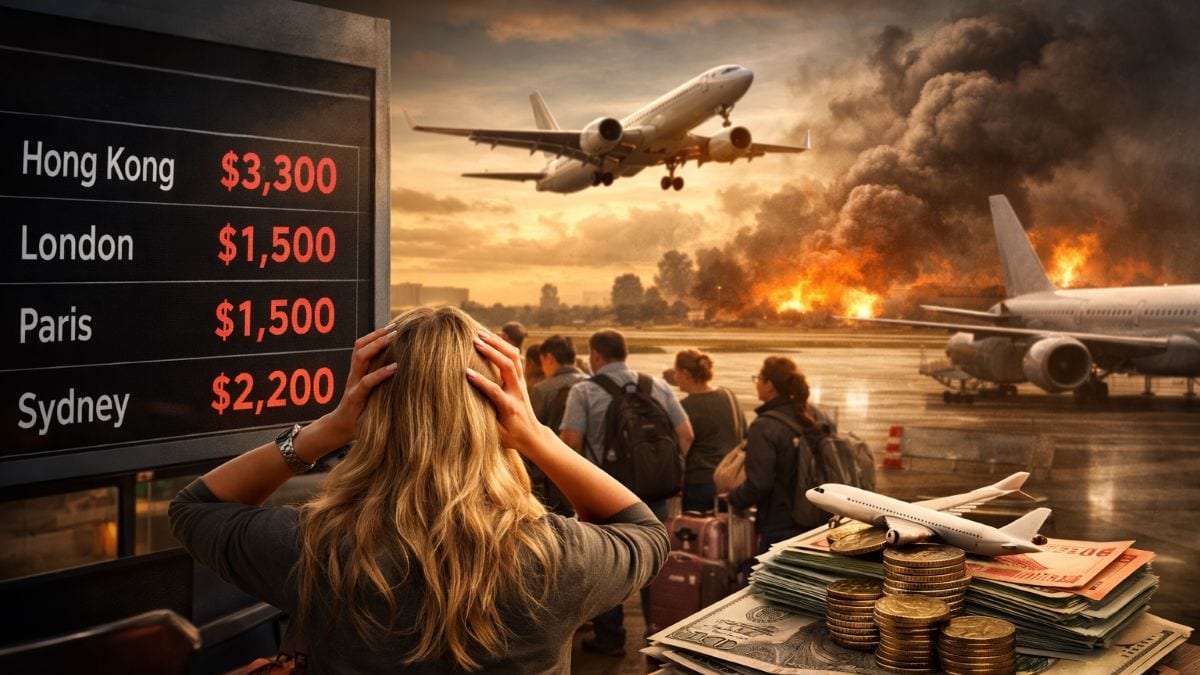
Image by Travel And Tour World
Conflict Turns Key Air Corridors Into No-Go Zones
The latest Middle East war has effectively shut or restricted large swaths of airspace over Iran and parts of neighboring states, forcing airlines to abandon some of the world’s busiest transit corridors between Europe and Asia. Publicly available flight-tracking data shows thousands of services rerouted or pulled from schedules as carriers avoid airspace now classified as high risk.
Major Gulf hubs that once funneled hundreds of thousands of passengers a day between continents have seen operations disrupted or temporarily halted following missile and drone strikes in the region. Reports indicate that tens of thousands of passengers have been stranded in cities such as Dubai and Doha on multiple occasions, as carriers scramble to reposition aircraft and crews around closed skies.
Industry briefings describe the situation as the most severe test for global aviation since the height of the pandemic, with more than 50,000 flights to and from the broader Middle East reportedly cancelled since the latest phase of the conflict began. Each lost leg removes seats from the worldwide system, concentrating demand on remaining routes and setting the stage for sharp fare increases.
Analysts note that the Middle East accounts for a significant share of international transfer traffic, so any prolonged disruption ripples far beyond the region. Travelers connecting between Europe and Asia, or between Africa and North America, are increasingly being pushed onto longer non-stop routes or via secondary hubs, further tightening capacity.
Fuel Price Shock Feeds a Rapid Airfare Surge
At the same time, the war’s impact on energy markets is driving a spike in jet fuel costs, one of the most important inputs in airline pricing. Recent assessments of commodity markets show crude oil and refined products jumping as shipping through strategic chokepoints has been disrupted, with jet fuel prices reported to have leapt from roughly mid-$2 to above $4 per gallon in a matter of days after the latest escalation.
Research from aviation and tourism consultancies indicates that every sustained jump in fuel costs quickly filters through to passengers in the form of higher base fares and fuel surcharges. Analysts cited by business media outlets estimate that a move of just 5 percent in fuel prices can cut airline profits by as much as a third, depending on hedging strategies, which is pushing carriers to raise prices aggressively to protect margins.
Early booking data for 2026 already points to broad-based airfare inflation. Consumer travel coverage in Europe and Asia reports very few long-haul leisure markets where ticket prices remain near pre-crisis levels, with some high-demand holiday routes now several times higher than in early 2024 once taxes and surcharges are included. While the headline figure of a 560 percent jump reflects extreme cases on constrained routes at peak dates, it captures the depth of the shock facing many travelers.
In some instances, travelers caught in the wrong place at the wrong time are paying extraordinary premiums. Reporting from regional outlets describes stranded passengers in Gulf hubs turning to private charters or last-seat availability on indirect routings at prices several multiples of normal economy fares, underscoring how quickly conflict-driven scarcity can turn mobility into a luxury.
Tourism Economies Face Sudden Revenue Freefall
The price surge arrives just as many destinations were celebrating a return to or even surpassing of pre-pandemic visitor numbers. United Nations Tourism data for 2025 highlighted the Middle East as one of the fastest-growing regions, with arrivals and spending climbing sharply on the back of major events, new attractions and expanded air connectivity.
That outlook has reversed within weeks. New scenarios from tourism research groups and industry associations now frame the situation as a crisis, with projections that international arrivals to the Middle East could fall by more than a quarter in 2026 if the conflict and associated travel warnings persist. Forecasts put potential spending losses in the tens of billions of dollars for the region alone.
The fallout is not confined to countries directly involved in the fighting. Neighboring destinations once marketed as safe alternatives are confronting steep drops in bookings as travelers avoid the broader region or balk at higher travel costs. Tourism consultancies and national statistics offices in parts of North Africa, the Eastern Mediterranean and the Caucasus are already reporting double-digit declines in forward reservations compared with the same period a year earlier.
Globally, the World Travel & Tourism Council and independent analysts estimate that the combined effect of war-related disruptions, price hikes and shifting consumer sentiment is erasing hundreds of millions of dollars in tourism receipts each day. For economies that pivoted to tourism as a pillar of diversification, the loss of visitors and aviation connectivity is raising fresh concerns over employment, investment and fiscal stability.
Ripple Effects Reach Asia, Europe and the Americas
Beyond the immediate warzone, travelers in Asia-Pacific and Europe are encountering more expensive and less predictable journeys. Regional media in Southeast Asia report that tour operators are fielding a wave of cancellations from European visitors who would normally travel via Gulf hubs to reach destinations such as Thailand or Indonesia, while also facing higher airfares on outbound long-haul trips.
In New Zealand and parts of East Asia, airlines have publicly confirmed fare increases across domestic, regional and long-haul networks, citing fuel costs and the need to reroute around conflict-affected airspace. Even modest nominal rises of tens of dollars per segment can add hundreds of dollars to the cost of a multi-stop itinerary, squeezing budget-conscious travelers.
Transatlantic and transpacific markets are not immune. As aircraft and crews are redeployed from disrupted Middle Eastern networks, capacity constraints are emerging on certain long-haul corridors linking North America with Europe and Asia. Corporate travel managers and online agencies report that, on some peak summer dates, economy-class fares on popular city pairs are already tracking several times higher than equivalent periods two years ago.
Higher ticket prices are also feeding into inflation metrics and consumer confidence surveys, particularly in countries where outbound tourism is a significant component of household spending. Economists warn that if air travel becomes prohibitively expensive for a critical mass of middle-income consumers, the hit to discretionary spending could weigh on broader economic growth.
Travelers Adjust Plans as Industry Seeks a New Balance
For individual travelers, the result is a rapidly changing map of what is affordable and acceptable risk. Travel platforms and comparison sites are recording a pivot toward closer-to-home and shorter trips, as well as increased interest in destinations perceived as politically stable and reachable without transiting conflict-adjacent hubs.
Budget travelers are responding by extending booking lead times, embracing multi-stop routings via secondary hubs, or opting for ground and rail alternatives where available. However, the scale of recent fare spikes on certain routes, particularly those that once relied heavily on Middle Eastern connectors, is limiting the effectiveness of such strategies, especially during peak seasons.
On the supply side, airlines and tourism boards are working to redirect demand and rebuild confidence without clear visibility on how long hostilities and associated airspace restrictions will last. Network planners are weighing whether to commit scarce widebody aircraft to lengthened non-stop routes with higher fuel burn or to pull back capacity until operating conditions stabilize.
Industry observers note that previous conflicts and crises eventually gave way to renewed growth in air travel and tourism, but warn that the current combination of widespread geopolitical tension, elevated fuel prices and still-recovering balance sheets leaves airlines and destinations with less room for error. Until energy markets and air corridors normalize, travelers should expect elevated fares and uneven access to the world, turning what was once routine holiday planning into a far more complex and costly calculation.