

More news on this day
From blizzard-battered hubs in the United States to overcrowded runways in Europe, the first months of 2026 have underscored how fragile global airline schedules remain, with weather, staffing gaps and surging demand combining to keep flights running late and travelers on edge.
Get the latest news straight to your inbox!
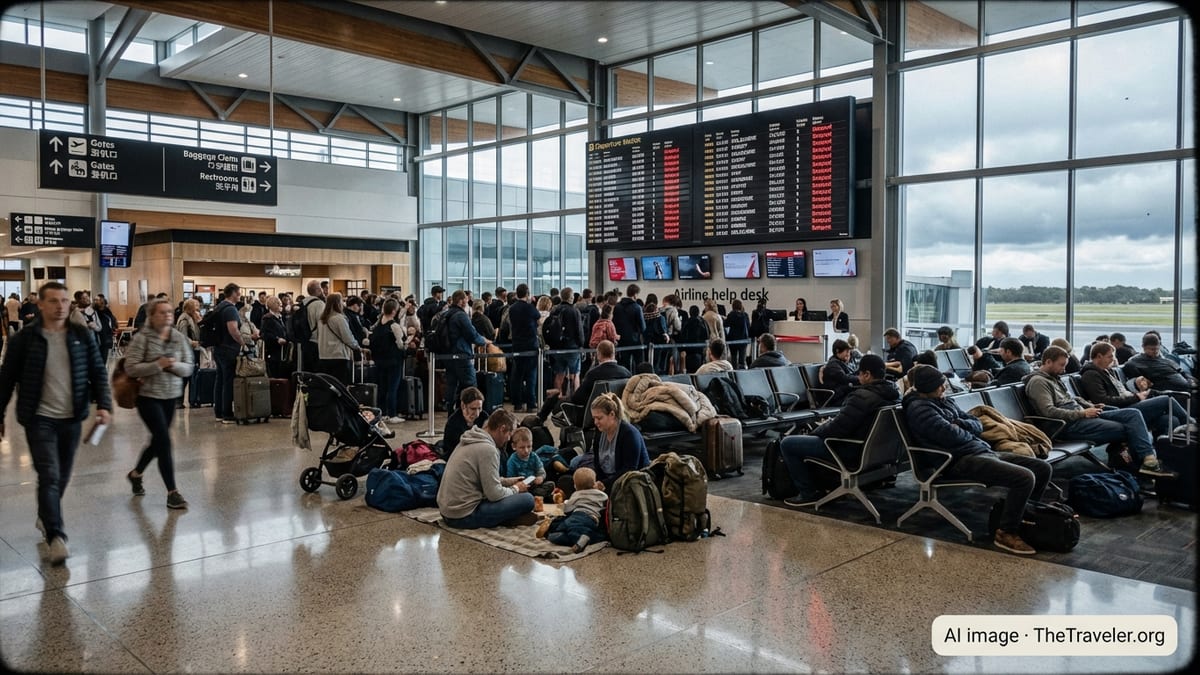
Stormy Skies Drive a New Wave of Disruptions
Winter weather has been a dominant driver of airline delays in early 2026, particularly across North America. A powerful series of storms in January and February brought heavy snow, ice and strong winds to major hubs, triggering mass cancellations and rolling delays across key corridors. Publicly available data on the January 23 to 27 winter storm showed flight cancellations reaching their highest levels since the pandemic, with knock-on delays extending well beyond the immediate weather window as airlines struggled to reposition aircraft and crew.
March continued the pattern. A storm system moving from the Midwest to the East Coast in mid March led to thousands of cancellations and delays at major U.S. airports, including Atlanta, Chicago and New York. Travel coverage noted that at one point more than 1,100 flights were canceled in a single day and roughly 7,300 delayed nationwide, illustrating how a single major weather event can ripple across the entire domestic network for days.
Localized extremes have also produced flashpoints of disruption. Reports from mid March highlighted a weekend where nearly 700 flights were canceled and more than 4,000 delayed across the United States, with Minneapolis, Chicago, Atlanta and New York particularly affected. For travelers, these events have reinforced the reality that winter operations in 2026 remain highly vulnerable to severe storms, even as airlines and airports tout improved resilience.
In Europe, the 2025 to 2026 windstorm season has produced similar turmoil. One early January storm caused widespread chaos at Amsterdam Schiphol, where more than 325 flights were canceled and over 600 delayed in a single day after heavy snow and shifting crosswinds reduced runway capacity. The disruption hit major carriers such as KLM and easyJet, and highlighted how quickly conditions at a single hub can cascade through airline networks.
Staffing and Infrastructure Keep Pressure on Flight Schedules
While weather dominates headlines, underlying structural issues in air traffic control and airport infrastructure continue to shape delay patterns in 2026. In the United States, federal workforce plans show the Federal Aviation Administration is hiring aggressively, with thousands of new air traffic controllers entering training. However, projections also show large numbers of retirements and internal moves, leaving some critical facilities with thin staffing. Industry analysis suggests that this gap continues to contribute to ground stops, flow restrictions and slower recovery when storms or equipment issues hit.
Recent incidents have highlighted the fragility of this system. In late March, airports serving Washington, D.C., Baltimore and parts of Virginia briefly halted flights after a strong chemical odor at the regional radar approach control facility. Flight operations resumed within hours, but airlines imposed ground holds and travelers experienced residual delays throughout the evening. Earlier disruptions in 2025, including temporary closures of air traffic control towers because of staffing shortages, underscored how non-weather events can trigger sudden capacity reductions and network-wide delays.
At the airport level, construction and safety measures are adding friction. At San Francisco International Airport, for example, a combination of runway work and safety concerns led federal regulators to temporarily reduce arrival rates by roughly a third in late March, setting up a sustained period of congestion and longer taxi and holding times. Similar projects at other major hubs are expected to continue through the year as airports invest in runway upgrades and new technology, with short term pain for on time performance.
Infrastructure limits are visible in Europe as well. Eurocontrol data for early 2026 indicates that overall delay minutes per flight are modestly lower than in 2025, but still above pre pandemic benchmarks, with air traffic management capacity and staffing issues among the main contributors. Network operations reports show that bottlenecks in key airspace sectors, combined with busy low cost carrier schedules and dense holiday traffic, are continuing to generate congestion and minor but persistent departure delays.
Regional Hotspots and the Airlines Most Affected
The impact of delays in 2026 is uneven, with certain hubs and carriers emerging as particular trouble spots. In the United States, recent consumer reporting on airport performance has pointed to Newark Liberty as one of the most delay prone major airports, a trend that follows earlier safety and congestion concerns in the New York airspace. During peak staffing shortages and equipment failures in 2025, Newark’s on time performance at one point dropped to roughly half of all flights arriving or departing on schedule, and early 2026 data suggests only gradual improvement.
Other U.S. hubs, including Chicago Midway, LaGuardia and Los Angeles International, have seen waves of disruption tied to both storms and operational strain. Travel coverage in April highlighted that low cost and hybrid carriers have been hit hard during recent disruption events, with some airlines recording hundreds of delayed flights in a single day across multiple airports. The concentration of point to point services, tight turnaround schedules and high aircraft utilization rates can amplify delays for these operators when even a small number of flights begin running late.
In Europe, publicly available analytics based on Eurocontrol and other datasets show that certain airports have developed reputations for chronic delays. Lisbon has been cited for having one of the highest rates of departures delayed by more than an hour, linked to capacity constraints and a heavy reliance on a national carrier that already faces a high share of late flights. Other hubs, including major German and Spanish airports, continue to wrestle with a mix of airspace restrictions, weather and local infrastructure challenges.
Despite these hotspots, there are signs of gradual improvement. Eurocontrol’s review of 2025 reported that average all cause delay per flight on departure fell to about 14.6 minutes, a roughly 16 percent reduction compared with 2024. Early 2026 weekly overviews show total air traffic flow management delay minutes per flight lower than last year, even as traffic inches above 2019 levels. For passengers, that means the worst days remain very bad, but the typical day may feel slightly smoother than during the immediate post pandemic rebound.
What Early 2026 Means for Summer and Beyond
The pattern emerging from the first quarter of 2026 points to a year shaped by high demand, intense but sporadic weather disruption and lingering structural bottlenecks. Eurocontrol expects total European flights to grow further in 2026 after returning to 2019 levels in 2025, driven in large part by low cost carriers expanding leisure routes. In the United States, federal forecasts anticipate continued growth in tower operations, which will put additional pressure on airspace and airport capacity even as controller hiring ramps up.
Industry organizations and network managers have responded by emphasizing better coordination and more realistic scheduling. European network planning for summer continues to stress the importance of on time first departures and achievable turnaround times, noting that a delay to the first rotation of the day can multiply by the time evening flights depart. Similar messages are emerging from U.S. airline operations teams, which are fine tuning schedules and crew deployment to add resilience, though tight margins and competitive pressures limit how much slack can be built into timetables.
Travelers are likely to see a landscape where average delays improve slowly, but headline making disruption days remain frequent. Large winter storms, summer thunderstorms, wildfires and occasional air traffic control issues all have the potential to freeze parts of the system, especially when they strike at already congested hubs. The first months of 2026 have illustrated how quickly conditions can deteriorate, and how long it can take to restore normal operations once crew duty limits, aircraft positioning and passenger rebooking all come into play.
For now, publicly available statistics suggest that 2026 is not a year of record breaking delays across the board, but rather one of persistent vulnerability. With air travel volumes near or above pre pandemic levels and only incremental gains in staffing and infrastructure, even well planned airline operations remain exposed to the next storm system, equipment glitch or airspace restriction. How the industry navigates the upcoming peak summer season will be a critical test of whether the worst turbulence in airline punctuality is finally easing, or merely entering a new phase.