

More news on this day
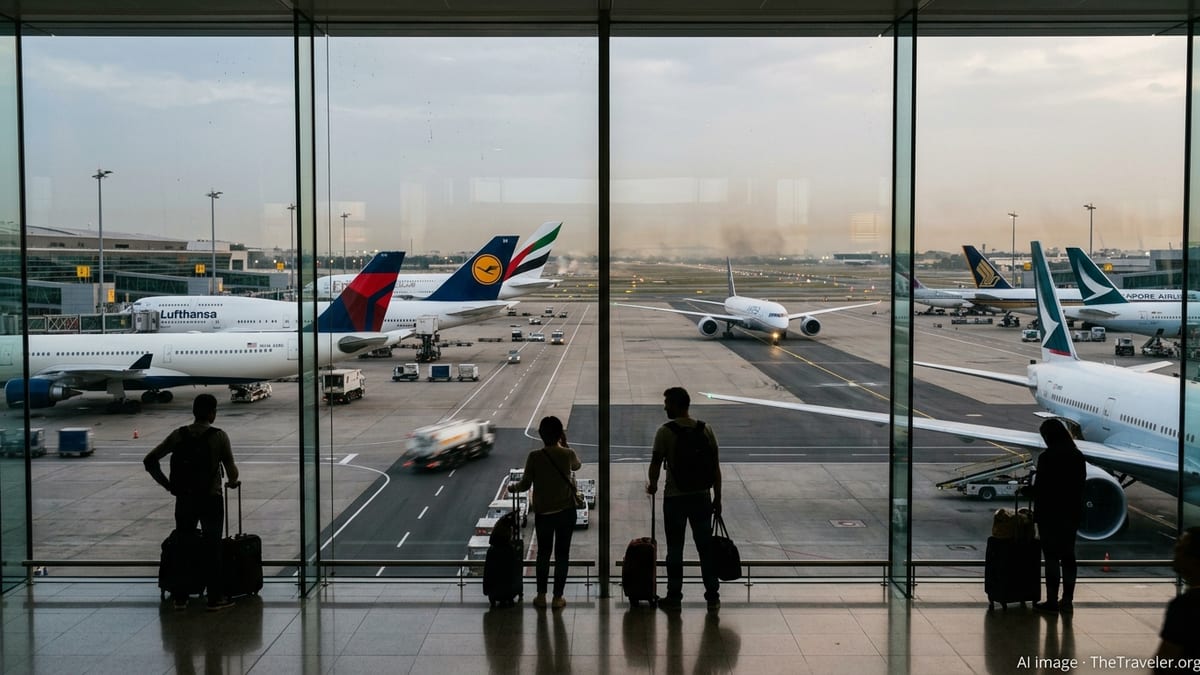
Nearly two dozen publicly listed major airlines, including Delta Air Lines, Air France-KLM, Lufthansa, British Airways parent IAG, Cathay Pacific and Singapore Airlines, have collectively lost close to 53 billion dollars in market value since the latest escalation of the Middle East crisis, sharpening concerns over the financial resilience of global carriers and adding fresh instability to long-haul travel networks.
Get the latest news straight to your inbox!
Sharp Market Repricing Hits Flagship Carriers
Publicly available trading data show that the latest bout of conflict in the Middle East has triggered a rapid selloff in airline stocks across Europe, North America and Asia. Large network carriers with heavy exposure to intercontinental routes, particularly those linking Europe and Asia, have borne the brunt of the reaction as investors reassess the risks to fuel costs, route viability and demand.
Market capitalization has fallen steeply at airline groups such as Delta in the United States, Air France-KLM and Lufthansa in continental Europe, IAG in the United Kingdom, and Cathay Pacific and Singapore Airlines in Asia. These companies anchor global alliance networks and operate many of the world’s most important long-haul corridors, meaning their share price swings are often treated as a barometer of wider aviation sentiment.
Analysts cited in recent financial coverage have noted that the selloff is not limited to carriers serving the Gulf or Israel directly. Instead, investors appear to be pricing in a prolonged period of elevated geopolitical risk, potential airspace closures and higher operating costs, all of which could weigh on profitability even for airlines that are only indirectly exposed to the region.
The roughly 53 billion dollar figure represents cumulative value wiped from these airline groups over a relatively short period since the conflict flared, underscoring how quickly equity markets can move when fuel price expectations, war-risk insurance premiums and network predictability come under pressure at the same time.
Airspace Closures Disrupt Long-Haul Flight Networks
Reports indicate that the latest phase of the Middle East crisis has led to widespread disruptions across Gulf and Levant airspace, including temporary closures, capacity restrictions and heightened security rules on overflight. International carriers such as British Airways, Lufthansa, Air France, KLM, Cathay Pacific, Singapore Airlines and Delta have all adjusted schedules, with a mix of cancellations, diversions and longer routings around affected zones.
These changes have been particularly acute for flights linking Europe and North America with South and Southeast Asia, which traditionally rely on efficient great-circle routes passing near or over the region. Rerouting to avoid conflict zones can add hundreds of miles to a sector, increasing fuel burn and crew costs, while also disrupting carefully calibrated aircraft rotations and connection banks at hub airports.
According to recent aviation tracking and industry reporting, services to major Gulf hubs such as Dubai and Abu Dhabi have been curtailed or temporarily suspended by several European and Asian flag carriers. As a result, key sixth-freedom connections, where passengers transit through the Gulf on their way between other continents, have been reduced, pushing more traffic onto alternative hubs in Istanbul, Doha, Singapore and parts of Europe.
For passengers, the immediate impact has been felt through sudden timetable changes, extended journey times and narrower choices on popular long-haul routes. For airlines, the operational complexity of rethreading global networks with limited notice is combining with already tight aircraft availability, given ongoing delivery delays and maintenance constraints.
Rising Costs and Weakening Sentiment Challenge Recovery
The market reaction comes at a delicate moment for the aviation sector, which had only recently returned to more stable profitability after the pandemic. Many major airlines entered 2026 with plans for capacity growth and fleet renewal, based on expectations of steady demand for international travel and a gradually improving cost base.
The new crisis has disrupted that narrative. Jet fuel prices have swung higher amid concerns over supply through key shipping chokepoints, while war-risk and insurance premiums for flights near affected areas have risen. These factors threaten to compress margins on some of the most lucrative long-haul routes, which traditionally help subsidize thinner domestic and regional networks.
Equity analysts tracking the sector have warned in published notes that the combination of higher costs, route uncertainty and more cautious consumer sentiment could prompt airlines to revisit capacity plans for the northern summer season. Some have already flagged the possibility of moderating growth on long-haul sectors most exposed to volatile overflight costs or security perceptions, even if headline travel demand remains resilient.
In parallel, the selloff highlights lingering investor skepticism about the sector’s ability to withstand repeated external shocks, from health crises to wars and energy disruptions. After years of heavy borrowing to survive the pandemic, several large carriers remain highly leveraged, leaving little room for extended periods of depressed yields or elevated operating expenses.
Passenger Experience: Longer Flights, Fewer Nonstops
For travelers, the financial turbulence in airline stocks is less visible than the day-to-day operational changes now spreading through long-haul schedules. With multiple carriers altering routings to avoid sensitive airspace, itinerary planners and booking engines are increasingly returning options with additional stops, longer block times or more complex connections.
Passengers flying between Europe and destinations in India, Southeast Asia and Australia are among those most affected, as nonstops that once passed over parts of the Middle East are retimed or temporarily withdrawn. Travel agents and online booking platforms report a growing pattern of routings via alternative hubs such as Istanbul, Doha, Singapore and select European gateways, often at the expense of shorter, more direct options through the Gulf.
Business travelers, who value schedule reliability and time savings, may be particularly sensitive to these changes. Some corporate travel programs are reviewing risk guidelines and preferred carrier lists for journeys that traverse higher-risk regions, potentially reshaping premium demand on certain routes. Leisure travelers, meanwhile, are facing increased uncertainty about whether flight times and routings will remain stable between booking and departure.
While many airlines have waived change fees or introduced flexible policies for itineraries touching affected areas, the broader pattern points to a more fragile international network in which geopolitical developments can rapidly alter the viability of certain long-haul city pairs.
Outlook: Volatility Becomes the New Normal for Global Aviation
The latest 53 billion dollar erosion in airline market value illustrates how quickly sentiment can turn against a sector that depends on open skies, predictable fuel supplies and stable demand. Industry observers note that even if a ceasefire or de-escalation brings some near-term relief to operations and costs, investors may remain cautious about assigning high valuations to carriers whose fortunes are so tightly linked to geopolitical stability.
In the near term, attention is likely to focus on how fast airlines can adapt their networks, pricing and fuel hedging strategies to the new environment. Carriers with diversified route structures, strong balance sheets and access to alternative hubs may be better positioned to manage extended disruption, while those with concentrated exposure to affected corridors could face tougher choices about capacity and fleet deployment.
For travelers, the implication is a more volatile landscape for long-haul journeys, especially across Europe, the Middle East and Asia. Schedules may remain in flux, flight times irregular and fare patterns harder to predict as airlines constantly rebalance risk and revenue. The recent stock market losses serve as a reminder that in global aviation, shocks in one region can quickly reverberate through balance sheets, route maps and passenger experiences worldwide.