

More news on this day
Escalating conflict between the United States and Iran is rapidly reshaping global air travel, as airlines confront closed skies over the Gulf, surging fuel costs, and mounting pressure on already stretched international networks.
Get the latest news straight to your inbox!
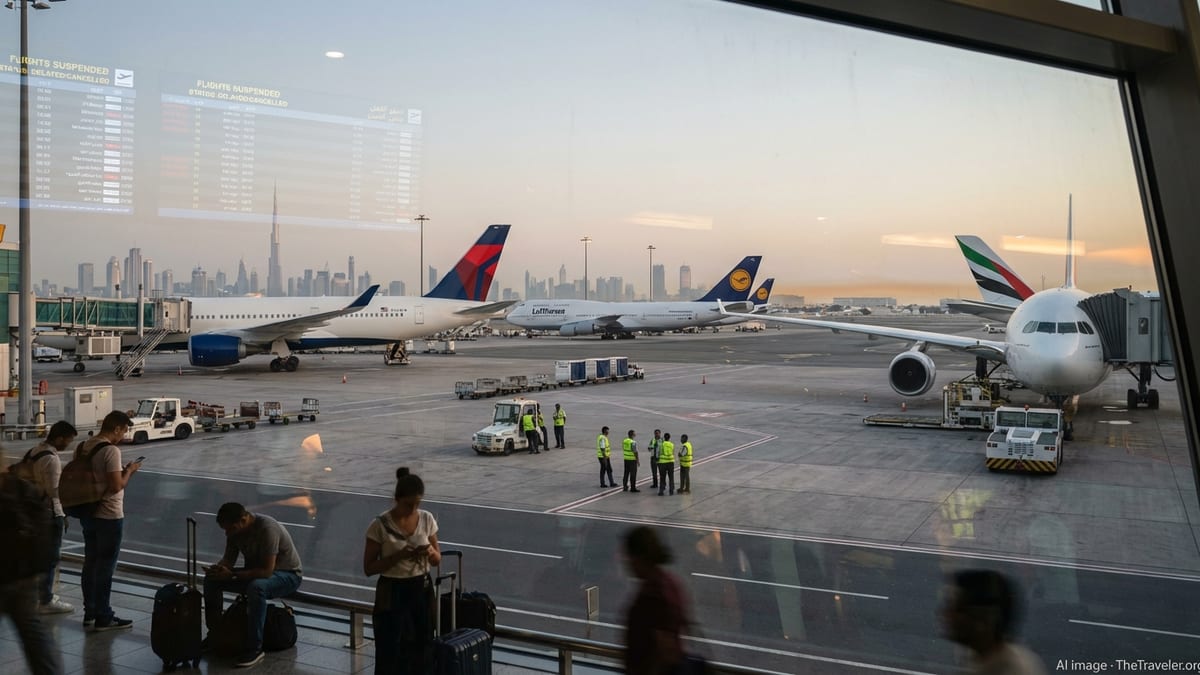
Skies Close Over Critical Gulf Corridors
Key airspace across Iran and parts of the Gulf region has been periodically shut or heavily restricted since late February 2026, according to multiple aviation trackers and industry analyses. Flight data reviewed in recent weeks shows commercial traffic over Iran, Iraq, Kuwait, Bahrain, Qatar, the United Arab Emirates, and Israel dropping to minimal levels as carriers divert around the conflict zone.
Coverage from international outlets and specialist aviation sites indicates that this evolving patchwork of closures began after coordinated United States and Israeli strikes on Iran on 28 February 2026 and subsequent Iranian missile attacks on targets across the region. The result has been widespread disruption at major Gulf hubs that once served as indispensable bridges between Europe, Africa, and Asia.
Reports on air travel conditions describe some of the worst global disruption since the height of the Covid‑19 crisis, with thousands of flights cancelled or delayed in early March alone. Traffic through Doha, Dubai, Abu Dhabi, and other regional airports has been sharply curtailed as airlines and aviation authorities reassess the safety of overflying or operating near active conflict zones.
Publicly available advisory documents and airspace briefs also point to heightened war‑risk considerations over the Strait of Hormuz, the Persian Gulf, and adjoining approaches. Airlines that continue to serve the broader region are doing so on more circuitous routings, adding distance and complexity to already long intercontinental journeys.
Global Carriers Reroute, Cut Capacity, and Redeploy Fleets
Major airlines in Europe, Asia, and North America are responding with a mix of suspensions, reroutings, and tactical capacity shifts. Travel industry coverage notes that carriers such as Turkish Airlines, United Airlines, Air France, Japan Airlines, Finnair, Vietnam Airlines, and AirBaltic have all announced reductions or temporary halts on selected services to the Middle East or across affected corridors in March 2026.
Some European airlines have taken particularly stark measures. Finnair, for example, has suspended services to Dubai for much of March and halted flights from Doha for several days, citing the need to avoid Iranian, Iraqi, Syrian, and Israeli airspace for safety reasons. Other legacy carriers are trimming frequencies to Gulf destinations and prioritizing resources on alternative routings through southern Europe, North Africa, or Central Asia.
Asian airlines are also reshaping their networks. Industry reports indicate that Air India has cancelled more than 2,500 flights to West Asia over the past three weeks and cut its broader schedule in the region by around 30 percent. To keep aircraft utilized and capture displaced demand, some carriers, including Cathay Pacific, are adding extra frequencies on trunk routes such as London–Hong Kong and Zurich–Hong Kong, effectively absorbing passengers who would previously have connected through Gulf hubs.
For many operators, the challenge is compounded by existing bans on using Russian airspace that remain in place due to the Ukraine conflict. With the Gulf now heavily constrained and northern corridors still closed to Western airlines, route planners face a shrinking map. Aviation navigation providers describe this combination of restrictions as creating a large void in the middle of traditional Europe–Asia flight paths, forcing airlines into longer southern or central detours.
Costs Surge as Fuel Prices and Insurance Premiums Climb
The operational fallout of the US–Iran confrontation extends well beyond schedule changes. Economic assessments of the 2026 Iran conflict suggest that aviation has been among the hardest‑hit industries, as longer routings, higher fuel burn, and intensified safety protocols intersect with surging commodity prices.
Oil benchmarks climbed sharply in early March, with some analyses noting that Brent crude briefly exceeded 100 US dollars per barrel for the first time in several years, driven in part by fears over sustained supply risks in the Strait of Hormuz. For airlines already contending with narrow margins and post‑pandemic debt loads, fuel spikes of this scale translate quickly into higher operating costs and, ultimately, higher fares for passengers.
Industry‑focused reports state that war‑risk insurers are reassessing coverage terms for flights that skirt or transit the Gulf region, leading to increased premiums for affected routes. Some risk advisories highlight the potential for further hikes if missile activity continues near major hubs or if new military incidents occur close to established airways.
Preliminary estimates from aviation analysts place the potential cost to the global airline sector in the billions of dollars if current conditions persist for several months. Beyond direct fuel and insurance expenses, airlines face additional outlays for crew positioning, schedule recovery, disrupted cargo flows, and passenger care when flights are cancelled or severely delayed.
Passengers Confront Longer Journeys and Uncertain Itineraries
For travelers, the conflict’s impact is being felt most directly through extended journey times, sudden routings changes, and complex rebooking experiences. Travel advisories compiled in March 2026 warn that many long‑haul itineraries linking North America, Europe, and Asia now face additional two to eight hour detours as aircraft are redirected around closed skies.
Consumer‑oriented travel guides report that passengers who previously used Doha, Dubai, or Abu Dhabi as convenient one‑stop connections between continents are being rerouted through alternative hubs such as Istanbul, London, Frankfurt, or Singapore. In some cases, airlines are automatically rebooking passengers onto entirely different routings without advance notification, leaving travelers to discover changes only when checking in or viewing updated itineraries.
On top of time penalties, disrupted air cargo flows through Gulf hubs are adding pressure to global supply chains. Analyses of the aviation crisis over Iran point to the Persian Gulf as a crucial node for high‑value freight, including electronics, pharmaceuticals, and just‑in‑time industrial components. With capacity squeezed and transit times lengthening, logistics experts warn that downstream effects could include higher prices and sporadic shortages in destination markets.
Travel specialists are advising passengers bound for the Middle East, Eastern Mediterranean, or connecting via Gulf airports to monitor their bookings closely, sign up for airline alerts, and allow substantial buffer time for onward connections. Some guidance also suggests postponing non‑essential journeys to the region until airspace restrictions stabilize and more predictable schedules return.
US and European Aerospace Sector Faces Knock‑On Effects
The turbulence is reverberating across the wider aerospace ecosystem, from aircraft manufacturers to maintenance providers and leasing firms. Economic impact assessments of the 2026 Iran war note that airline share prices in the United States and Europe have come under renewed pressure since late February, with notable drops for major network carriers heavily exposed to long‑haul international traffic.
Order books for wide‑body jets, which depend heavily on long‑distance routes linking Europe, North America, and Asia, are drawing fresh scrutiny from investors. While there is no immediate wave of cancellations reported publicly, analysts warn that prolonged instability along key corridors could prompt airlines to defer deliveries or slow fleet renewal plans, especially if demand softens under the weight of higher fares.
Maintenance and overhaul operations with facilities in or near the Gulf region are also working through operational contingencies as aircraft visits are rescheduled or relocated. Leasing companies, meanwhile, are reassessing asset placement strategies, as aircraft originally earmarked for Middle East growth are redirected to more stable markets or temporarily parked.
For now, aerospace suppliers and manufacturers are emphasizing the long‑term nature of global air travel demand, pointing to previous geopolitical shocks that eventually gave way to renewed growth. Yet with the US–Iran conflict still evolving and no durable ceasefire announced as of early April 2026, industry observers caution that airlines and the wider aerospace sector may be navigating a prolonged period of uncertainty in one of the world’s most strategically vital airspaces.