

More news on this day
Travellers moving through South Korea this week are facing a patchwork of cancellations and last minute schedule changes, as Korean Air, Qatar Airways, Delta Air Lines and several partner carriers pull or consolidate more than a dozen flights touching Seoul, Busan, Jeju, Guam, Doha, Seattle and other key hubs.
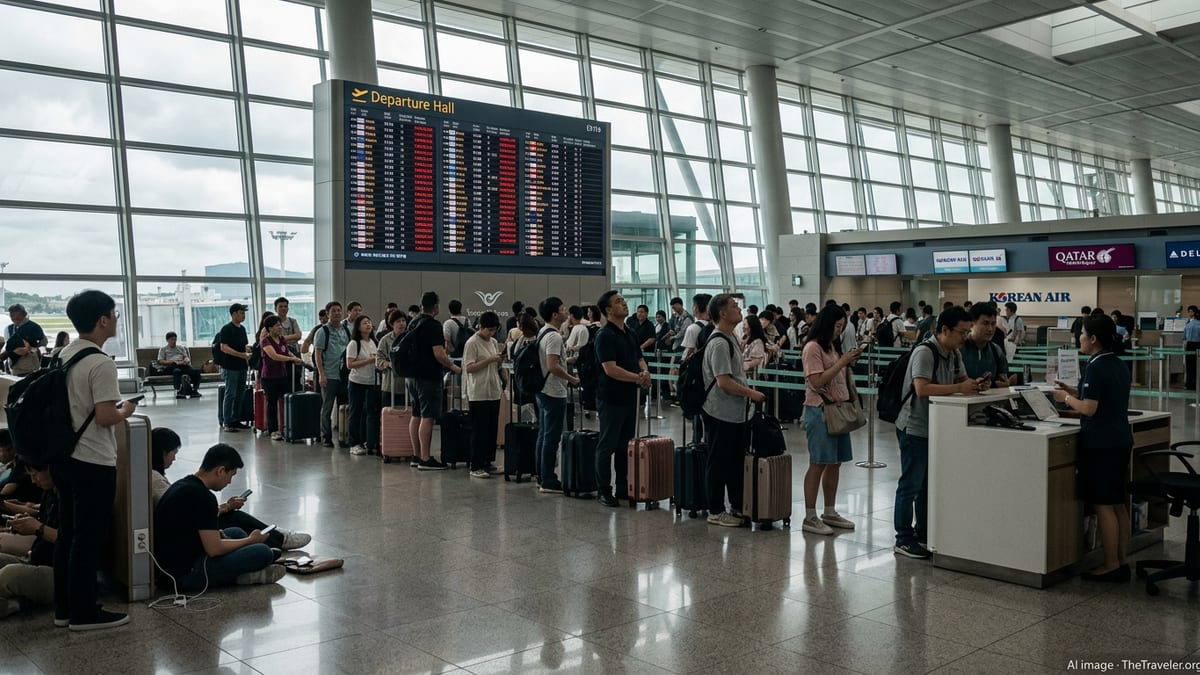
Airspace Turmoil Ripples Into South Korean Gateways
A regional airspace closure centered on Doha has triggered cascading schedule changes across airline networks, with South Korea’s major airports among those feeling the strain. Qatar Airways has been operating a sharply reduced timetable into and out of Hamad International Airport, affecting onward links to Seoul Incheon and a string of global destinations. The carrier has instead been mounting a limited series of so-called relief flights to move stranded passengers, rather than offering its normal daily frequencies.
The disruption has quickly rippled into codeshare and joint venture operations. Routes that normally see strong cooperation between Qatar Airways, Korean Air and Delta are being thinned out or temporarily canceled, as airlines attempt to keep aircraft and crews positioned while working around restricted airspace. Even when flights are still operating, many are running as one-off sectors on specific days, leaving gaps in what are usually daily timetables.
South Korean authorities and airport operators have urged passengers to check flight status repeatedly in the 24 hours before departure, warning that conditions remain fluid. With airlines making rolling adjustments as the situation in the Middle East evolves, the official online timetables for Incheon and other airports have lagged behind the rapid-fire schedule changes being made by carriers’ operations centers.
Korean Air and Delta Trim Services Linking Seoul, Busan, Jeju and the U.S.
Korean Air, the country’s largest carrier, has been at the center of the disruption for travelers moving within and beyond South Korea. Industry flight trackers show multiple Korean Air services touching Incheon and Gimpo being removed from schedules or zeroed out for sale, including selected rotations between Busan and Seoul, as well as some Jeju services. While many core domestic flights are still operating, the pattern of departures is less predictable than usual, with short-notice cancellations as aircraft and crews are reassigned.
Transpacific links have also come under pressure. Routes such as Seoul Incheon to Seattle, normally shared across Korean Air and its joint venture partner Delta, have seen isolated cancellations and re-timings as the partners rebalance capacity and work around disrupted connecting flows via Doha and other Middle Eastern hubs. Some passengers booked on Delta-coded services have been shifted to Korean Air metal or vice versa, while others have been asked to travel on different dates.
Domestic tourism hotspots have not been spared. Travellers heading to or from Jeju Island report scrubbed or heavily rebooked departures to Seoul and Busan, with entire blocks of flights disappearing from some booking systems for short periods before limited inventory returns. Although alternative seats are often available later the same day, families and tour groups are dealing with missed hotel check-ins and shortened stays as they are forced onto later departures.
Qatar Airways Cuts and Consolidates Flights Touching Seoul and Doha
Qatar Airways has confirmed that it is operating only a skeleton schedule to and from Doha this week as it navigates the airspace closure and resulting congestion on remaining permitted routings. The airline has prioritized a limited list of long-haul and regional destinations, including an altered pattern of flights linking Doha with Seoul Incheon. These services are running on select days only, with one-way relief flights in each direction rather than the full daily roundtrips that travelers are accustomed to.
Passengers bound for or transiting through South Korea on Qatar Airways are among those most affected. Many itineraries that once relied on smooth connections at Hamad International have had their Doha sectors canceled entirely, leaving travelers to piece together replacement journeys via alternative hubs in East Asia or Europe. Travel agents in Seoul describe a surge of last minute rebookings onto Korean Air, Delta and other alliance partners, with some itineraries now requiring two or even three connections instead of one.
For those who must still pass through Doha, the experience has become far less predictable. Departures that remain in the schedule have been subject to time changes, aircraft swaps and last minute operational holds as air traffic control slots are reassessed. Industry observers note that Qatar Airways’ decision to focus on a narrow band of relief flights is intended to give stranded passengers at least some pathway home, but at the expense of broader connectivity across its network, including to and from South Korea.
International Links to Guam, Seattle and Other Regional Hubs Strained
Beyond domestic and Doha-linked sectors, a web of international routes connected to South Korea is also feeling the impact. Services between Incheon and Guam, a popular leisure and shopping destination for Korean travelers, have seen selected cancellations and aircraft down-gauges as airlines including Korean Air and various low-cost carriers trim schedules and redeploy capacity. Seat availability has tightened on departures that are still operating, driving some passengers to postpone or shorten their island holidays.
On the transpacific side, Seattle sits at a key junction of this disruption. Joint operations by Korean Air and Delta on the Seoul Incheon to Seattle route rely heavily on connecting flows from across Asia and the Middle East. With Qatar Airways reducing its own long-haul footprint and sending fewer passengers into those networks, both carriers have been adjusting capacity and occasionally canceling rotations that no longer support viable load factors. Travellers who planned to connect in Seattle onward to cities like Minneapolis or Atlanta are among those facing rebookings.
Elsewhere in the region, routes touching Busan and Jeju are caught in a broader reshuffle affecting secondary cities across East Asia and the Pacific. Airlines are concentrating scarce aircraft and crew resources on trunk routes while trimming lightly booked or operationally complex sectors, including some overnight and early morning flights linking South Korea to nearby points such as Guam and selected Japanese and Southeast Asian cities. The net effect for passengers is fewer departure options and longer total journey times.
What Affected Passengers in and out of South Korea Should Do Now
With the situation still evolving, travel experts are urging anyone flying into or out of South Korea over the coming days to treat their booking as provisional until shortly before departure. That means checking the status of every segment directly with the operating airline, even if the ticket was purchased through a partner carrier or online travel agency. In many cases, codeshare flights appear as available in one system but show as canceled, waitlisted or zeroed out in another, leading to confusion at check-in.
Passengers whose flights have already been canceled are being offered a range of options, from free date changes to rerouting via alternate hubs, and in some cases full refunds. Policies vary from airline to airline, and even within the same carrier depending on the fare type and point of purchase. Travellers are being encouraged to keep all documentation, including original booking confirmations and any messages received from the airline about schedule changes, to smooth the process of securing new arrangements or claiming refunds later.
For those yet to depart, flexibility remains the most valuable asset. Industry insiders suggest building in longer connection times, avoiding tight layovers, and where possible choosing nonstop routes between South Korea and final destinations such as Guam, Seattle or Doha rather than itineraries with multiple connections. With Korean Air, Qatar Airways, Delta and their partners continuing to adjust schedules day by day, even well-planned journeys may still encounter last minute changes as the wider airspace disruption plays out.