

More news on this day
Global air travel to the Middle East has entered a new phase of disruption as major airlines extend widespread cancellations and schedule cuts to Dubai and Tel Aviv, responding to escalating conflict involving Iran and a US–Israel military coalition that has turned key Gulf air corridors into active risk zones.
Get the latest news straight to your inbox!
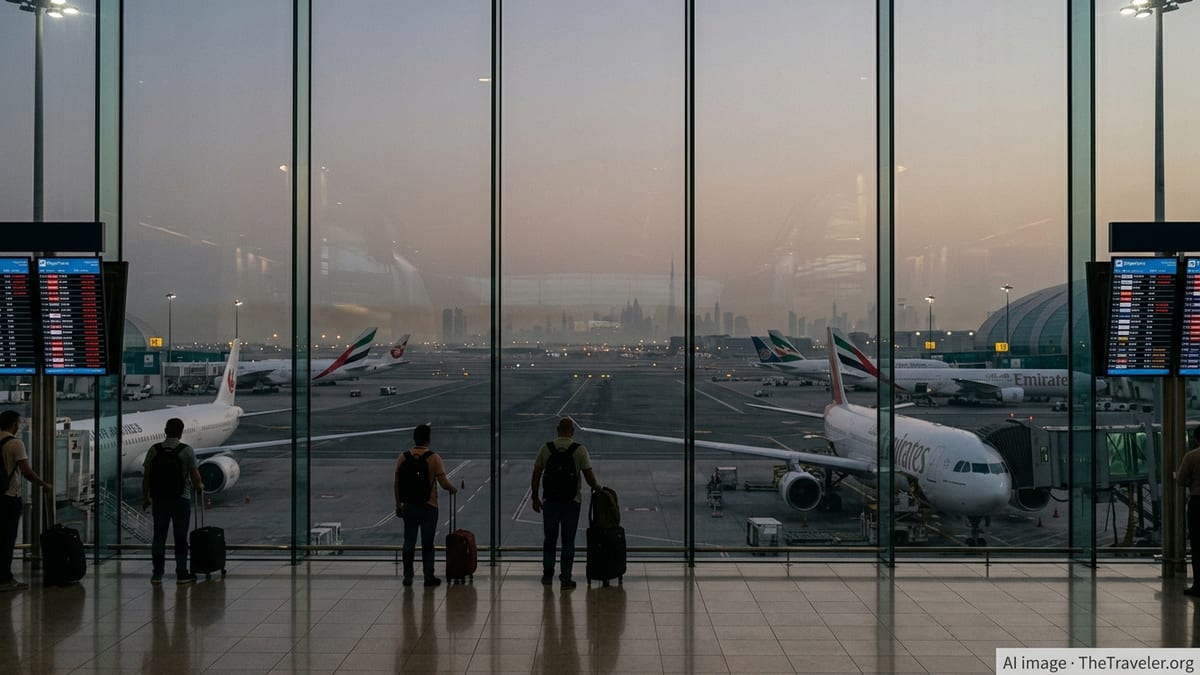
Conflict Escalation Pushes Regional Aviation to the Brink
The latest wave of cancellations follows weeks of military exchanges that have drawn much of the Gulf’s commercial airspace into the footprint of the Iran war. Publicly available situation reports describe large sections of airspace over Iran, Iraq, Israel, Jordan, Kuwait, Qatar, Bahrain, Syria and the United Arab Emirates either closed or heavily restricted for civilian traffic, sharply reducing safe routing options for long-haul flights into the region.
Analysts tracking the conflict note that Iran’s strikes across the Gulf and retaliatory attacks on Iranian infrastructure have coincided with a steep fall in overflights and scheduled services. Flight-tracking data and government advisories show that airlines began withdrawing from the most exposed routes in late February, then progressively broadened cancellations as missile and drone activity continued close to major hubs.
Dubai, a critical connecting point between Europe, Asia and Africa, has been hit especially hard. Reports on the economic impact of the war describe Dubai International and Abu Dhabi airports facing both physical damage from debris and prolonged operational suspensions, forcing tens of thousands of passengers into sudden itinerary changes or leaving them stranded in transit.
In parallel, Tel Aviv’s Ben Gurion Airport remains under sustained caution. International carriers have repeatedly suspended or thinned out services to Israel since the opening days of the conflict, and the latest schedule updates suggest that many airlines now expect reduced or no operations into Tel Aviv well into April and beyond.
Global Airlines Extend Cancellations and Waivers
Major Gulf-based carriers, including Emirates, Etihad Airways, Qatar Airways, flydubai and Air Arabia, moved early to halt regular services as airspace closures spread across the Gulf. According to travel advisories and airline notices summarized by aviation risk consultants, these operators have suspended most flights to and from Dubai and neighboring hubs, operating only limited repatriation or special services where conditions allow.
European and Asian airlines that rely on Gulf stopovers or overflight rights have followed suit. Carriers such as Lufthansa, British Airways, Air India and others have canceled or rerouted flights that would normally cross the Gulf region, trading their shortest paths for longer detours around closed skies. Industry assessments indicate that these changes add significant flying time and fuel burn to some of the world’s busiest corridors.
US carriers are also heavily adjusting schedules. Travel waiver bulletins published for customers show that at least one major US airline has repeatedly expanded and extended its “Middle East unrest” flexibility policy for Tel Aviv, allowing rebooking deep into the Northern Hemisphere summer. The same airline has continued to list all departures to Dubai as canceled through early March, and later advisories prolong this flexible rebooking window as conditions fail to normalize.
Regional airlines based in countries such as Saudi Arabia, Bahrain, Jordan and Kuwait are similarly tightening their networks. Industry circulars and port advisories describe national carriers suspending services to multiple Gulf destinations, including Dubai and Abu Dhabi, while also trimming flights to Tel Aviv and other high-risk airports until airspace restrictions ease.
Dubai Hub Under Strain as Missiles, Drones and Fuel Risks Converge
The strategic importance of Dubai’s aviation sector has made it a focal point of both physical and operational risk. Conflict reporting on Iranian strikes against the United Arab Emirates describes debris falling near Dubai International Airport and at least one major fuel-related fire linked to drone activity, events that have reinforced the case for conservative flight suspensions.
Infrastructure risk assessments released in recent days highlight a second layer of vulnerability: jet fuel storage and refueling systems around Gulf hubs. These reports point to the March drone attack on a jet fuel facility near Dubai as an example of how aviation disruption now extends beyond airspace closures to the integrity of ground infrastructure. With war-risk insurance premiums climbing and critical assets under threat, airlines have strong financial as well as safety incentives to limit operations.
Travel intelligence briefings for corporate clients note that Dubai is currently operating only a skeleton pattern of repatriation and essential flights, with most commercial passenger services suspended “until further notice.” Passengers are repeatedly urged to avoid traveling to the airport without confirmed rebooking, as on-the-spot departures are rare and terminal congestion poses additional challenges.
The impact spills into the cargo sector as well. Dubai’s role as a global airfreight crossroads means that suspended belly capacity and constrained freighter operations are delaying high-value and time-sensitive shipments, from pharmaceuticals to electronics. Logistics analysts warn that continuing disruption could ripple through supply chains worldwide, particularly between Europe and Asia.
Tel Aviv Cut Off as War Risk Dominates Airline Calculus
Tel Aviv has become another emblem of aviation upheaval. Since the start of the Iran conflict, multiple international carriers have either fully suspended or sharply reduced services to Ben Gurion Airport, citing regional security conditions and changing overflight permissions. Travel waiver notices show that rebooking windows for Tel Aviv travel now stretch into mid-June for at least one US airline, underscoring expectations of a prolonged disruption.
Regional and European airlines are applying similar caution. Some have publicly confirmed that they are avoiding not only Israeli airspace but also neighboring corridors over Lebanon, Jordan, Iraq and Iran, forcing Tel Aviv routes to be withdrawn entirely or operated only as occasional special flights. This elevates the city’s dependence on a reduced number of local and regional carriers still able to operate under enhanced security protocols.
Travel risk advisories warn that even when flights technically remain on airline schedules, last-minute cancellations and diversions are common. Passengers heading for Tel Aviv are urged to build in contingency time, maintain flexible plans and monitor airline channels closely, given that missile or drone activity in the wider region can prompt sudden operational pauses.
The extended isolation of Israel’s main gateway is also having knock-on effects for religious, business and tourism travel. Tour operators serving pilgrimage routes and corporate travel programs centered on Tel Aviv report widespread itinerary overhauls, with some groups postponing trips and others pivoting to video meetings in the face of persistent aviation uncertainty.
Travelers Face Long Detours, Rising Costs and Prolonged Uncertainty
For passengers, the combination of closed airspace, damaged infrastructure and heightened insurance risk is translating into longer journeys, fewer options and rising costs. Industry-wide analyses of the war’s economic impact estimate that thousands of flights have been canceled each day across the broader region since late February, leaving hundreds of thousands of travelers facing disruptions, from extended layovers to unplanned stopovers in third countries.
Where flights do operate, rerouting around the Gulf has added substantial flying time between Europe and South or Southeast Asia. Aviation observers point out that northbound detours over Turkey or southbound loops via the Arabian Sea and Indian Ocean can add several hours to a single sector, affecting crew scheduling, aircraft utilization and ticket pricing.
At the same time, jet fuel markets are reacting to perceived supply risks from attacks on energy infrastructure across the Gulf. Recent risk briefings link the Iran conflict to higher jet fuel prices, which, combined with longer routings, raise operating costs for airlines already contending with war-related capacity cuts. These pressures increase the likelihood of fare increases and surcharges on routes that still serve the wider region.
Travel experts caution that volatility is likely to persist, even if temporary pauses in fighting are announced. With war-risk insurers reassessing coverage, governments issuing evolving flight advisories, and airlines continuously recalibrating schedules, the skies over Dubai, Tel Aviv and the surrounding region are expected to remain unsettled for weeks or months, keeping global travelers on alert and reshaping one of the world’s busiest aviation crossroads.