

More news on this day
As Boeing’s delayed 777X inches toward a revised 2027 service entry, airlines from the Gulf to North America are focusing fresh attention on an often overlooked feature of the jet: compact, hidden crew rest compartments tucked into the overhead spaces of the fuselage that could reshape how ultra long haul flights are staffed and experienced.
Get the latest news straight to your inbox!
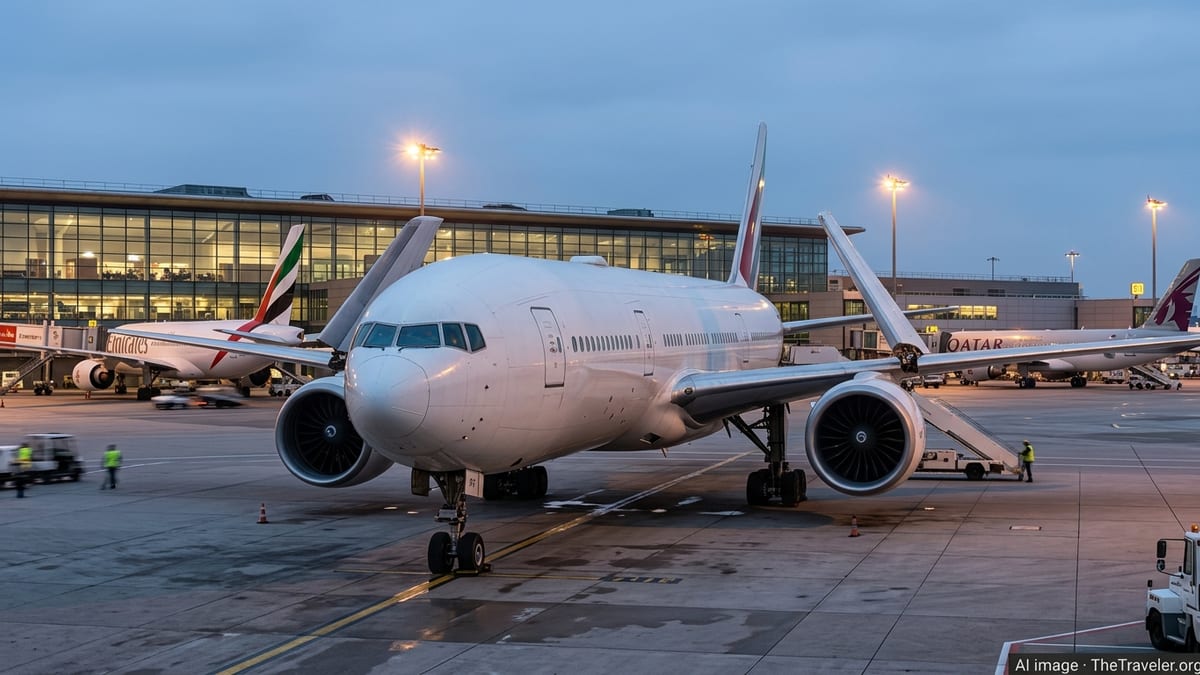
A New Widebody Built Around Ultra Long Haul Missions
The Boeing 777X program, which includes the 777 8 and 777 9 variants, has been designed from the outset for missions that routinely exceed twelve hours, a profile that has made dedicated crew rest areas a structural requirement rather than a retrofit option. Publicly available technical descriptions of the type highlight a configuration that places flight and cabin crew bunks in enclosed modules above the passenger cabin, using volume that traditionally housed only wiring, ducts, and some storage.
These overhead rest areas build on concepts already flying on earlier Boeing 777 and 787 models, as well as the Airbus A350, where recessed bunks are accessed by a discrete stairway or ladder from the main deck. On the 777X, the arrangement is more deeply integrated into the airframe, allowing airlines to preserve high value floor space for revenue seats while satisfying regulatory requirements for crew fatigue management on sectors that can stretch close to 18 hours.
Regulatory and design documents indicate that Boeing offers multiple crew rest layouts for the 777X, ranging from compact two bunk cockpit crew spaces near the front of the aircraft to larger cabin crew rest modules positioned over the aft cabin. The modular approach gives airlines flexibility to adapt the rest areas to specific route structures and staffing models, and it is this flexibility that many carriers now see as a competitive advantage.
Emirates Scales Up 777X Orders Around Premium Experience
Dubai based Emirates remains by far the largest customer for the 777X family, with more than 200 aircraft in its backlog after an additional order for 65 777 9s announced at the Dubai Airshow in late 2025. Publicly available financial disclosures and media coverage show that the airline now expects its first 777 9 deliveries no earlier than the second quarter of 2027, several years later than the original 2020 target.
Emirates’ strategy has historically centered on dense, long range flying across its Dubai hub, pairing high premium cabin counts with large economy cabins. Airline statements and industry analysis consistently link the 777X to this model, describing plans for new first and business class products, revamped premium economy, and higher overall seat counts compared with the current 777 300ER. Within that layout, the hidden crew rest compartments are crucial to maintaining crew numbers and service levels without sacrificing saleable cabin space.
Commentary in aviation trade media indicates that Emirates intends to schedule its initial 777X aircraft on high profile trunk routes connecting Dubai with Europe, North America, and East Asia, markets where flight times and payloads justify the cost of a next generation widebody. For these missions, the ability to rotate multiple sets of cockpit and cabin crew through quiet, isolated bunks is seen as essential to sustaining the intensive onboard service for which the carrier is known, especially as the airline retrofits its existing A380 and 777 fleets to bridge the gap until the new jets arrive.
Qatar Airways, Gulf Rivals and the Battle for Long Haul Market Share
Qatar Airways has also committed heavily to the 777X, with publicly reported orders for more than 120 aircraft. Reports on the airline’s fleet plan describe the type as central to replacing aging 777 300ERs and expanding capacity on key long haul routes from Doha to North America, Australasia and Europe, where flight times regularly pass 14 hours.
Industry coverage portrays the 777X as a core element of an ongoing arms race among Gulf carriers, including Emirates and Qatar Airways, to differentiate long haul products with quieter cabins, larger windows, reduced fuel burn and more sophisticated crew rest integration. Positioning crew bunks above the cabin allows operators to avoid sacrificing cargo space in the lower holds, a critical factor given the high volume of belly freight carried on many Gulf hub services.
Aviation analysts note that modern crew rest layouts can also influence passenger experience indirectly. By moving crew breaks entirely out of the main cabin, airlines can limit disturbances in premium cabins, reduce the need for blocked passenger seats near older rest areas, and allocate more contiguous zones for families or corporate travelers. On ultra long haul routes such as Doha to Los Angeles or Auckland, this combination of operational efficiency and subtle comfort gains is increasingly viewed as a deciding factor for high yield customers.
U.S. Airlines Weigh the 777X Against Smaller Long Haul Jets
In the United States, the picture around the 777X is more fluid. Publicly available fleet plans show that the largest U.S. carriers have focused recent widebody orders on the Boeing 787 and Airbus A350 families, which offer long range capability in slightly smaller, lighter airframes. Industry commentary frequently notes that U.S. airlines consider the 777X to be larger and heavier than they currently require for most international markets.
United Airlines, historically one of the world’s largest 777 operators, has repeatedly revisited its long deferred Airbus A350 order while also expanding its 787 commitments. Coverage of executive remarks indicates that the carrier continues to evaluate future options that could include either the A350 or, in the longer term, the 777X to replace aging 777 200s toward the end of the decade. For such missions, modern crew rest solutions would be an important factor, since United’s network includes some of the world’s longest commercial flights linking hubs like San Francisco, Houston and Newark with Asia and the Middle East.
Other major U.S. carriers are following similar paths, reinforcing long haul fleets with 787s and A350s that also feature overhead crew rest modules. At the same time, sustained interest in ultra long haul point to point routes, including possible new nonstop links to the Gulf and South Asia, keeps the 777X concept on the radar. Analysts suggest that if traffic demand rises and airport slot constraints tighten further, the combination of high seat counts and integrated crew rest areas on the 777X could eventually appeal to at least one of the big U.S. airlines.
Hidden Crew Rests as a Selling Point in a Delayed Program
Boeing’s own financial reporting and regulatory disclosures show that the prolonged certification of the 777X has resulted in significant additional costs and pushed planned entry into service to 2027, with some major customers publicly voicing frustration over the shifting schedule. Yet the same documents and technical material underline that the aircraft’s core design features, including new composite wings, updated GE9X engines and advanced cabin systems, remain central to its value proposition.
Within this package, the integrated crew rest architecture has become a surprisingly visible differentiator in industry discussions. Long haul operations specialists point to the way hidden overhead bunks free up both passenger deck and lower hold volume, reduce cabin noise around improvised rest areas, and simplify compliance with rest regulations that continue to tighten as ultra long haul flying grows more common.
As airlines refine their post pandemic long haul strategies, the 777X’s unseen spaces may play an outsized role in deployment decisions. For carriers such as Emirates and Qatar Airways, that have already committed to large fleets, the hidden crew rest modules are another tool for maximizing revenue and service levels on high density, high yield routes. For potential future customers, including U.S. airlines still weighing their next generation widebody choices, these tucked away compartments highlight how much of modern aviation’s innovation is now occurring out of passengers’ direct view, in the overhead corners of the cabin and behind closed doors.