

As Internorga 2026 prepares to open its doors in Hamburg this March, coffee is emerging as the surprise focal point for both hospitality operators on the ground and airlines in the skies, with Swiss manufacturer Rex-Royal set to showcase next-generation machines just as carriers such as United Airlines, Lufthansa and Air France intensify their push toward more premium inflight coffee experiences.
Internorga 2026 Puts Coffee Technology in the Spotlight
Internorga 2026, running from March 13 to 17 at Hamburg Messe, is expected to draw thousands of hospitality and foodservice professionals looking for the latest trends in beverages, equipment and guest experience. Among the core themes this year are automation, digitalization and quality, all converging dramatically around one product category that touches almost every traveler and hotel guest: coffee.
The trade fair, long regarded as a bellwether for European foodservice innovation, has expanded its focus on coffee and machines in recent editions, reflecting the beverage’s rising status as both a profit driver and a brand signature. Exhibitors range from artisan roasters to global equipment makers, each vying to show how precise extraction and consistent quality can be delivered at scale in hotels, bakeries, quick-service counters and travel hubs.
For airlines and rail operators, Internorga’s emphasis on high-efficiency, compact equipment is particularly relevant. The same pressures facing a hotel breakfast room or a busy café line up closely with the constraints inside an aircraft galley: limited space, fast throughput and guests who increasingly expect barista-level quality. That makes the Hamburg show an important reference point for aviation and rail buyers looking to modernize their inflight offerings.
This year’s edition is unfolding against a backdrop of renewed investment in onboard food and beverage across major carriers. From the United States to Europe, airlines are aggressively rethinking coffee as more than a basic amenity, positioning it instead as a differentiator in a competitive market where loyalty often hinges on small but memorable comforts.
Rex-Royal Unveils Next-Gen Machines for a Compact, Connected Future
Within this environment, Rex-Royal is drawing attention as it prepares to introduce a new generation of fully automatic coffee machines tailored to high-demand yet space-constrained locations. While full technical details remain closely held ahead of the show, industry expectations center on more efficient brewing, enhanced milk systems and advanced connectivity designed to support predictive maintenance and remote monitoring.
Manufacturers across the sector are racing to integrate smarter sensors, telemetry and cloud analytics into their machines. For an operator, that can mean automatic alerts when cleaning cycles are overdue, usage-based ingredient forecasting and real-time performance dashboards across a global estate of hotels, lounges or airport kiosks. Rex-Royal’s upcoming models are widely expected to lean into this data-driven approach, enabling operators to keep quality consistent and downtime minimal.
Another priority is sustainability. The new machines are anticipated to feature lower energy consumption, refined standby modes and more efficient water use, all key concerns for hospitality groups facing tightening environmental targets. In addition, more precise dosing and extraction control can reduce waste, helping to ensure that each cup uses exactly the coffee it needs and no more.
Form factor also matters. With airlines, rail operators and compact hotel concepts in mind, Rex-Royal and its competitors are working to condense professional-grade performance into smaller footprints. Modular componentry, front-access service points and flexible milk and bean configurations are becoming standard expectations from buyers who operate in galleys, micro-lobbies or tight back-of-house corridors.
Airlines Turn to Premium Coffee to Strengthen Brand Loyalty
United Airlines, Lufthansa, Air France and other major carriers are increasingly aware that the quality of a cup of coffee served at 35,000 feet can shape traveler impressions long after landing. In premium cabins, where fares can reach into the thousands of dollars, passengers have come to expect a beverage experience that mirrors what they enjoy in their favorite cafés at home.
The industry has already seen a wave of partnerships between airlines and well-known coffee brands, from Italian roasters to specialty American chains. These collaborations often extend to airport lounges, where business travelers may take multiple meetings over coffee before boarding. For carriers, aligning with an established roaster gives them a recognizable name and a narrative about craftsmanship, sourcing and flavor profiles, while the roaster gains global visibility.
Behind the scenes, equipment choices are just as important as bean selection. Airlines must balance taste and consistency with operational constraints, including limited power, turbulence and the need for quick service during short flights. This has led to growing interest in compact, ruggedized automatic machines and improved brewing technology that can handle challenging cabin conditions while still extracting a flavorful, aromatic cup.
As passenger expectations climb, carriers are also using coffee as a relatively low-cost way to elevate the perception of their entire product. A well-presented cappuccino or carefully brewed filter coffee in economy can go a long way toward mitigating frustrations related to delays or seat comfort. In that sense, the emerging “coffee arms race” among airlines is rooted not only in culinary ambition but also in customer psychology.
Transatlantic Players: United, Lufthansa, Air France and the Coffee Arms Race
Across the transatlantic corridor, United Airlines, Lufthansa and Air France are all under pressure to refine their onboard hospitality as competition intensifies from both traditional rivals and younger carriers. Coffee has become one of the most visible frontiers where these brands can differentiate themselves without reconfiguring entire cabins.
United, with its extensive long-haul network linking North America to Europe and beyond, has been steadily upgrading elements of its inflight service, from expanded snack offerings to premium cabin dining. Coffee is a natural next step in that transformation, particularly as U.S. travelers become more discerning about brew strength, freshness and bean provenance. Whether served in Polaris business class or in economy on transcontinental flights, the airline’s hot beverage experience increasingly factors into online reviews and satisfaction scores.
Lufthansa and Air France, both anchored in countries with deep-rooted coffee cultures, face their own expectations at home. Customers boarding in Frankfurt, Munich or Paris are accustomed to robust espresso, silky milk textures and a range of options extending beyond simple filtered coffee. Replicating that experience in the air is technically challenging, but it is also a powerful way to signal national identity and culinary pride.
In recent years, European flag carriers have experimented with specialty roasters, upgraded beans and improved preparation methods. Cabin crew training has also become more sophisticated, with airlines recognizing that well-calibrated machines are only as good as the staff operating them. Little details, from serving temperature to how milk is poured, can influence whether a passenger perceives their coffee as premium or perfunctory.
From Lounges to Galleys: How Internorga Innovations Travel into the Sky
The innovations on display at Internorga are not limited to restaurants and hotels. Many of the same manufacturers supplying cafés and bakeries also serve airport lounges and, in some cases, adapt their equipment for airline use. As a result, what appears first in a Hamburg exhibition hall may later be found behind a lounge counter in Chicago, Paris or Frankfurt, and eventually in an aircraft galley.
For airlines, Internorga functions as both a marketplace and a research lab. Procurement teams and catering partners can compare machine performance across multiple brands, test cup quality side by side and explore integration with digital platforms they already use. For example, an airline might seek a coffee system that links to its catering logistics software, enabling more precise planning of coffee and milk stocks based on route length, cabin size and historic consumption patterns.
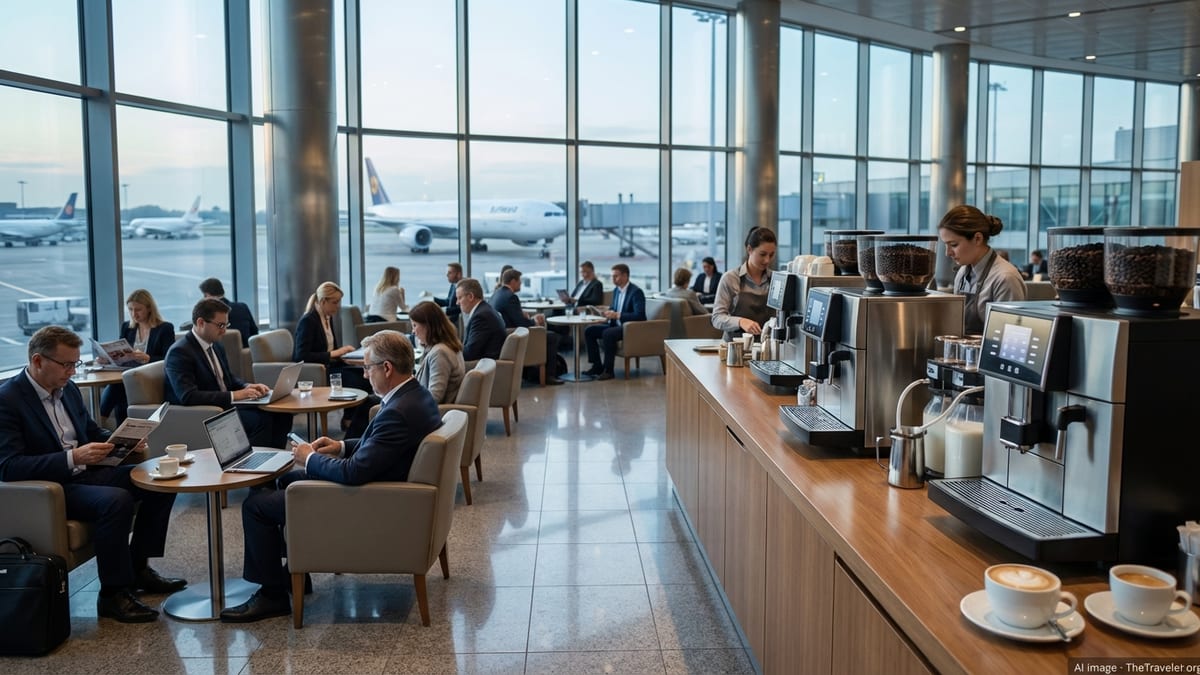
Airport lounges are often the first place where carrier coffee upgrades appear. Here, space is less constrained than on board, and operators can experiment with higher-end machines, multiple bean options and different milk alternatives. Once a concept proves successful on the ground, elements of it may be simplified and adapted for the cabin, using more compact equipment that still preserves the signature flavor profile passengers recognize from the lounge.
This ground-to-air pipeline highlights why trade shows like Internorga carry outsized influence in aviation, despite being oriented primarily to the broader hospitality sector. Airlines increasingly position themselves as part of a traveler’s total lifestyle, and the coffee served before boarding, during flight and after landing is part of a single, coherent narrative.
Rising Passenger Expectations Reshape Beverage Strategies
Passenger expectations around coffee are changing in parallel with broader consumer trends. Specialty cafés have made terms like single origin, light roast and cold brew mainstream, particularly among younger travelers. These guests are less willing to accept burnt or watery coffee as simply an unavoidable feature of flying, and they often notice when an airline makes a visible effort to improve quality.
Data from customer satisfaction surveys consistently place food and beverage, and coffee in particular, among the easiest places for airlines to win or lose points. A single negative experience may be forgiven, but repeated disappointments can drive customers to seek alternatives when comparable routes and fares are available. By contrast, a reputation for reliably good coffee can become part of a carrier’s identity, much like generous legroom or friendly crews.
In response, carriers are refining not only the product in the cup but also the rituals around it. Some airlines now highlight their coffee partners in onboard magazines, share stories about bean origins and sustainability initiatives, or feature limited-edition blends on specific routes. These touches aim to connect with travelers who care about authenticity and responsible sourcing, adding narrative depth to what might otherwise be a routine beverage service.
At the same time, airlines must remain pragmatic. Any coffee program needs to be replicable across fleets, time zones and catering bases, and it must function reliably under the unique constraints of aviation operations. This is where advances in machine technology, like those expected from Rex-Royal at Internorga, can make elevated coffee experiences achievable at scale rather than limited to a handful of flagship routes.
Hospitality and Aviation Converge Around Smart, Sustainable Coffee
The convergence between hospitality and aviation around coffee technology is becoming increasingly clear. Hotels, restaurants and airlines all grapple with the need to deliver high-quality beverages consistently, with limited skilled labor and mounting sustainability requirements. Smart, connected coffee machines promise to address many of these pressures by automating routine tasks while preserving a human touch at the point of service.
Rex-Royal’s anticipated next-generation systems are entering a market that now expects energy-efficient components, recyclable packaging where possible and transparency about sourcing. Airlines like United, Lufthansa and Air France, which report regularly on environmental initiatives, are likely to favor equipment that supports more efficient resource use and simpler waste streams, particularly as regulations tighten around single-use plastics and emissions.
Looking ahead, industry observers expect greater collaboration among machine manufacturers, coffee roasters and carriers to create integrated solutions tailored specifically to aviation and travel hubs. This could include customized brewing profiles for different cabin classes, shared data on consumption trends to optimize supply chains, and co-branded concepts that blur the line between an airline and a café brand.
As Internorga 2026 opens in Hamburg, the unveiling of Rex-Royal’s next-generation machines is poised to resonate far beyond hotel lobbies and bakery counters. For travelers stepping onto flights operated by United, Lufthansa, Air France and their peers, the innovations showcased on the trade fair floor may soon translate into a noticeably better cup of coffee at cruising altitude, underscoring how even small upgrades in hospitality can reshape the modern travel experience.