

More news on this day
Major airlines across North America, Europe and the Asia Pacific are rushing to rewrite flight plans, fares and fuel strategies as the escalating crisis in West Asia chokes jet fuel supplies, closes key air corridors and sends ticket prices sharply higher on long haul routes.
Get the latest news straight to your inbox!
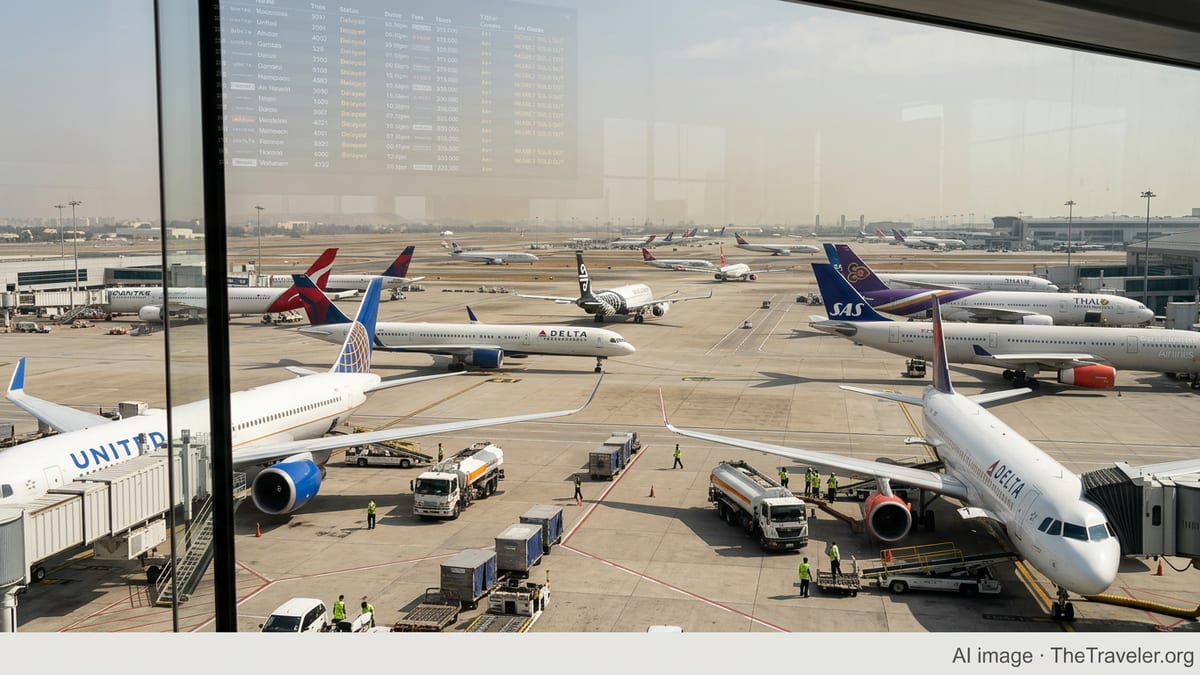
Jet Fuel Shock Ripples Through Global Aviation
The latest escalation of conflict centered on Iran and the Strait of Hormuz since late February 2026 has exposed how dependent global aviation remains on West Asian energy and airspace. Industry analysis shows Brent crude and refined products have spiked after tanker traffic through the strait was severely curtailed, while damage and shutdowns at Gulf energy and export facilities have tightened jet fuel availability worldwide.
Recent assessments by airline and freight analysts indicate that jet fuel prices have nearly doubled in a matter of weeks, with some benchmarks moving from January levels to more than 170 dollars a barrel by early March. The International Air Transport Association has highlighted how war risk premiums, longer routings around closed skies, and congestion along remaining corridors are amplifying the impact of the raw fuel surge on carrier operating costs.
Global supply constraints are compounded by the ongoing closure or restriction of airspace over Iran, Iraq and several Gulf states, forcing airlines to reroute around the eastern Mediterranean and over Saudi Arabia, Egypt, and Central Asia. Flight tracking data and logistics advisories describe a dense concentration of traffic through these remaining paths, with rising delays and additional fuel burn now built into many schedules.
Aviation economists note that fuel, typically the second largest operating cost after labor for many carriers, is now threatening to erase already thin profit margins projected for 2026. Even airlines with partial fuel hedges are seeing hedging protection erode as prices and route lengths rise together, making airfare increases difficult to avoid.
United, Delta and Southwest Adjust in a Volatile U.S. Market
In the United States, major carriers are beginning to translate the fuel shock and routing disruptions into strategy shifts affecting both international and domestic travelers. Publicly available remarks from senior executives at large network airlines indicate that fare increases are expected to materialize quickly, particularly on long haul services that now require substantial detours to avoid conflict zones.
United Airlines has been closely exposed to transatlantic, Middle East and South Asia flows, and has introduced a series of flexibility and travel waiver programs for itineraries touching the affected region. These waivers, covering late February through at least the end of March, allow customers to change plans without fees while the airline adjusts capacity, routings and schedules on flights that previously crossed Iranian, Iraqi or neighboring airspace.
Delta Air Lines has maintained suspensions on its Tel Aviv services and continues to review routings on Europe, Middle East and South Asia connections that rely on partner and alliance networks. Booking data shared through online agency and customer reports show higher fares on transatlantic itineraries that connect onward to South Asia and East Africa, reflecting both higher fuel surcharges and reduced inventory as schedules are trimmed.
Southwest Airlines, which operates a predominantly domestic and near international network, is feeling the impact primarily through fuel costs rather than routing disruptions. Regulatory and investor filings released in recent weeks highlight fuel price volatility and geopolitical conflict as key risks, with the carrier leaning on its hedging program to cushion some of the spike. Nevertheless, analysts expect that sustained high jet fuel prices will filter into U.S. domestic fares across carriers through the Spring and Summer travel peaks.
Asia Pacific and European Carriers Face Steep Rerouting Costs
Airlines in the Asia Pacific and Europe are experiencing some of the most severe operational fallout, as West Asia airspace closures disrupt core corridors between Asia and Europe. Published fare data and travel industry monitoring show that one way economy tickets on certain Asia Europe routes have climbed by double digit percentages, with extreme price spikes appearing on peak dates where capacity is especially constrained.
Reports indicate that aviation fuel prices in the region reached nearly 174 dollars per barrel in early March, driving Asia Pacific airlines such as Singapore Airlines, Cathay Pacific and Indian carriers to implement steep fare rises or additional fuel surcharges on long haul services. At the same time, many flights between Asia and Europe that traditionally transited Gulf hubs are now detouring via Central Asia, the Caucasus or southern Mediterranean corridors, often adding several hours to block times.
European network airlines including Lufthansa Group carriers, Air France KLM and British Airways have also rerouted services to avoid Iranian, Iraqi, Syrian and Israeli airspace. Travel advisories and schedule updates describe longer routings to India, Southeast Asia and parts of East Asia, which not only consume more fuel but also tie up aircraft and crews for longer periods, reducing daily utilization and limiting available seats.
In parallel, cargo and freight forwarder bulletins outline reduced hub connectivity and rising air freight rates on Asia Europe lanes. With capacity constrained and costs elevated, both passenger and cargo operators are prioritizing the most commercially critical routes, leaving secondary city pairs with thinner schedules or temporary suspensions.
Air New Zealand, Qantas, SAS, Thai Airways and Others Rework Networks
In the South Pacific, Air New Zealand and Qantas are recalibrating their long haul networks to Europe and parts of Asia in light of the current crisis. Public timetable changes and booking engine displays show tighter capacity on itineraries that once depended on Middle Eastern hubs, with some flows now reshaped through Asian or European gateway partners instead.
For Qantas passengers traveling between Australia and Europe, routings that previously transited Dubai or other Gulf hubs are increasingly being replaced by connections via Singapore, Bangkok and other Southeast Asian cities. These alternate paths tend to be longer when Middle Eastern shortcuts are unavailable, a factor that is now reflected in both higher fares and extended travel times shown in online searches.
Air New Zealand, which relies heavily on partner links to connect New Zealand with Europe, is seen concentrating demand through stable hubs in East Asia and North America while avoiding the most disrupted West Asia corridors. Industry commentary suggests that, with aircraft and crews already tightly utilized, the carrier has limited flexibility to add extra capacity, further reinforcing upward pressure on ticket prices during peak Northern Hemisphere seasons.
In Europe and Asia, Scandinavian carrier SAS and Thai Airways are making similar network adjustments. Published coverage describes SAS rerouting flights to Asia to steer clear of affected airspace, while Thai Airways has adjusted paths to Europe and the Middle East and is communicating longer travel times for certain routes. Across these airlines, the pattern is consistent: more circuitous routing, fewer frequencies on marginal routes, and a growing reliance on fare increases and surcharges to offset higher fuel and insurance costs.
What Travelers Can Expect in the Months Ahead
Travel analysts broadly expect the combined impact of higher jet fuel prices, disrupted airspace and constrained capacity to linger at least through mid 2026, even if some Gulf airports and corridors gradually reopen. Airlines are signaling that, while short term waivers and schedule protections are in place, structural changes to networks and pricing will depend on the duration and intensity of the conflict and on how quickly energy flows through West Asia normalize.
For leisure and business travelers, the most visible changes are likely to be elevated fares on long haul routes touching Europe, Asia, Africa and Oceania, particularly where flights once relied on Middle Eastern hubs or overflight permissions. Travelers originating in North America may also see higher prices and fewer nonstop options to certain South Asian and African destinations, as U.S. and partner airlines prioritize the most profitable trunk routes.
Longer scheduled flight times, additional technical stops and tighter connection windows are also becoming more common as airlines work around congestion in the remaining open corridors. Airport and regulator advisories urge passengers with upcoming trips through the wider region to monitor bookings closely, as last minute adjustments to routings and departure times remain possible.
While some low cost and regional airlines with robust fuel hedging may temporarily blunt the impact of the price shock, most full service carriers are now passing at least part of the additional cost directly into airfares. Unless the conflict eases and energy markets stabilize, the current combination of fuel shortages, rerouting and war risk pricing is set to keep global air travel more expensive and less predictable than it was even a few weeks ago.