

More news on this day
Airlines and airport groups across Europe are intensifying pressure on Brussels to preserve emergency suspension mechanisms for the European Union’s new biometric Entry/Exit System, warning that without flexible “off switches” the continent risks severe airport gridlock and damaged tourism flows as the summer peak approaches.
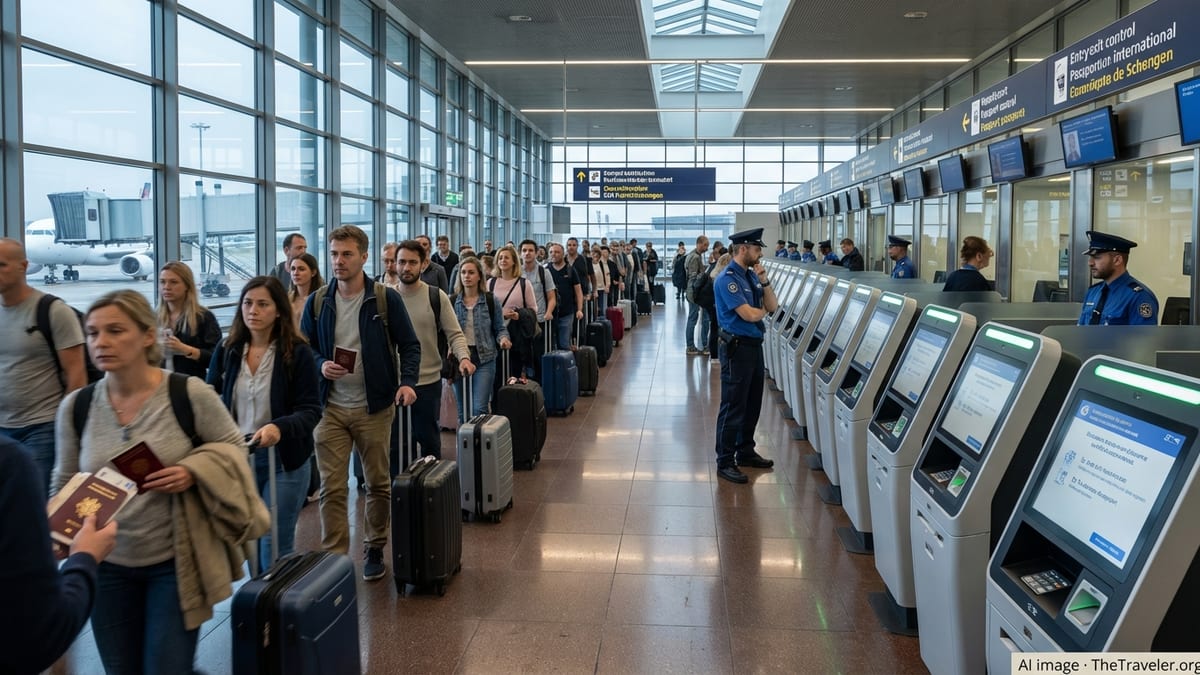
Mounting Calls for a Safety Valve on the New Border Regime
With the EU’s long-planned Entry/Exit System (EES) moving toward full application in 2026, aviation and travel stakeholders are no longer arguing over whether the system should exist, but how it can be tempered when reality at the border clashes with regulatory timelines. Industry bodies including Airports Council International Europe, Airlines for Europe and the International Air Transport Association have publicly urged the European Commission to confirm that member states will retain the option to partially or fully suspend EES operations during periods of exceptional strain.
Their warnings are rooted in live experience rather than hypothetical models. Since EES began its phased rollout in October 2025, only around a third of eligible non-EU passengers have been consistently processed through the new biometric checks, yet several airports have already reported queues of two to three hours. In Lisbon, waiting times briefly stretched to around seven hours before Portuguese authorities halted the system at the capital’s airport for a three-month period in early 2026 to restore operational stability.
Industry leaders argue that without clearly defined and practically usable suspension protocols, Europe could see these isolated breakdowns morph into continent-wide disruption as EES coverage ramps up to 100 percent of third-country nationals. They insist the ability to dial down or pause the system temporarily, especially at pressure points, is now an essential safeguard rather than a political concession.
Portuguese Suspension Highlights Risks of Rigid Rollout
Portugal has become a high-profile test case for how EES can collide with on-the-ground capacity. When Lisbon Airport moved into the second phase of the system, which requires biometric data capture for non-EU arrivals, border control quickly buckled. Reports of waits surpassing seven hours and missed connections prompted the government in Lisbon to take the politically sensitive step of suspending EES operations for non-EU travelers at the airport for three months, while rushing in extra staff and expanding equipment capacity.
The Portuguese authorities framed the move as an emergency corrective measure rather than a repudiation of the border modernization project. Additional personnel were deployed and the throughput of both electronic and staffed control points was increased by roughly a third, in an attempt to handle demand without relying fully on a system that was clearly not yet calibrated to real-world volumes. Officials also acknowledged that the necessary training and systems integration had lagged behind the political timetable.
For aviation groups across Europe, Lisbon’s experience is a stark illustration of what could happen elsewhere during peak travel weeks if EES cannot be dialed back quickly when cracks appear. They point out that the congestion in Portugal erupted at a time when only a portion of travelers were being processed under EES rules. Once every eligible non-EU passenger must be registered at every crossing, they argue, localized breakdowns could rapidly propagate across airline schedules, creating missed connections, aircraft rotations out of position and further crowding at already stressed terminals.
The Portuguese suspension has therefore become a powerful case study in lobbying efforts in Brussels, reinforcing the argument that legal and technical frameworks must explicitly allow similar interventions by other states without lengthy approvals or fear of infringing Schengen obligations.
French Hub Operators Seek Summer Suspension to Protect Flows
In France, which remains the world’s most visited country, airport operators are now openly calling for a pause in further EES deployment during the core summer months. Aéroports de Paris, which runs Paris Charles de Gaulle and Orly, has urged that the planned expansion of EES processing in April be postponed or significantly tempered, warning of “congestion” risks if full coverage coincides with record-breaking visitor numbers.
Executives at the Paris hub group say that testing of EES kiosks and procedures has so far been carried out under relatively controlled conditions with limited passenger volumes. When queues begin to stretch and flows become erratic, staff have been able to revert swiftly to manual checks to keep operations moving. This trial environment, they caution, bears little resemblance to what will occur once summer schedules, transfer banks and holiday traffic converge on the French capital’s complex terminals.
The group is advocating a broader suspension window for EES during the summer peak, roughly from June through August, not only for Paris but as an available option across major European gateways. The goal, according to airport managers, is to ensure that any technical glitches, staffing mismatches or passenger misunderstandings do not snowball into hours-long queues that could tarnish France’s and Europe’s image as welcoming, efficient destinations.
Behind the French calls lies a broader concern that if EES is perceived as synonymous with delay and confusion at Schengen borders, travelers from key long-haul markets may reconsider their plans or reroute through non-EU hubs, particularly in the Gulf or the United Kingdom. Protecting the fluidity of hub operations is therefore framed not just as an operational priority but as a strategic imperative for Europe’s competitiveness in global aviation.
Industry Letter Warns of Four-Hour Queues Without Flexibility
The aviation sector’s lobbying has coalesced into a formal appeal to the European Commission. In a joint letter to the EU Commissioner responsible for home affairs and migration, the heads of ACI Europe, Airlines for Europe and IATA warned that if EES implementation proceeds without sufficient flexibility, peak-season waiting times could reach four hours or more at some border crossings, particularly in July and August.
The letter paints a picture of a system whose benefits for security and border management are widely acknowledged, but whose operational underpinnings remain wobbly. It cites chronic understaffing at many national border police units, unresolved technology problems with automated e-gates and kiosks, and the “very limited” uptake among member states of a Frontex-backed pre-registration app intended to front-load data collection away from airport counters.
Crucially, the signatories argue that there is a “disconnect” between the relatively positive perception of EES performance in Brussels and the daily experience of frontline staff and passengers at major hubs. While official progress reports highlight successful enrollments and system stability, airlines and airports report mounting delays for non-EU travelers and growing frustration among crews trying to maintain schedules in the face of unpredictable border queues.
The core demand of the letter is that the Commission explicitly confirm that under the phased rollout rules, member states can maintain the option of partial or total EES suspension at least until the end of October 2026. The concern is that under current regulations, some of these derogations could lapse as early as July 2026, just as traffic peaks, leaving authorities locked into full EES processing even when it proves unsustainable in practice.
Balancing Security Modernization With Tourism and Connectivity
European policymakers have long argued that EES is a vital step in modernizing the bloc’s external borders, replacing manual passport stamping with a centralized database recording biometric and travel history information for non-EU nationals. Supporters say this will make it easier to detect overstays, identify repeat offenders and combat document fraud, while providing a more accurate picture of inflows and outflows at a time of heightened political sensitivity around migration and security.
However, the travel and tourism sector has consistently stressed that the way EES is introduced will shape public perception for years. Short-term chaos at border checkpoints, they warn, could overshadow long-term benefits, especially if holidaymakers’ first encounter with the system is a multi-hour queue in cramped arrival halls during a heatwave. For destinations heavily reliant on international tourism revenue, the reputational cost of such scenes could be significant.
There is also an economic dimension that extends beyond leisure travel. European hubs compete fiercely for business travelers and for transfer passengers on intercontinental routes. If EES bottlenecks make connections through Schengen airports less predictable, airlines fear that high-yield passengers may opt for alternative routings through non-Schengen hubs that can guarantee smoother transfers, even if that means longer overall flight times.
Against this backdrop, industry calls for suspension protocols are framed not as an attempt to weaken border security, but as a recognition that digital transformation projects of this magnitude rarely proceed without setbacks. In their view, allowing national authorities to slow down or pause EES processing in exceptional circumstances is a pragmatic way to protect Europe’s broader connectivity and tourism goals while technical and staffing issues are resolved.
Regulatory Timetables Clash With Airport Realities
Part of the tension around EES stems from the gap between Brussels’ legislative calendars and the incremental nature of airport operations planning. Member states agreed on the legal framework and funding mechanisms years before the system went live, and successive delays to the launch have already created political pressure to demonstrate progress. As a result, the push toward full operational coverage in 2026 is underpinned by strong expectations in the Council and Parliament that the project must now move forward decisively.
On the ground, however, airport operators describe a far more granular picture. Integrating new biometric booths into existing terminal layouts, upgrading network infrastructure, training border police and airline staff, and educating passengers all require time and testing. Some airports report that national decision-making over procurement and staffing has lagged behind, leading to patchy readiness even as legal deadlines approach.
The phased approach to EES, under which only a share of eligible travelers are currently processed through the system, was designed as a compromise between political urgency and operational caution. Yet early experience suggests that even this limited deployment is uncovering weaknesses faster than they can be addressed. When queues spike, border staff often revert to traditional manual stamping to clear backlogs, undercutting the very data collection the system was meant to standardize.
Industry groups are therefore pressing EU institutions to adapt the regulatory framework to these realities. They argue that hard cut-off dates for progressive stages of EES should be complemented by clearly defined, easy-to-activate suspension protocols that empower local commanders to manage flows on the day, rather than waiting for formal derogations that may come too late to prevent disruption.
Preparations for Easter and Summer Peak Under Scrutiny
Attention is now turning to two critical stress tests: the Easter holiday period and the core summer months. With EES coverage scheduled to expand further in April, just after the Easter peak and ahead of the main vacation season, airlines and tour operators worry that a misaligned timetable could amplify the risk of disruption. Industry publications and national travel trade associations have begun advising their members to prepare contingency plans, including longer minimum connection times and proactive communication with customers about potential delays.
Consumer-facing guidance has also started to shift. Travel agents and information portals are encouraging non-EU travelers heading to the Schengen area to arrive at airports earlier than usual, complete any available pre-registration steps and remain patient at border checkpoints. While such messaging may help cushion expectations, tourism boards are wary that constantly warning visitors about long queues could itself dampen demand.
European institutions, for their part, insist that member states have been given both time and resources to get ready, and that the phased rollout is already helping iron out issues before full coverage begins. Nonetheless, the persisting reports of multi-hour waits at certain airports and the dramatic suspension in Lisbon suggest that more needs to be done to align policy ambition with operational capacity.
How the coming Easter and summer peaks play out will likely determine whether calls for a formal, long-term EES suspension protocol gain traction in Brussels or remain an industry wishlist. If widespread disruption materializes, pressure from national governments whose tourism sectors are hit hardest could quickly reshape the debate.
What Travelers Should Expect as the Debate Continues
For travelers outside the EU who are planning trips to Europe in 2026, the policy arguments in Brussels may feel abstract, but the consequences will be experienced at the border. As EES enrollment becomes more widespread, non-Schengen nationals should be prepared for additional steps at passport control, including fingerprint and facial scans at kiosks or manned booths, especially on their first entry after the system goes fully live.
Travel experts suggest building extra time into itineraries that involve tight connections within Europe, particularly through major Schengen hubs such as Paris, Amsterdam, Frankfurt, Madrid and Lisbon. Where possible, choosing flights with longer layovers and avoiding last departures of the day can provide a margin of safety against unexpected border delays triggered by EES bottlenecks or partial suspensions.
At the same time, it is possible that high-profile warnings and early turbulence will spur authorities to act quickly to reinforce staffing, upgrade technology and refine procedures, especially if formal suspension mechanisms remain available as a backstop. In that scenario, traveler experiences could gradually improve over the course of 2026, with EES shifting from a source of stress to a largely invisible infrastructure layer underpinning border checks.
Until then, the fate of strategic requests for EES suspension protocols will remain a closely watched indicator of how Europe intends to balance its drive for smarter, more secure borders with the practical need to keep people moving. For the continent’s airports, airlines and tourism destinations, the stakes could hardly be higher as another busy travel season approaches.