

More news on this day
A new generation of enclosed business class suites is set to reshape premium long haul travel from 2026, as airlines including Air Canada, Qatar Airways and All Nippon Airways invest heavily in more private, customizable cabins aimed at business and high-end leisure travelers.
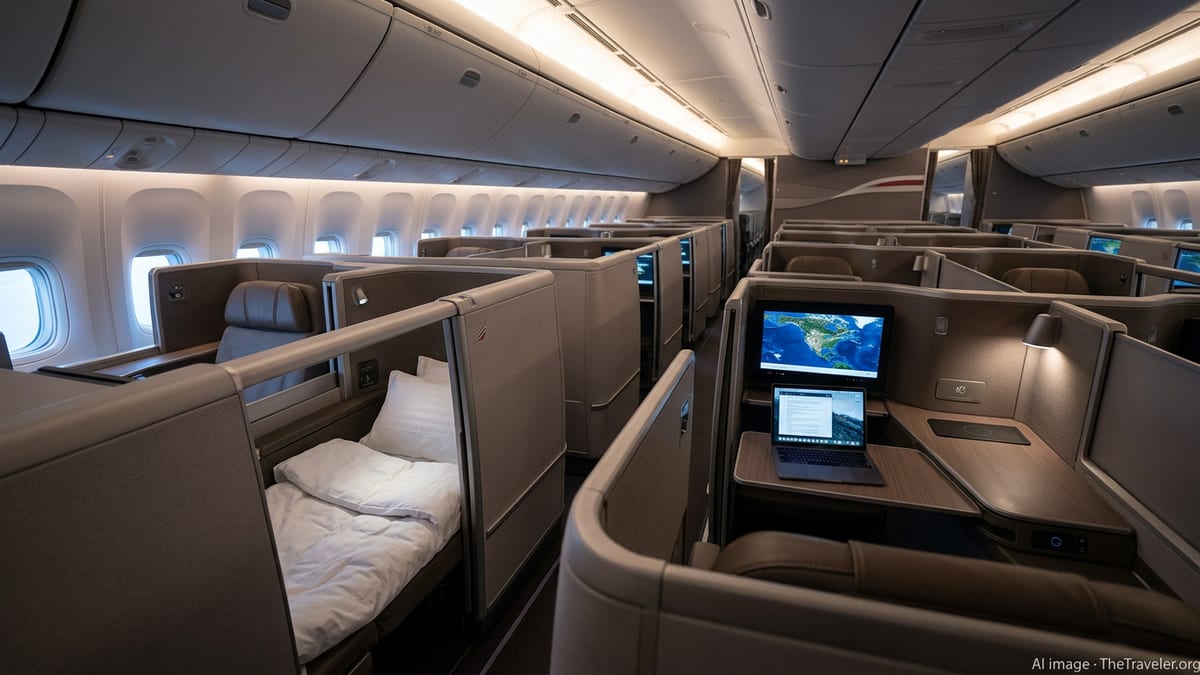
Qatar Airways Pushes the Suite Concept to a New Level
Qatar Airways, long a benchmark in premium cabins, is preparing to roll out its next-generation Qsuite product across new widebody deliveries from the middle of the decade. The so-called Qsuite Next Gen was first unveiled at the Farnborough Airshow in 2024 and has since picked up industry awards ahead of entry into regular service. The airline plans to debut the refreshed suites on its Boeing 777-9 fleet, with wider beds, refined privacy doors and an updated version of its well-known quad-suite family and group seating concept.
The new Qsuite iteration aims to deepen the blend of privacy and sociability that made the original product a standout. Passengers will see more flexible dividers between seats, extra shoulder room in lie-flat mode and improved sound insulation, all intended to give business travelers a more restful working and sleeping environment on ultra-long haul sectors. Enhanced wireless charging, higher resolution 4K screens and updated mood lighting are being used as points of differentiation as other carriers catch up with enclosed suites of their own.
Qatar Airways is also under pressure to harmonize the business class experience across a fleet where several seat types still coexist. Industry observers expect the 2026 introduction of the new suites to be accompanied by a broader retrofit roadmap over the following years, particularly on key trunk routes linking Doha with Europe, North America and Asia-Pacific. While the airline has not published a detailed schedule, it has made clear that the newest aircraft and flagship routes will be first in line.
ANA Bets on Sofa-Style Privacy With “THE Room FX”
All Nippon Airways is taking a different path with its next-generation business class, “THE Room FX,” which is scheduled to enter service on Boeing 787-9 long haul routes from 2026. Unveiled at the 2025 Paris Air Show, the design builds on the highly regarded “THE Room” suites on ANA’s Boeing 777-300ERs but adapts them to a slightly narrower fuselage and to evolving passenger expectations around flexibility and space.
Instead of a traditional recline mechanism, THE Room FX uses a fixed-shell, sofa-style seat that transforms into a large, flat sleeping surface when combined with an integrated ottoman. ANA’s design partners at Safran Seats and London-based Acumen have emphasized living-room comfort, with wider benches, a squared-off footprint and sliding doors that provide full privacy at cruising altitude. The approach mirrors a broader industry move toward non-reclining, lounge-like layouts that allow airlines to fine-tune ergonomics around specific phases of flight.
ANA plans a gradual rollout of THE Room FX, starting with key transpacific routes where the 787-9 is already a workhorse. The airline has stated that the new product will coexist with the original THE Room on its 777-300ER fleet, effectively giving it two tiers of suite-style business class. For corporate travel buyers, the emphasis will be on consistency of privacy, bed size and work space rather than exact seat geometry, as ANA positions itself as a premium option in an ever-more competitive Japan–North America and Japan–Europe market.
Air Canada Signals a Premium Pivot Ahead of 2026
Air Canada has not yet unveiled a fully new business class suite comparable to its Middle Eastern and Asian rivals, but moves planned for 2026 suggest a renewed focus on the premium long haul cabin. The carrier is ramping up widebody flying from its Toronto and Montreal hubs, including a relaunched seasonal Athens service from summer 2026 operated by aircraft featuring its Signature Class cabin with lie-flat seats and upgraded soft product.
Industry analysts and aircraft interior suppliers expect Air Canada to be among the next North American carriers to commit to door-equipped suites in business class as it refreshes parts of its Boeing 787 and 777 fleets later in the decade. The airline already offers a reverse herringbone lie-flat product, but as enclosed suites rapidly become the new benchmark, competitive pressure is mounting on transatlantic and transpacific routes where it faces airlines such as Qatar Airways, ANA, Emirates and British Airways.
For now, the Canadian flag carrier is emphasizing incremental upgrades, including expanded connectivity, refreshed cabin finishes and more curated dining with a particular focus on routes linking Canada to Europe and Asia. As manufacturers such as Safran, Collins Aerospace, Thompson and Stelia bring more off-the-shelf suite platforms to market for 2026 onwards, Air Canada will have a broader choice of designs than early adopters did, potentially shortening lead times for a full-scale business class reinvention.
A Global Wave of Enclosed Suites From 2026 Onward
The moves by Qatar Airways, ANA and Air Canada are part of a much wider shift across the industry as business class continues to encroach on traditional first class territory. European, Gulf and Asian carriers have already signaled plans to introduce or expand suite-style cabins with sliding doors on new and retrofitted widebodies from 2026. Seat makers showcased a raft of such concepts at recent interior trade shows, including front-row “business plus” mini-suites and upgraded staggered configurations designed to offer more space without major density penalties.
For travelers, the most visible changes will be higher walls, closing doors and more home-like layouts, particularly at the front row of business cabins where airlines can take advantage of extra floor space. Under the surface, however, the quiet revolution involves lighter composite structures, advanced kinematics that allow beds to be longer without intruding on neighboring passengers, and reworked storage to accommodate larger personal devices and carry-on items. The 2026–2028 period is shaping up as a key window in which these technologies migrate from trade-show prototypes onto mainstream routes.
There are trade-offs. As more space is devoted to privacy structures and doors, airlines must balance passenger comfort with cabin density and ticket pricing. Some carriers are responding by trimming or eliminating international first class while investing more heavily in top-end business cabins. Others are experimenting with an additional “business plus” sub-cabin that sits between business and first, capturing passengers willing to pay a premium for extra room without bearing the full cost of a separate first class.
What Travelers Can Expect on Board in 2026
For frequent flyers, the rollout of these new suites will not happen overnight, but the impact will be felt most quickly on flagship routes and newly delivered aircraft from 2026. Travelers booking business class on Qatar Airways’ new 777-9 services, ANA’s 787-9 long haul network and Air Canada’s busiest transatlantic and transpacific routes should begin to see more fully enclosed, highly personalized spaces with improved sleep quality and more intuitive storage.
Beyond the physical seat, airlines are pairing next-generation suites with upgraded service rituals, including expanded dine-on-demand menus, more personalized beverage offerings and refined bedding packages. Enhanced inflight connectivity and larger, higher-resolution screens are being positioned as extensions of the office and living room, allowing passengers to move seamlessly between work and rest throughout a long flight.
As the 2026 travel season approaches, corporate travel managers and high-end leisure customers are watching aircraft and cabin assignments more closely, seeking to lock in flights featuring the newest products. For airlines, the challenge will be to deliver on marketing promises by accelerating retrofits and minimizing product inconsistency across fleets. For passengers, the upshot is clear: business class is becoming more like a private hotel room in the sky, and the next two to three years will determine which carriers set the standard for that experience.