

More news on this day
From enclosed double suites to cabin layouts that resemble boutique hotel rooms, airlines are radically rethinking first class as an ultra-exclusive space for a shrinking but highly lucrative group of travelers.
Get the latest news straight to your inbox!
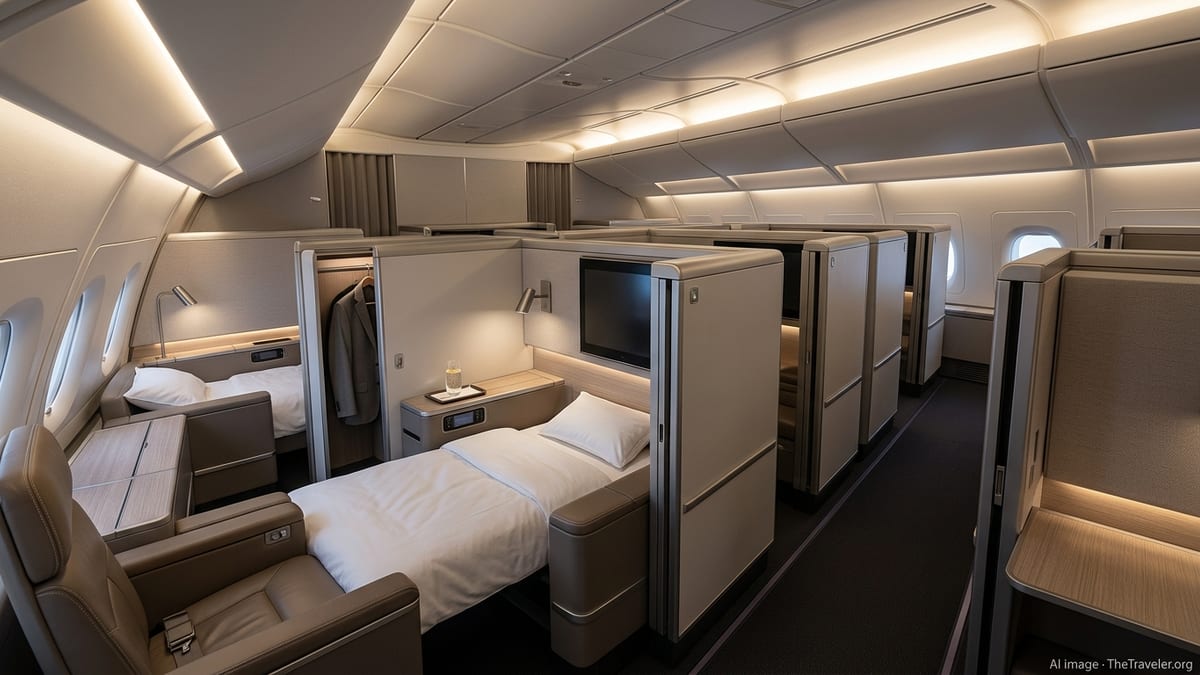
From Open Cabins to Fully Enclosed Private Spaces
First class has long been the prestige showcase for international airlines, but the latest generation of products pushes far beyond traditional wide seats and fine dining. Carriers are introducing fully enclosed suites with high walls and closing doors, designed to create a sense of seclusion that more closely resembles a private train compartment or hotel room than an aircraft cabin. The shift reflects a desire to differentiate first class from increasingly sophisticated business cabins, which now commonly feature lie-flat beds and partial privacy doors.
Singapore Airlines set an early benchmark with its Airbus A380 Suites, which provide a separate swivel armchair and an independent, stowable bed rather than a seat that converts into one. Published reviews describe a layout that gives passengers two distinct zones for working and sleeping, complemented by generous storage and finishes intended to evoke residential design rather than transport interiors. More recent reports indicate that the airline plans a multibillion-dollar cabin investment program, including updated first-class products on its long-haul fleet, reinforcing its focus on suites as a brand signature.
At the ultra-luxury end of the spectrum, Etihad Airways continues to promote its three-room Residence and single-aisle First Apartments on the Airbus A380 as the pinnacle of private air travel. Public information shows that these concepts, which bundle a lounge chair, separate bed and even a private shower in the most premium configuration, helped establish the template for over-the-top first-class suites that function as self-contained living spaces rather than simple seats.
New Flagship Suites for the Longest Flights
The most ambitious new suites are being developed with ultra-long-haul routes in mind, where passengers may spend 18 to 20 hours on board. Qantas has positioned its forthcoming Project Sunrise Airbus A350-1000 aircraft as a showcase for this trend. According to the airline’s publicly available cabin previews, each first-class suite will include a fixed flat bed roughly two meters in length, a separate reclining armchair, a sizeable personal wardrobe and dedicated work and dining space. The cabin will have a relatively low overall seat count, with a large proportion of the jet devoted to premium cabins in order to make nonstop flights from Sydney to New York and London more tolerable.
Qantas has also highlighted a focus on wellbeing, with cabin layouts designed in consultation with academic sleep and health researchers. That approach is visible in features such as carefully calibrated lighting, additional storage to reduce clutter and broader personal space compared with earlier generations of first class. Although the first Project Sunrise aircraft are not due to enter commercial service until the second half of this decade, the airline’s A350 mock-ups are already influencing customer expectations around what first class on the world’s longest flights should look like.
Lufthansa is taking a similar flagship approach with its Allegris First Class Suite, debuting on select Airbus A350-900 aircraft. The airline’s product information describes individual suites with nearly floor-to-ceiling walls, extra-wide seats convertible into beds and personal wardrobes. A centerpiece is the so-called Suite Plus, a double suite designed for couples or close travel companions, which can be transformed into a full double bed. Reports on early booking data indicate that Allegris cabins are initially being deployed on high-profile routes from Munich to major intercontinental hubs, underscoring the role of these suites in the carrier’s premium strategy.
Hotel-Inspired Design and High-Tech Touches
As suites grow more spacious, airlines are leaning heavily on residential and hospitality cues to justify premium pricing. Materials such as textured fabric wall panels, warm-toned wood veneers, stone-effect surfaces and leather upholstery are increasingly common in first-class marketing imagery. Designers talk about “softening” the cabin with rounded corners, concealed storage and indirect lighting, echoing boutique hotel interiors. In the newest suites, fixed beds allow for more generous mattresses and bedding, while separate lounge chairs are shaped to resemble club armchairs rather than conventional aircraft seats.
Technology is another differentiator. Many of the latest suites feature large 4K screens, Bluetooth audio connectivity and multiple charging options, including wireless pads built into side tables. Airlines are also promoting integrated touchscreens to control seat positions, lighting, privacy blinds and entertainment, sometimes paired with handheld tablets. In some products, passengers can pair airline mobile apps to pre-select films or adjust settings in flight. These features are framed as part of a seamless digital experience that parallels smart-home environments.
Wellbeing has become a central theme as well. New long-haul flagships often incorporate dedicated wellness areas accessible to all passengers, but first-class suite holders typically receive curated amenities, ambient lighting programs and sometimes bespoke sleepwear or skincare kits. Carriers argue that the combination of space, privacy and tailored lighting helps mitigate jet lag on multi-time-zone journeys, especially on nonstop flights exceeding 15 hours.
A Polarized Market: Some Carriers Double Down, Others Exit
Despite the publicity surrounding new first-class suites, the global picture is more nuanced. Several large network airlines have reduced or eliminated first class altogether, concluding that modern business cabins with suite-style seats can satisfy most premium demand at a lower operating cost. Public documents on Thai Airways, for example, indicate a plan to phase out its Royal First Class over the next few years as part of a broader restructuring. The airline intends to concentrate on an upgraded business product with enhanced privacy and a small sub-cabin of more spacious seats rather than maintain a separate first-class cabin.
Elsewhere, some European and North American carriers have narrowed first class to a small subset of flagship routes or withdrawn it entirely from long-haul fleets, investing instead in business-class suites. Industry analysis suggests that the revenue premium for first class must be exceptionally high to justify the additional cabin complexity and floor space, particularly when business class already offers lie-flat beds and high-end service. As a result, the new generation of first-class suites is becoming a niche proposition, reserved for airlines with strong premium demand or strategic reasons to maintain a halo product.
At the same time, airlines that retain first class are leveraging it as a key branding tool. High-profile suite launches tend to attract outsized media attention and social media coverage, even when only a handful of seats are available on a limited number of aircraft. These cabins serve as proof-of-concept spaces where carriers can experiment with new materials, technologies and service concepts that may eventually filter down to business class or premium economy products.
The Blurring Line Between First and Business Suites
As first-class suites become more elaborate, airlines are also pushing business class closer to what used to be first-class territory. Seat manufacturers now market business-class mini-suites with sliding doors, direct aisle access and fully flat beds as standard features on new long-haul cabins. Some carriers, particularly in North America and Europe, are introducing branded business suites with taller privacy doors, larger entertainment screens and more personal storage while stopping short of offering a separate first-class cabin.
This creates a compressed hierarchy in which the distinction between the top of business class and entry-level first class can be subtle. Often the differences lie in cabin density, individual square footage and soft-product elements such as dining, ground services and lounge access rather than radically different hardware. Analysts note that, over time, airlines may push more of the current first-class design language into business suites, reserving only the most expansive multi-room concepts and ultra-limited configurations for first class itself.
For travelers, the result is a market characterized by extremes. On one end, a shrinking number of airlines are competing to offer over-the-top first-class suites that resemble private hotel rooms in the sky. On the other, many carriers are betting that well-executed business-class suites with doors can deliver enough privacy and comfort for most long-haul customers. How airlines balance those strategies over the next decade will determine whether first class remains a rarefied showcase or evolves into an even more exclusive, almost bespoke experience available only on select flagship routes.